
Pulp Fiction, 1865 · page 212 of 400
The Argosy — page 212: what you’re looking at
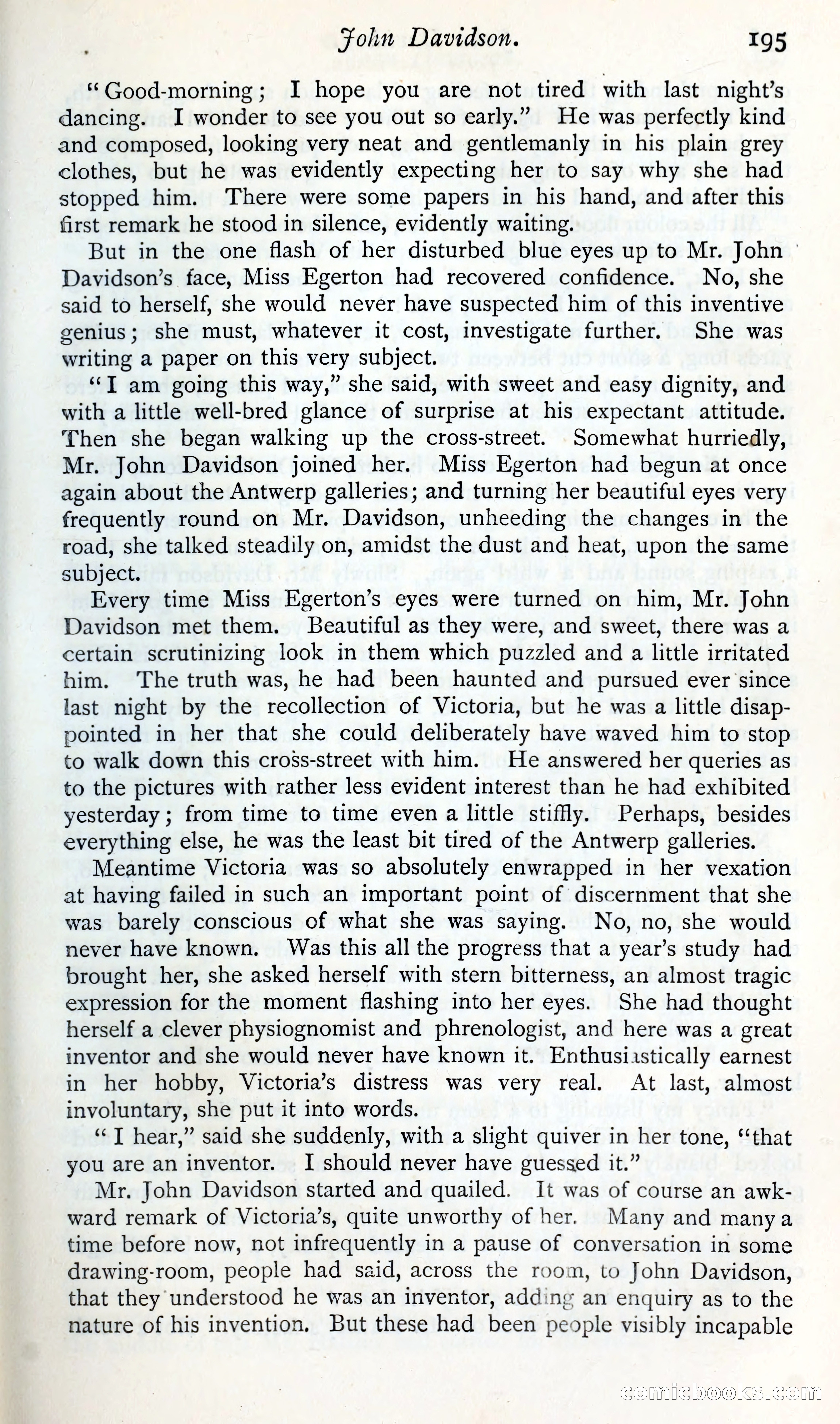
A restored page from Pulp Fiction, 1865. Page through the whole issue in the reader above.
📄 Transcribed text from this page (OCR, searchable)
Machine-transcribed from the original scan — historical spelling and the odd misread are preserved.
Fohn Davidson. IQ5 ‘“ Good-morning; I hope you are not tired with last night’s dancing. I wonder to see you out so early.” He was perfectly kind and composed, looking very neat and gentlemanly in his plain grey clothes, but he was evidently expecting her to say why she had stopped him. ‘There were some papers in his hand, and after this first remark he stood in silence, evidently waiting. But in the one flash of her disturbed blue eyes up to Mr. John > Davidson’s face, Miss Egerton had recovered confidence. No, she said to herself, she would never have suspected him of this inventive genius; she must, whatever it cost, investigate further. She was writing a paper on this very subject. ‘“T am going this way,” she said, with sweet and easy dignity, and with a little well-bred glance of surprise at his expectant attitude. Then she began walking up the cross-street. Somewhat hurriedly, Mr. John Davidson joined her. Miss Egerton had begun at once again about the Antwerp galleries; and turning her beautiful eyes very frequently round on Mr. Davidson, unheeding the changes in the road, she talked steadily on, amidst the dust and heat, upon the same subject. Every time Miss Egerton’s eyes were turned on him, Mr. John Davidson met them. Beautiful as they were, and sweet, there was a certain scrutinizing look in them which puzzled and a little irritated him. The truth was, he had been haunted and pursued ever’since last night by the recollection of Victoria, but he was a little disap- pointed in her that she could deliberately have waved him to stop to walk down this cross-street with him. He answered her queries as to the pictures with rather less evident interest than he had exhibited yesterday ; from time to time even a little stiffly. Perhaps, besides everything else, he was the least bit tired of the Antwerp galleries. Meantime Victoria was so absolutely enwrapped in her vexation at having failed in such an important point of discernment that she was barely conscious of what she was saying. No, no, she would never have known. Was this all the progress that a year’s study had brought her, she asked herself with stern bitterness, an almost tragic expression for the moment flashing into her eyes. She had thought herself a clever physiognomist and phrenologist, and here was a great inventor and she would never have known it. Enthusiastically earnest in her hobby, Victoria’s distress was very real. At last, almost involuntary, she put it into words. ‘‘T hear,” said she suddenly, with a slight quiver in her tone, “‘that you are an inventor. I should never have guessed it.” Mr. John Davidson started and quailed. It was of course an awk- ward remark of Victoria’s, quite unworthy of her. Many and manya time before now, not infrequently in a pause of conversation in some drawing-room, people had said, across the room, to John Davidson, that they understood he was an inventor, adding an enquiry as to the nature of his invention. But these had been people visibly incapable COMICOOOKS.C©