
Pulp Fiction, 1865 · page 395 of 400
The Argosy — page 395: what you’re looking at
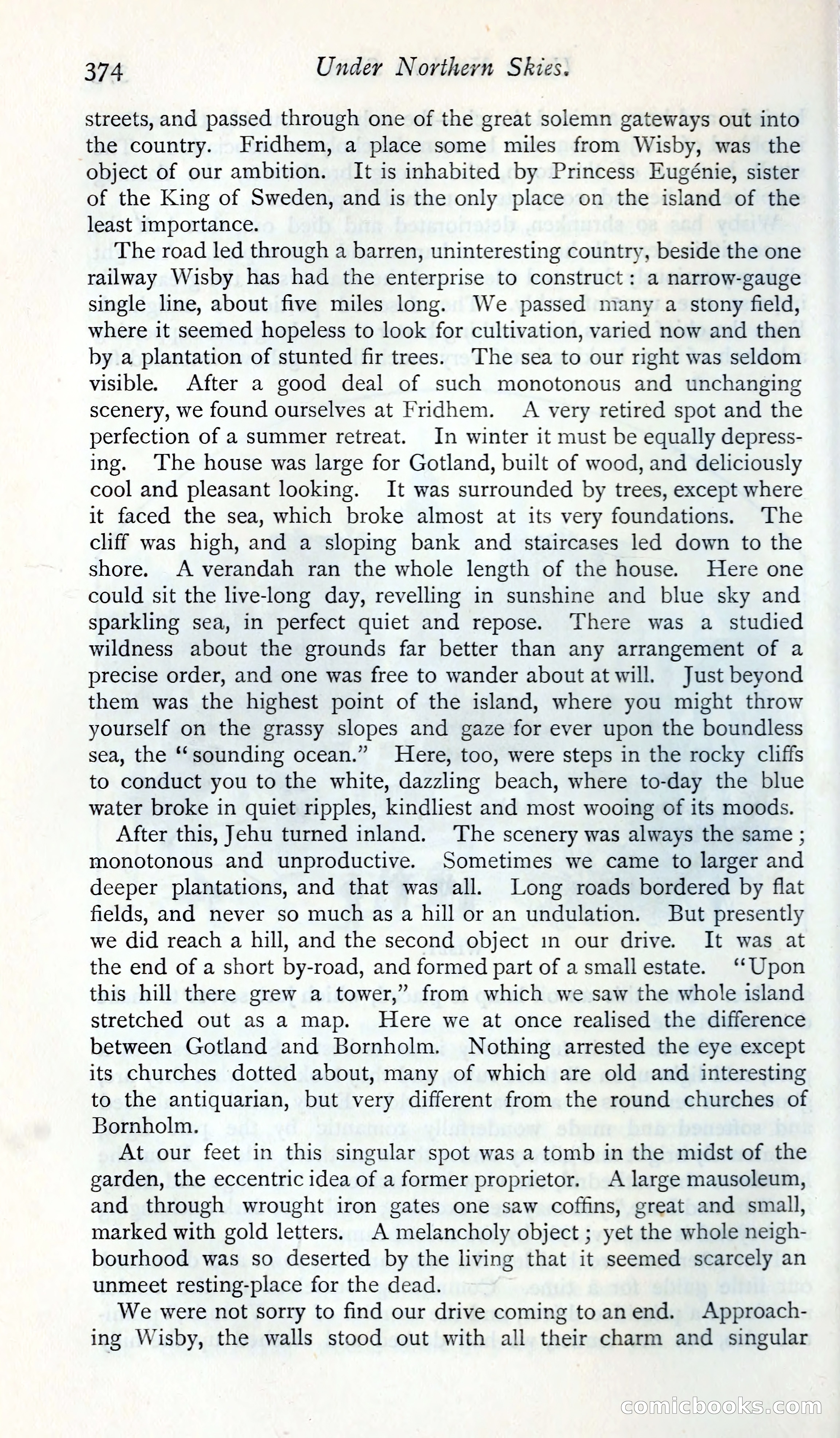
A restored page from Pulp Fiction, 1865. Page through the whole issue in the reader above.
📄 Transcribed text from this page (OCR, searchable)
Machine-transcribed from the original scan — historical spelling and the odd misread are preserved.
374 Under Northern Skies. streets, and passed through one of the great solemn gateways out into the country. Fridhem, a place some miles from Wisby, was the object of our ambition. It is inhabited by Princess Eugénie, sister of the King of Sweden, and is the only place on the island of the least importance. The road led through a barren, uninteresting country, beside the one railway Wisby has had the enterprise to construct: a narrow-gauge single line, about five miles long. We passed many a stony field, where it seemed hopeless to look for cultivation, varied now and then by a plantation of stunted fir trees. The sea to our right was seldom visible. After a good deal of such monotonous and unchanging scenery, we found ourselves at Fridhem. A very retired spot and the perfection of a summer retreat. In winter it must be equally depress- ing. The house was large for Gotland, built of wood, and deliciously cool and pleasant looking. It was surrounded by trees, except where it faced the sea, which broke almost at its very foundations. ‘The cliff was high, and a sloping bank and staircases led down to the shore. A verandah ran the whole length of the house. Here one could sit the live-long day, revelling in sunshine and blue sky and sparkling sea, in perfect quiet and repose. ‘There was a studied wildness about the grounds far better than any arrangement of a precise order, and one was free to wander about at will. Just beyond them was the highest point of the island, where you might throw yourself on the grassy slopes and gaze for ever upon the boundless sea, the “‘sounding ocean.” Here, too, were steps in the rocky cliffs to conduct you to the white, dazzling beach, where to-day the blue water broke in quiet ripples, kindliest and most wooing of its moods. After this, Jehu turned inland. ‘The scenery was always the same ; monotonous and unproductive. Sometimes we came to larger and deeper plantations, and that was all. Long roads bordered by flat fields, and never so much as a hill or an undulation. But presently we did reach a hill, and the second object in our drive. It was at the end of a short by-road, and formed part of a small estate. ‘‘Upon this hill there grew a tower,” from which we saw the whole island stretched out as a map. Here we at once realised the difference between Gotland and Bornholm. Nothing arrested the eye except its churches dotted about, many of which are old and interesting to the antiquarian, but very different from the round churches of Bornholm. At our feet in this singular spot was a tomb in the midst of the garden, the eccentric idea of a former proprietor. A large mausoleum, and through wrought iron gates one saw coffins, great and small, marked with gold letters. A melancholy object ; yet the whole neigh- bourhood was so deserted by the living that it seemed scarcely an unmeet resting-place for the dead. We were not sorry to find our drive coming toanend. Approach- ing Wisby, the walls stood out with all their charm and singular COMMICMOooKxS.coOm