
Pulp Fiction, 1865 · page 390 of 400
The Argosy — page 390: what you’re looking at
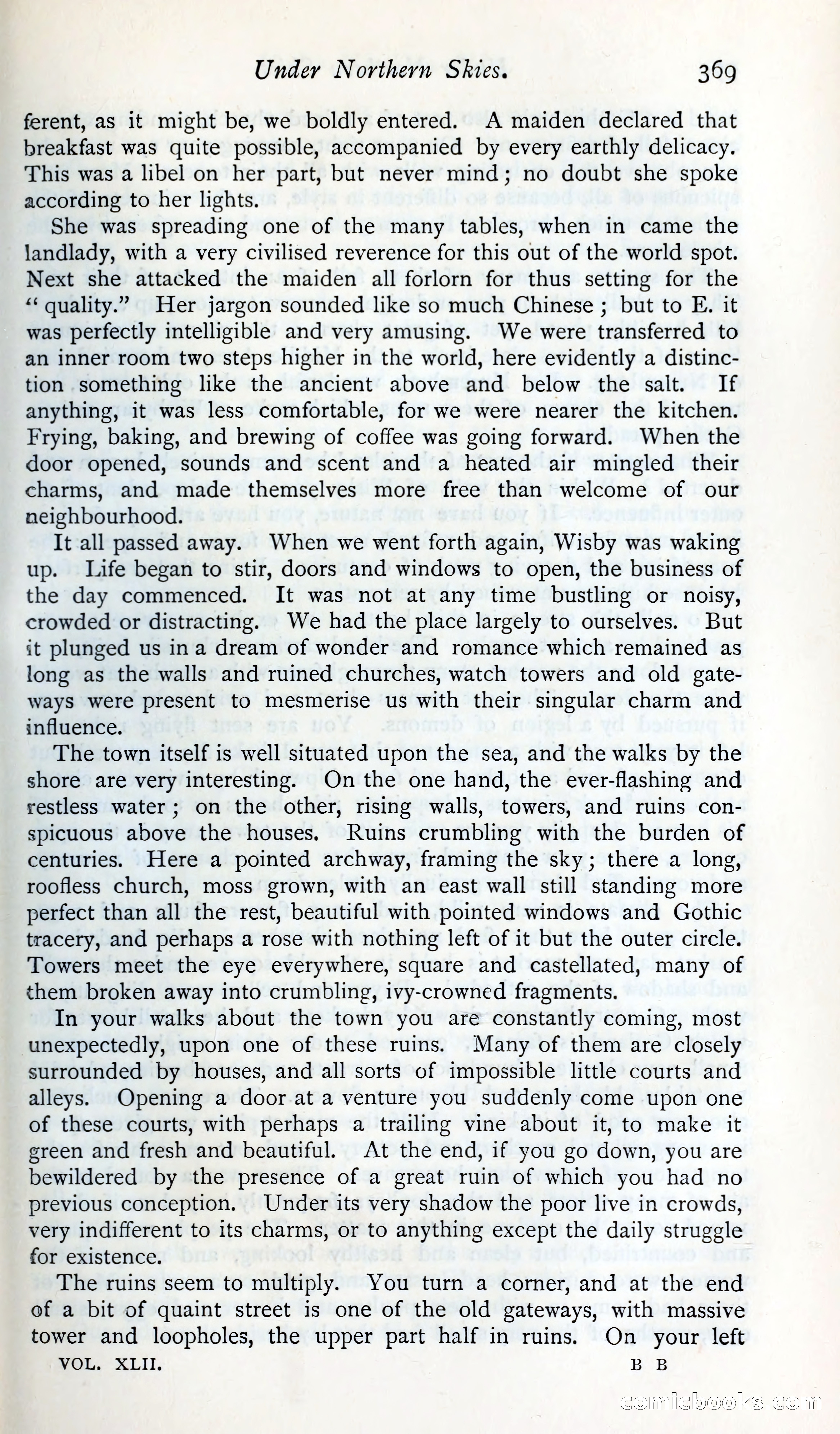
A restored page from Pulp Fiction, 1865. Page through the whole issue in the reader above.
📄 Transcribed text from this page (OCR, searchable)
Machine-transcribed from the original scan — historical spelling and the odd misread are preserved.
Under Northern Skies. 369 ferent, as it might be, we boldly entered. A maiden declared that breakfast was quite possible, accompanied by every earthly delicacy. This was a libel on her part, but never mind; no doubt she spoke according to her lights. She was spreading one of the many tables, when in came the landlady, with a very civilised reverence for this out of the world spot. Next she attacked the maiden all forlorn for thus setting for the “quality.” Her jargon sounded like so much Chinese ; but to E. it was perfectly intelligible and very amusing. We were transferred to an inner room two steps higher in the world, here evidently a distinc- tion something like the ancient above and below the salt. If anything, it was less comfortable, for we were nearer the kitchen. Frying, baking, and brewing of coffee was going forward. When the door opened, sounds and scent and a heated air mingled their charms, and made themselves more free than welcome of our neighbourhood. It all passed away. When we went forth again, Wisby was waking up. Life began to stir, doors and windows to open, the business of the day commenced. It was not at any time bustling or noisy, crowded or distracting. We had the place largely to ourselves. But it plunged us ina dream of wonder and romance which remained as long as the walls and ruined churches, watch towers and old gate- ways were present to mesmerise us with their singular charm and influence. The town itself is well situated upon the sea, and the walks by the shore are very interesting. On the one hand, the ever-flashing and restless water; on the other, rising walls, towers, and ruins con- spicuous above the houses. Ruins crumbling with the burden of centuries. Here a pointed archway, framing the sky; there a long, roofless church, moss grown, with an east wall still standing more perfect than all the rest, beautiful with pointed windows and Gothic tracery, and perhaps a rose with nothing left of it but the outer circle. Towers meet the eye everywhere, square and castellated, many of them broken away into crumbling, ivy-crowned fragments. In your walks about the town you are constantly coming, most unexpectedly, upon one of these ruins. Many of them are closely surrounded by houses, and all sorts of impossible little courts and alleys. Opening a door at a venture you suddenly come upon one of these courts, with perhaps a trailing vine about it, to make it green and fresh and beautiful. At the end, if you go down, you are bewildered by the presence of a great ruin of which you had no previous conception. Under its very shadow the poor live in crowds, very indifferent to its charms, or to anything except the daily struggle for existence. The ruins seem to multiply. You turn a corner, and at the end of a bit of quaint street is one of the old gateways, with massive tower and loopholes, the upper part half in ruins. On your left WoL, XLII. BB EOMINGIOOKS (CO)