
Pulp Fiction, 1865 · page 238 of 400
The Argosy — page 238: what you’re looking at
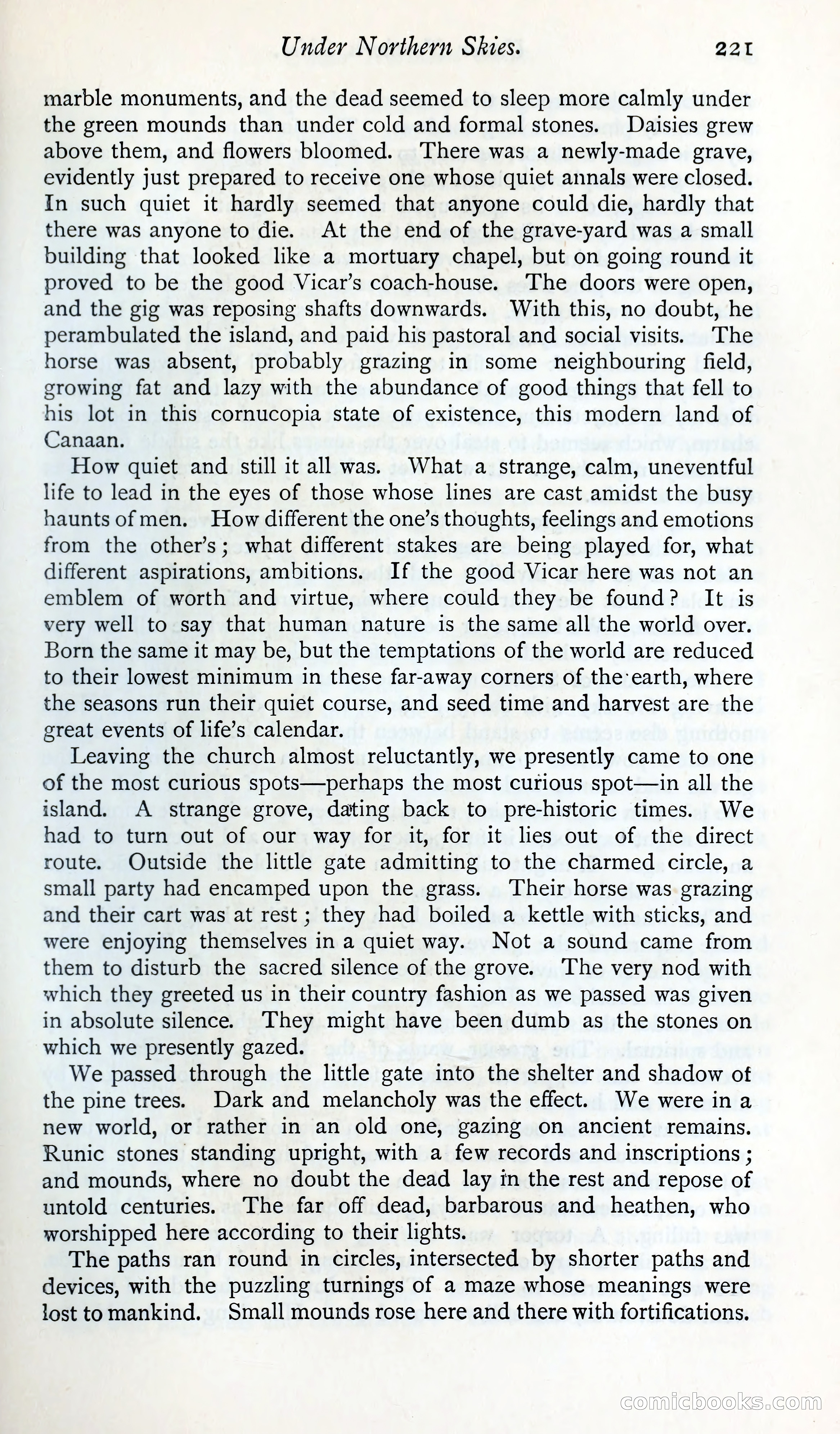
A restored page from Pulp Fiction, 1865. Page through the whole issue in the reader above.
📄 Transcribed text from this page (OCR, searchable)
Machine-transcribed from the original scan — historical spelling and the odd misread are preserved.
Under Northern Skies. 221 marble monuments, and the dead seemed to sleep more calmly under the green mounds than under cold and formal stones. Daisies grew above them, and flowers bloomed. ‘There was a newly-made grave, evidently just prepared to receive one whose quiet annals were closed. In such quiet it hardly seemed that anyone could die, hardly that there was anyone to die. At the end of the grave-yard was a small building that looked lke a mortuary chapel, but on going round it proved to be the good Vicar’s coach-house. ‘The doors were open, and the gig was reposing shafts downwards. With this, no doubt, he perambulated the island, and paid his pastoral and social visits. The horse was absent, probably grazing in some neighbouring field, growing fat and lazy with the abundance of good things that fell to his lot in this cornucopia state of existence, this modern land of Canaan. How quiet and still it all was. What a strange, calm, uneventful life to lead in the eyes of those whose lines are cast amidst the busy haunts ofmen. How different the one’s thoughts, feelings and emotions from the other’s; what different stakes are being played for, what different aspirations, ambitions. If the good Vicar here was not an emblem of worth and virtue, where could they be found? It is very well to say that human nature is the same all the world over. Born the same it may be, but the temptations of the world are reduced to their lowest minimum in these far-away corners of the earth, where the seasons run their quiet course, and seed time and harvest are the great events of life’s calendar. Leaving the church almost reluctantly, we presently came to one of the most curious spots—perhaps the most curious spot—in all the island. A strange grove, dating back to pre-historic times. We had to turn out of our way for it, for it lies out of the direct route. Outside the little gate admitting to the charmed circle, a small party had encamped upon the grass. Their horse was grazing and their cart was at rest ; they had boiled a kettle with sticks, and were enjoying themselves in a quiet way. Not a sound came from them to disturb the sacred silence of the grove. The very nod with which they greeted us in their country fashion as we passed was given in absolute silence. They might have been dumb as the stones on which we presently gazed. We passed through the little gate into the shelter and shadow of the pine trees. Dark and melancholy was the effect. We were in a new world, or rather in an old one, gazing on ancient remains. Runic stones standing upright, with a few records and inscriptions ; and mounds, where no doubt the dead lay in the rest and repose of untold centuries. ‘The far off dead, barbarous and heathen, who worshipped here according to their lights. The paths ran round in circles, intersected by shorter paths and devices, with the puzzling turnings of a maze whose meanings were lost tomankind. Small mounds rose here and there with fortifications. CoOnmnicoooks (CO)