
Pulp Fiction, 1865 · page 194 of 400
The Argosy — page 194: what you’re looking at
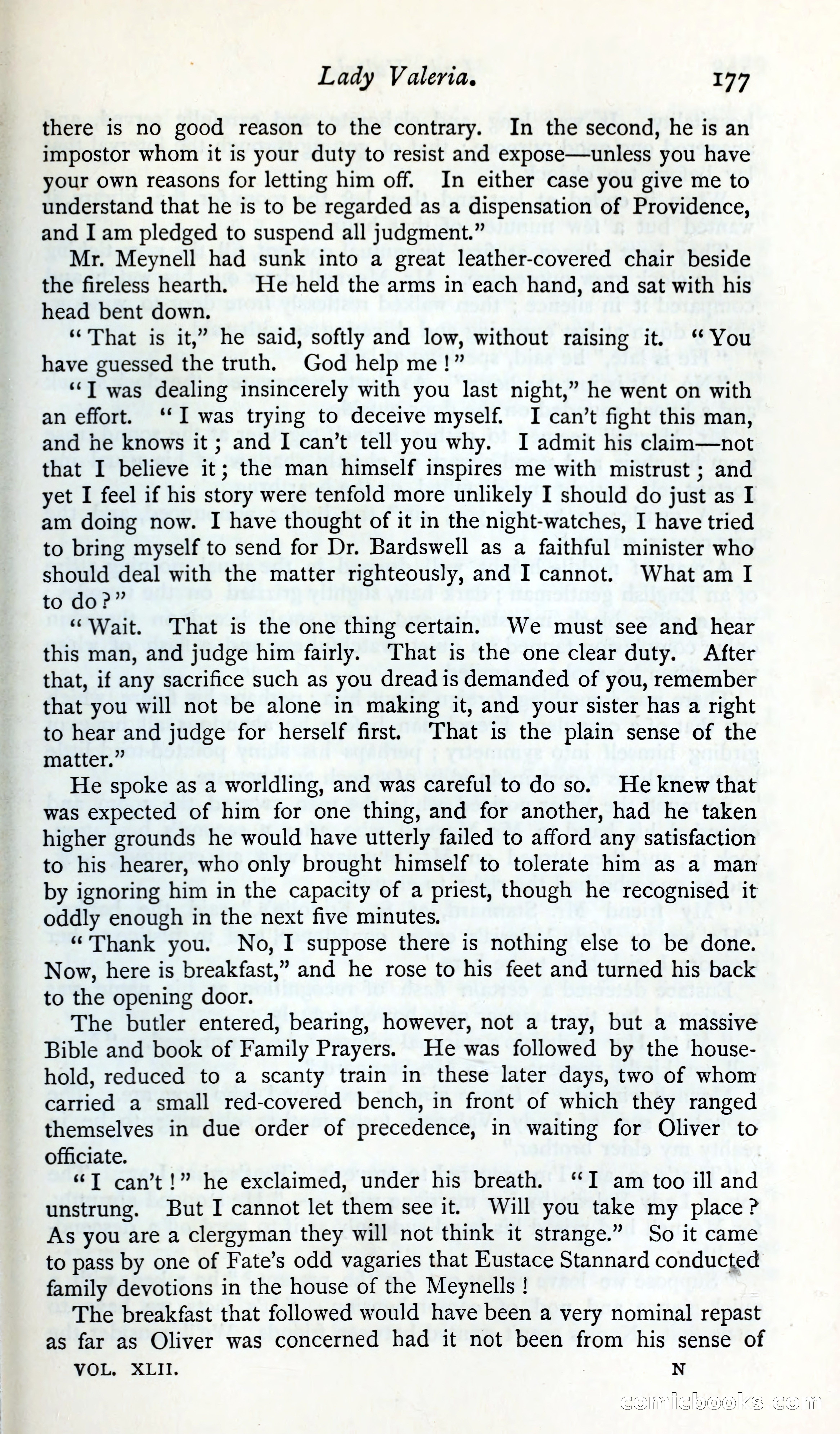
A restored page from Pulp Fiction, 1865. Page through the whole issue in the reader above.
📄 Transcribed text from this page (OCR, searchable)
Machine-transcribed from the original scan — historical spelling and the odd misread are preserved.
Lady Valeria. 177 there is no good reason to the contrary. In the second, he is an impostor whom it is your duty to resist and expose—unless you have your own reasons for letting him off. In either case you give me to understand that he is to be regarded as a dispensation of Providence, and I am pledged to suspend all judgment.” Mr. Meynell had sunk into a great leather-covered chair beside the fireless hearth. He held the arms in each hand, and sat with his head bent down. “That is it,” he said, softly and low, without raising it. ‘ You have guessed the truth. God help me!” ‘‘T was dealing insincerely with you last night,” he went on with an effort. ‘‘I was trying to deceive myself. I can’t fight this man, and he knows it; and I can’t tell you why. I admit his claim—not that I believe it; the man himself inspires me with mistrust ; and yet I feel if his story were tenfold more unlikely I should do just as I am doing now. I have thought of it in the night-watches, I have tried to bring myself to send for Dr. Bardswell as a faithful minister who should deal with the matter nghteously, and I cannot. What am I to do?” “Wait. ‘That is the one thing certain. We must see and hear this man, and judge him fairly. ‘That is the one clear duty. After that, if any sacrifice such as you dread is demanded of you, remember that you will not be alone in making it, and your sister has a right to hear and judge for herself first. That is the plain sense of the matter.” He spoke as a worldling, and was careful to do so. He knew that was expected of him for one thing, and for another, had he taken higher grounds he would have utterly failed to afford any satisfaction to his hearer, who only brought himself to tolerate him as a man by ignoring him in the capacity of a priest, though he recognised it oddly enough in the next five minutes. “Thank you. No, I suppose there is nothing else to be done. Now, here is breakfast,” and he rose to his feet and turned his back to the opening door. The butler entered, bearing, however, not a tray, but a massive Bible and book of Family Prayers. He was followed by the house- hold, reduced to a scanty train in these later days, two of whom carried a small red-covered bench, in front of which théy ranged themselves in due order of precedence, in waiting for Oliver to officiate. “T can’t!” he exclaimed, under his breath. ‘I am too ill and unstrung. But I cannot let them see it. Will you take my place? As you are a clergyman they will not think it strange.” So it came to pass by one of Fate’s odd vagaries that Eustace Stannard conducted family devotions in the house of the Meynells ! The breakfast that followed would have been a very nominal repast as far as Oliver was concerned had it not been from his sense of VOL, XLII. N COnnicoooks (CO) im