
Pulp Fiction, 1865 · page 149 of 400
The Argosy — page 149: what you’re looking at
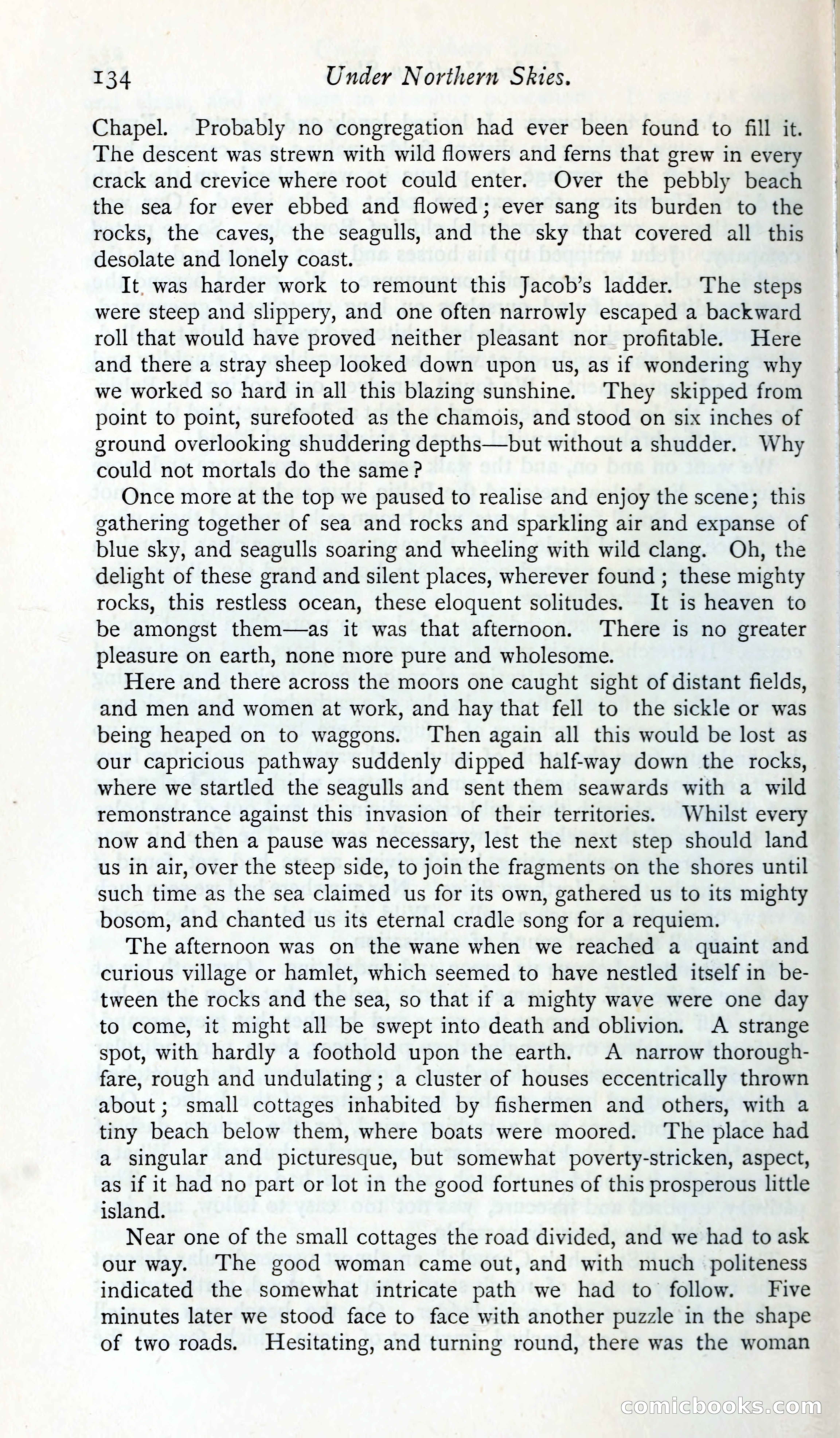
A restored page from Pulp Fiction, 1865. Page through the whole issue in the reader above.
📄 Transcribed text from this page (OCR, searchable)
Machine-transcribed from the original scan — historical spelling and the odd misread are preserved.
134 Under Northern Skies. Chapel. Probably no congregation had ever been found to fill it. The descent was strewn with wild flowers and ferns that grew in every crack and crevice where root could enter. Over the pebbly beach the sea for ever ebbed and flowed; ever sang its burden to the rocks, the caves, the seagulls, and the sky that covered all this desolate and lonely coast. It. was harder work to remount this Jacob’s ladder. The steps were steep and slippery, and one often narrowly escaped a backward roll that would have proved neither pleasant nor profitable. Here and there a stray sheep looked down upon us, as if wondering why we worked so hard in all this blazing sunshine. They skipped from point to point, surefooted as the chamois, and stood on six inches of ground overlooking shuddering depths—but without a shudder. Why could not mortals do the same? Once more at the top we paused to realise and enjoy the scene; this gathering together of sea and rocks and sparkling air and expanse of blue sky, and seagulls soaring and wheeling with wild clang. Oh, the delight of these grand and silent places, wherever found ; these mighty rocks, this restless ocean, these eloquent solitudes. It is heaven to be amongst them—as it was that afternoon. ‘There is no greater pleasure on earth, none more pure and wholesome. Here and there across the moors one caught sight of distant fields, and men and women at work, and hay that fell to the sickle or was being heaped on to waggons. ‘Then again all this would be lost as our capricious pathway suddenly dipped half-way down the rocks, where we startled the seagulls and sent them seawards with a wild remonstrance against this invasion of their territories. Whilst every now and then a pause was necessary, lest the next step should land us in air, over the steep side, to join the fragments on the shores until such time as the sea claimed us for its own, gathered us to its mighty bosom, and chanted us its eternal cradle song for a requiem. The afternoon was on the wane when we reached a quaint and curious village or hamlet, which seemed to have nestled itself in be- tween the rocks and the sea, so that if a mighty wave were one day to come, it might all be swept into death and oblivion. A strange spot, with hardly a foothold upon the earth. A narrow thorough- fare, rough and undulating; a cluster of houses eccentrically thrown about; small cottages inhabited by fishermen and others, with a tiny beach below them, where boats were moored. ‘The place had a singular and picturesque, but somewhat poverty-stricken, aspect, as if it had no part or lot in the good fortunes of this prosperous little island. Near one of the small cottages the road divided, and we had to ask our way. The good woman came out, and with much politeness indicated the somewhat intricate path we had to follow. Five minutes later we stood face to face with another puzzle in the shape of two roads. Hesitating, and turning round, there was the woman CORNICMOOOKS. C<On l a \