
Pulp Fiction, 1865 · page 391 of 400
The Argosy — page 391: what you’re looking at
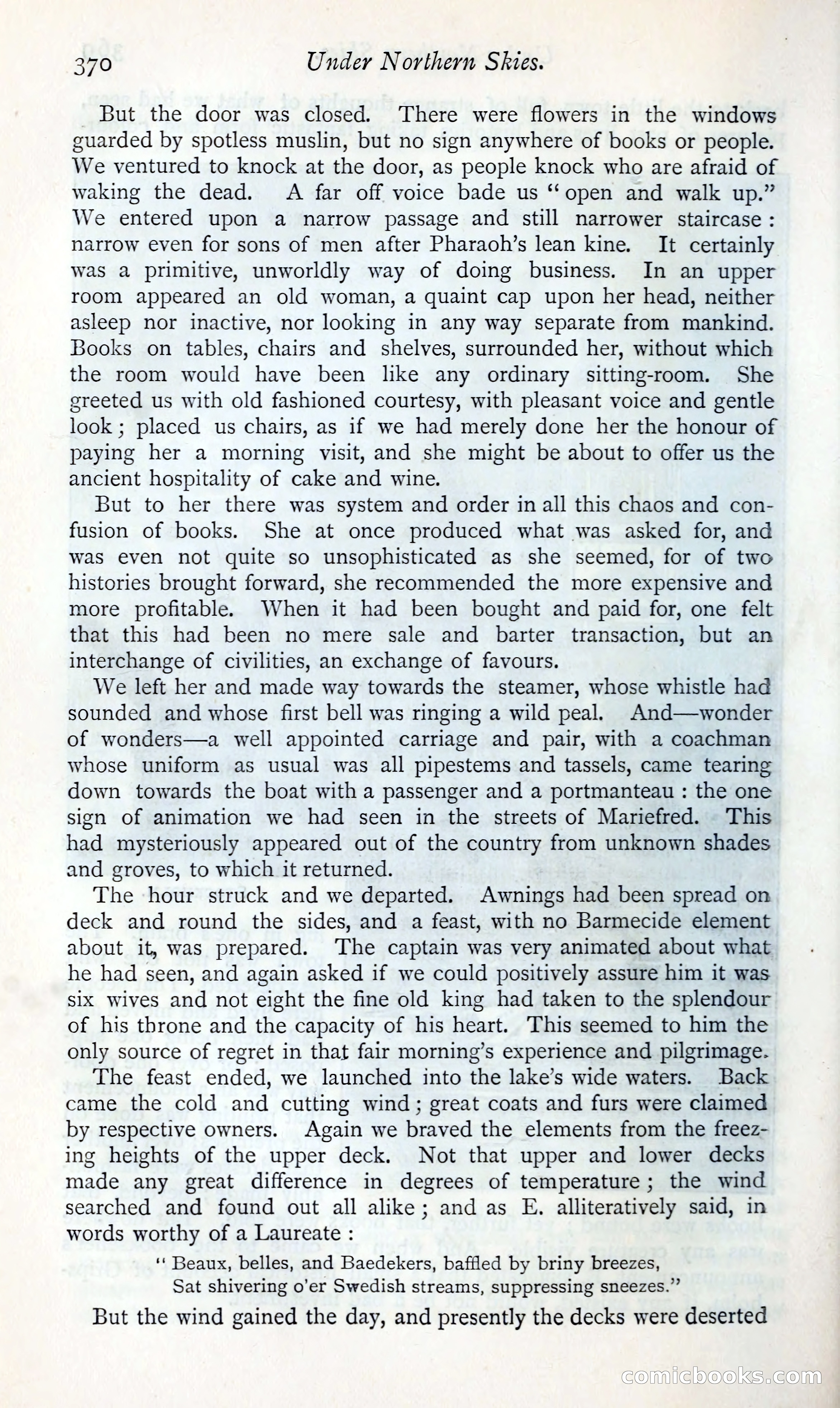
A restored page from Pulp Fiction, 1865. Page through the whole issue in the reader above.
📄 Transcribed text from this page (OCR, searchable)
Machine-transcribed from the original scan — historical spelling and the odd misread are preserved.
370 Under Northern Skues. But the door was closed. ‘There were flowers in the windows guarded by spotless muslin, but no sign anywhere of books or people. We ventured to knock at the door, as people knock who are afraid of waking the dead. A far off voice bade us ‘‘open and walk up.” We entered upon a narrow passage and still narrower staircase : narrow even for sons of men after Pharaoh’s lean kine. It certainly was a primitive, unworldly way of doing business. In an upper room appeared an old woman, a quaint cap upon her head, neither asleep nor inactive, nor looking in any way separate from mankind. Books on tables, chairs and shelves, surrounded her, without which the room would have been like any ordinary sitting-room. She greeted us with old fashioned courtesy, with pleasant voice and gentle look ; placed us chairs, as if we had merely done her the honour of paying her a morning visit, and she might be about to offer us the ancient hospitality of cake and wine. But to her there was system and order in all this chaos and con- fusion of books. She at once produced what was asked for, and was even not quite so unsophisticated as she seemed, for of two histories brought forward, she recommended the more expensive and more profitable. When it had been bought and paid for, one felt that this had been no mere sale and barter transaction, but an interchange of civilities, an exchange of favours. We left her and made way towards the steamer, whose whistle had sounded and whose first bell was ringing a wild peal. And—wonder of wonders—a well appointed carriage and pair, with a coachman whose uniform as usual was all pipestems and tassels, came tearing down towards the boat with a passenger and a portmanteau : the one sign of animation we had seen in the streets of Mariefred. This had mysteriously appeared out of the country from unknown shades and groves, to which it returned. The hour struck and we departed. Awnings had been spread on deck and round the sides, and a feast, with no Barmecide element about it, was prepared. ‘The captain was very animated about what he had seen, and again asked if we could positively assure him it was six wives and not eight the fine old king had taken to the splendour of his throne and the capacity of his heart. This seemed to him the only source of regret in that fair morning’s experience and pilgrimage. The feast ended, we launched into the lake’s wide waters. Back came the cold and cutting wind; great coats and furs were claimed by respective owners. Again we braved the elements from the freez- ing heights of the upper deck. Not that upper and lower decks made any great difference in degrees of temperature; the wind searched and found out all alike; and as E. alliteratively said, in words worthy of a Laureate : ‘‘ Beaux, belles, and Baedekers, baffled by briny breezes, Sat shivering o’er Swedish streams, suppressing sneezes.” But the wind gained the day, and presently the decks were deserted CORNICLIOOKS (E() im