
Pulp Fiction, 1865 · page 389 of 400
The Argosy — page 389: what you’re looking at
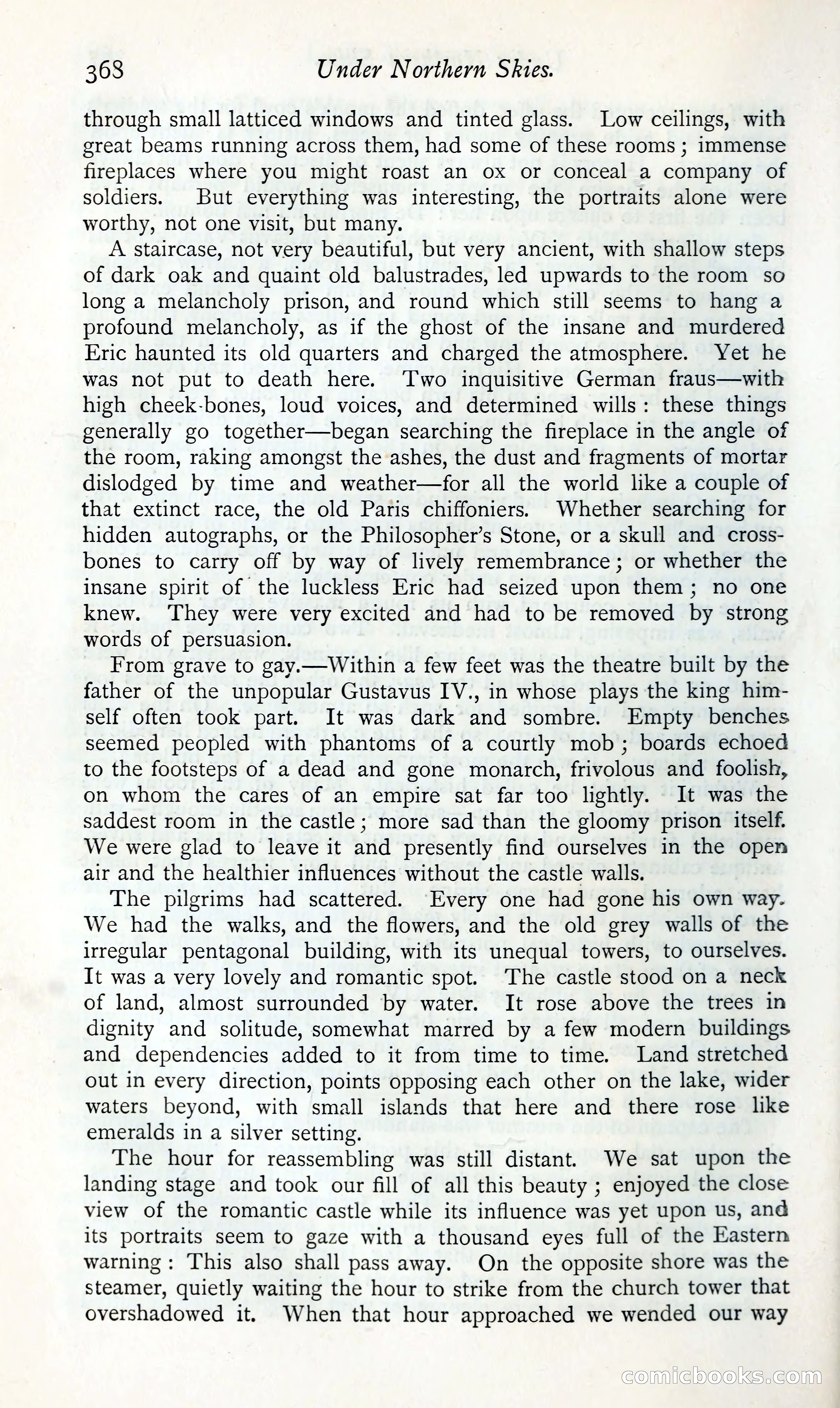
A restored page from Pulp Fiction, 1865. Page through the whole issue in the reader above.
📄 Transcribed text from this page (OCR, searchable)
Machine-transcribed from the original scan — historical spelling and the odd misread are preserved.
368 Under Northern Skies. through small latticed windows and tinted glass. Low ceilings, with great beams running across them, had some of these rooms ; immense fireplaces where you might roast an ox or conceal a company of soldiers. But everything was interesting, the portraits alone were worthy, not one visit, but many. A staircase, not very beautiful, but very ancient, with shallow steps of dark oak and quaint old balustrades, led upwards to the room so long a melancholy prison, and round which still seems to hang a profound melancholy, as if the ghost of the insane and murdered Eric haunted its old quarters and charged the atmosphere. Yet he was not put to death here. ‘Two inquisitive German fraus—with high cheek-bones, loud voices, and determined wills: these things generally go together—began searching the fireplace in the angle of the room, raking amongst the ashes, the dust and fragments of mortar dislodged by time and weather—for all the world like a couple of that extinct race, the old Paris chiffoniers. Whether searching for hidden autographs, or the Philosopher’s Stone, or a skull and cross- bones to carry off by way of lively remembrance; or whether the insane spirit of the luckless Eric had seized upon them; no one knew. They were very excited and had to be removed by strong words of persuasion. From grave to gay.—Within a few feet was the theatre built by the father of the unpopular Gustavus IV., in whose plays the king him- self often took part. It was dark and sombre. Empty benches seemed peopled with phantoms of a courtly mob; boards echoed to the footsteps of a dead and gone monarch, frivolous and foolish, on whom the cares of an empire sat far too lightly. It was the saddest room in the castle; more sad than the gloomy prison itself. We were glad to leave it and presently find ourselves in the open air and the healthier influences without the castle walls. The pilgrims had scattered. Every one had gone his own way. We had the walks, and the flowers, and the old grey walls of the irregular pentagonal building, with its unequal towers, to ourselves. It was a very lovely and romantic spot. The castle stood on a neck of land, almost surrounded by water. It rose above the trees in dignity and solitude, somewhat marred by a few modern buildings and dependencies added to it from time to time. Land stretched out in every direction, points opposing each other on the lake, wider waters beyond, with small islands that here and there rose like emeralds in a silver setting. The hour for reassembling was still distant. We sat upon the landing stage and took our fill of all this beauty ; enjoyed the close view of the romantic castle while its influence was yet upon us, and its portraits seem to gaze with a thousand eyes full of the Eastern warning : This also shall pass away. On the opposite shore was the steamer, quietly waiting the hour to strike from the church tower that overshadowed it. When that hour approached we wended our way COMMICEOOOKS.E@ im