
Pulp Fiction, 1865 · page 377 of 400
The Argosy — page 377: what you’re looking at
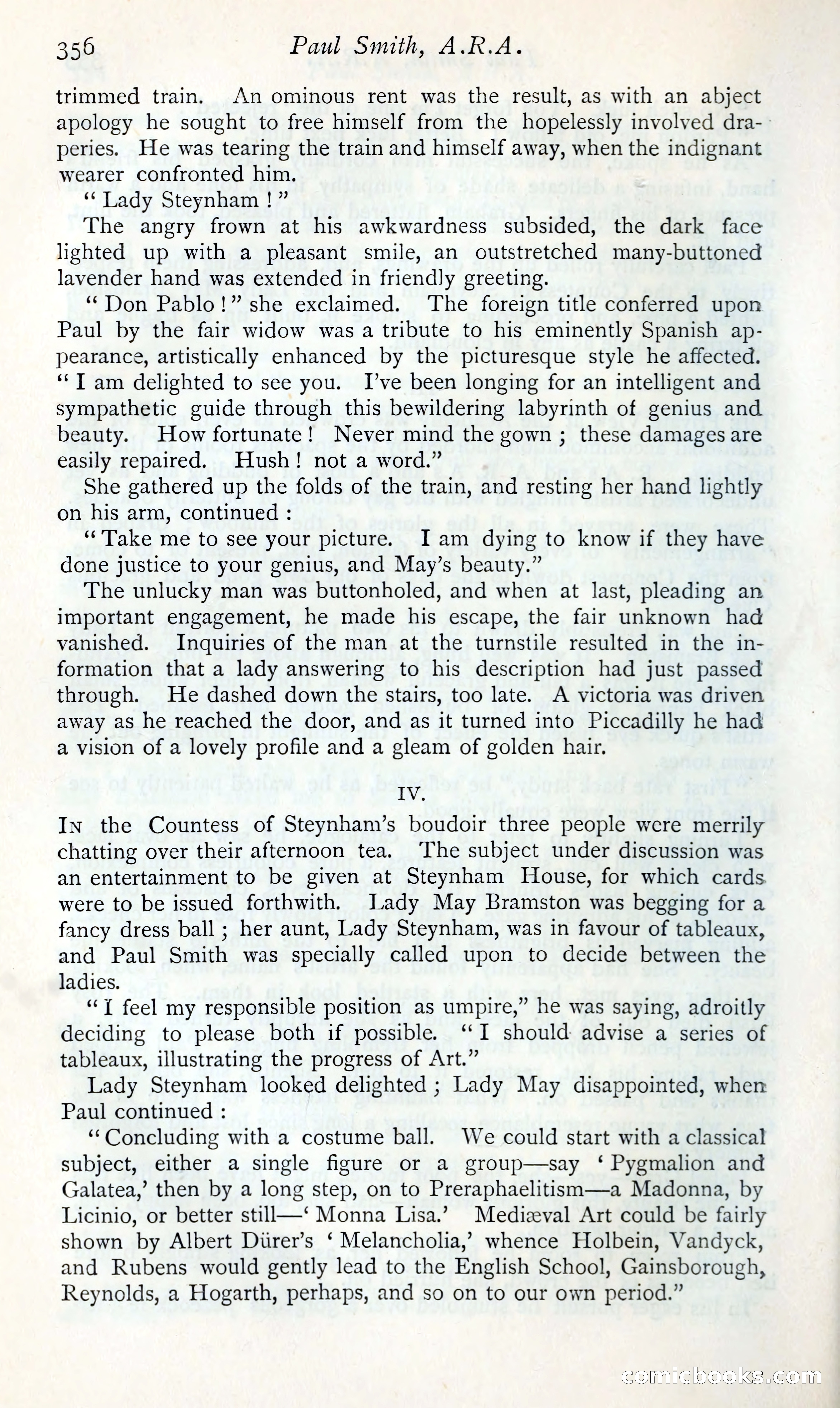
A restored page from Pulp Fiction, 1865. Page through the whole issue in the reader above.
📄 Transcribed text from this page (OCR, searchable)
Machine-transcribed from the original scan — historical spelling and the odd misread are preserved.
350 Paul Smith, A.R.A. trimmed train. An ominous rent was the result, as with an abject apology he sought to free himself from the hopelessly involved dra- peries. He was tearing the train and himself away, when the indignant wearer confronted him. ‘“‘ Lady Steynham ! ” The angry frown at his awkwardness subsided, the dark face lighted up with a pleasant smile, an outstretched many-buttoned lavender hand was extended in friendly greeting. “Don Pablo!” she exclaimed. ‘The foreign title conferred upon Paul by the fair widow was a tribute to his eminently Spanish ap- pearance, artistically enhanced by the picturesque style he affected. ‘“*T am delighted to see you. Ive been longing for an intelligent and sympathetic guide through this bewildering labyrinth of genius and beauty. How fortunate! Never mind the gown ; these damages are easily repaired. Hush! not a word.” She gathered up the folds of the train, and resting her hand lightly on his arm, continued : ‘“‘'Take me to see your picture. I am dying to know if they have done justice to your genius, and May’s beauty.” The unlucky man was buttonholed, and when at last, pleading an important engagement, he made his escape, the fair unknown had vanished. Inquiries of the man at the turnstile resulted in the in- formation that a lady answering to his description had just passed through. He dashed down the stairs, too late. <A victoria was driven away as he reached the door, and as it turned into Piccadilly he had a vision of a lovely profile and a gleam of golden hair. IV. In the Countess of Steynham’s boudoir three people were merrily chatting over their afternoon tea. The subject under discussion was an entertainment to be given at Steynham House, for which cards were to be issued forthwith. Lady May Bramston was begging for a fancy dress ball; her aunt, Lady Steynham, was in favour of tableaux, and Paul Smith was specially called upon to decide between the ladies. ‘“‘{ feel my responsible position as umpire,” he was saying, adroitly deciding to please both if possible. ‘‘I should advise a series of tableaux, illustrating the progress of Art.” Lady Steynham looked delighted ; Lady May disappointed, when Paul continued : ‘Concluding with a costume ball. We could start with a classical subject, either a single figure or a group—say ‘ Pygmalion and Galatea,’ then by a long step, on to Preraphaelitism—a Madonna, by Licinio, or better still—‘ Monna Lisa.’ Medieval Art could be fairly shown by Albert Durer’s ‘ Melancholia,’ whence Holbein, Vandyck, and Rubens would gently lead to the English School, Gainsborough, Reynolds, a Hogarth, perhaps, and so on to our own period.” CORNICLOOKS (F©) im