
Pulp Fiction, 1865 · page 186 of 400
The Argosy — page 186: what you’re looking at
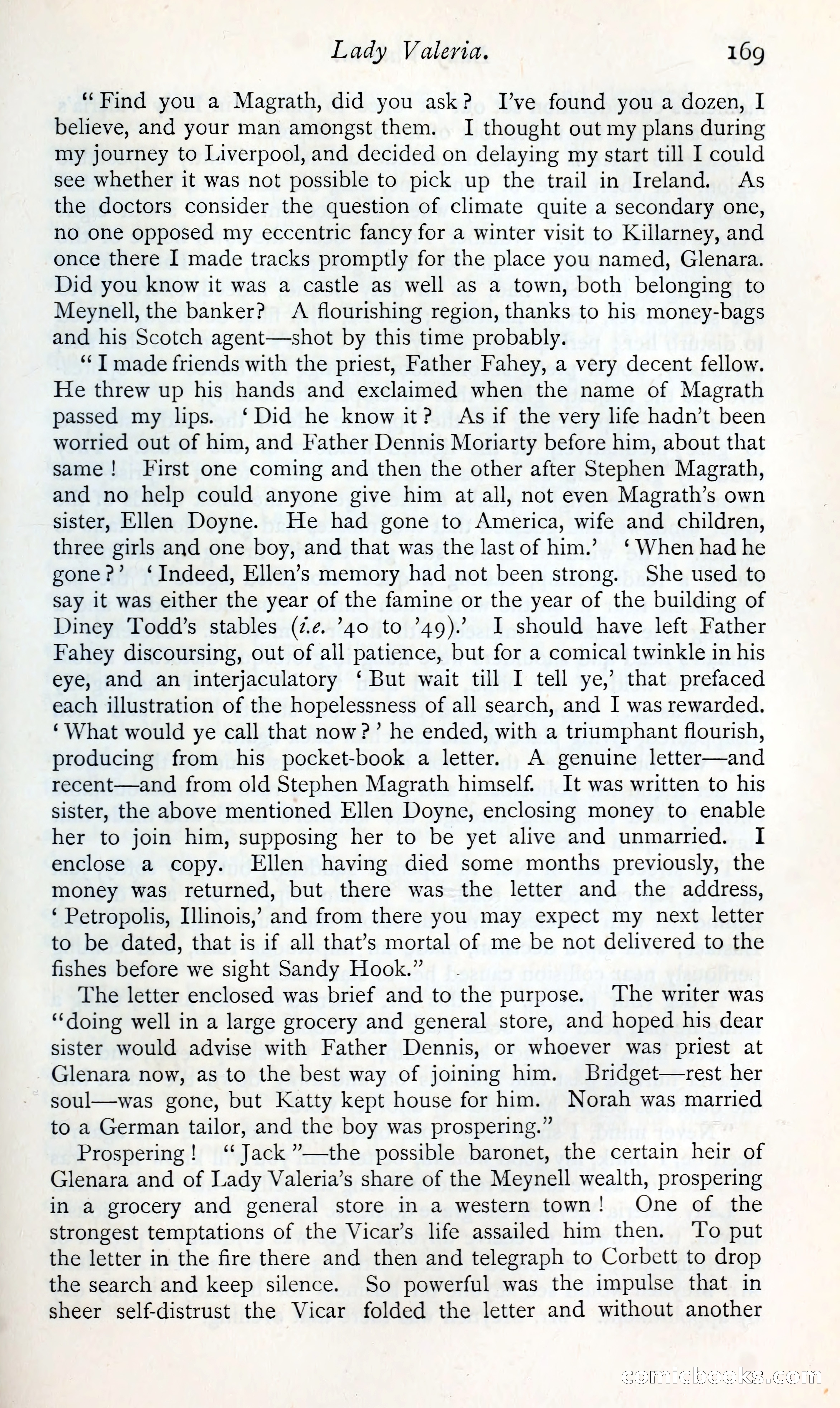
A restored page from Pulp Fiction, 1865. Page through the whole issue in the reader above.
📄 Transcribed text from this page (OCR, searchable)
Machine-transcribed from the original scan — historical spelling and the odd misread are preserved.
Lady Valeria. 169 “Find you a Magrath, did you ask? I’ve found you a dozen, I believe, and your man amongst them. I thought out my plans during my journey to Liverpool, and decided on delaying my start till I could see whether it was not possible to pick up the trail in Ireland. As the doctors consider the question of climate quite a secondary one, no one opposed my eccentric fancy for a winter visit to Killarney, and once there I made tracks promptly for the place you named, Glenara. Did you know it was a castle as well as a town, both belonging to Meynell, the banker? A flourishing region, thanks to his money-bags and his Scotch agent—shot by this time probably. ‘“‘T made friends with the priest, Father Fahey, a very decent fellow. He threw up his hands and exclaimed when the name of Magrath passed my lips. ‘Did he knowit? Asif the very life hadn’t been worried out of him, and Father Dennis Moriarty before him, about that same! First one coming and then the other after Stephen Magrath, and no help could anyone give him at all, not even Magrath’s own sister, Ellen Doyne. He had gone to America, wife and children, three girls and one boy, and that was the last of him.’ ‘When hadhe gone?’ ‘Indeed, Ellen’s memory had not been strong. She used to say it was either the year of the famine or the year of the building of Diney Todd’s stables (ze. ’40 to ’49).’ I should have left Father Fahey discoursing, out of all patience, but for a comical twinkle in his eye, and an interjaculatory ‘ But wait till I tell ye,’ that prefaced each illustration of the hopelessness of all search, and I was rewarded. ‘What would ye call that now?’ he ended, with a triumphant flourish, producing from his pocket-book a letter. A genuine letter—and recent—and from old Stephen Magrath himself. It was written to his sister, the above mentioned Ellen Doyne, enclosing money to enable her to join him, supposing her to be yet alive and unmarried. I enclose a copy. Ellen having died some months previously, the money was returned, but there was the letter and the address, ‘Petropolis, Illinois,’ and from there you may expect my next letter to be dated, that is if all that’s mortal of me be not delivered to the fishes before we sight Sandy Hook.” The letter enclosed was brief and to the purpose. The writer was ‘doing well in a large grocery and general store, and hoped his dear sister would advise with Father Dennis, or whoever was priest at Glenara now, as to the best way of joining him. Bridget—rest her soul—was gone, but Katty kept house for him. Norah was married to a German tailor, and the boy was prospering.” Prospering! ‘Jack ”—the possible baronet, the certain heir of Glenara and of Lady Valeria’s share of the Meynell wealth, prospering in a grocery and general store in a western town! One of the strongest temptations of the Vicar’s life assailed him then. To put the letter in the fire there and then and telegraph to Corbett to drop the search and keep silence. So powerful was the impulse that in sheer self-distrust the Vicar folded the letter and without another COMmMicoaooks (CO) im