
Pulp Fiction, 1865 · page 139 of 400
The Argosy — page 139: what you’re looking at
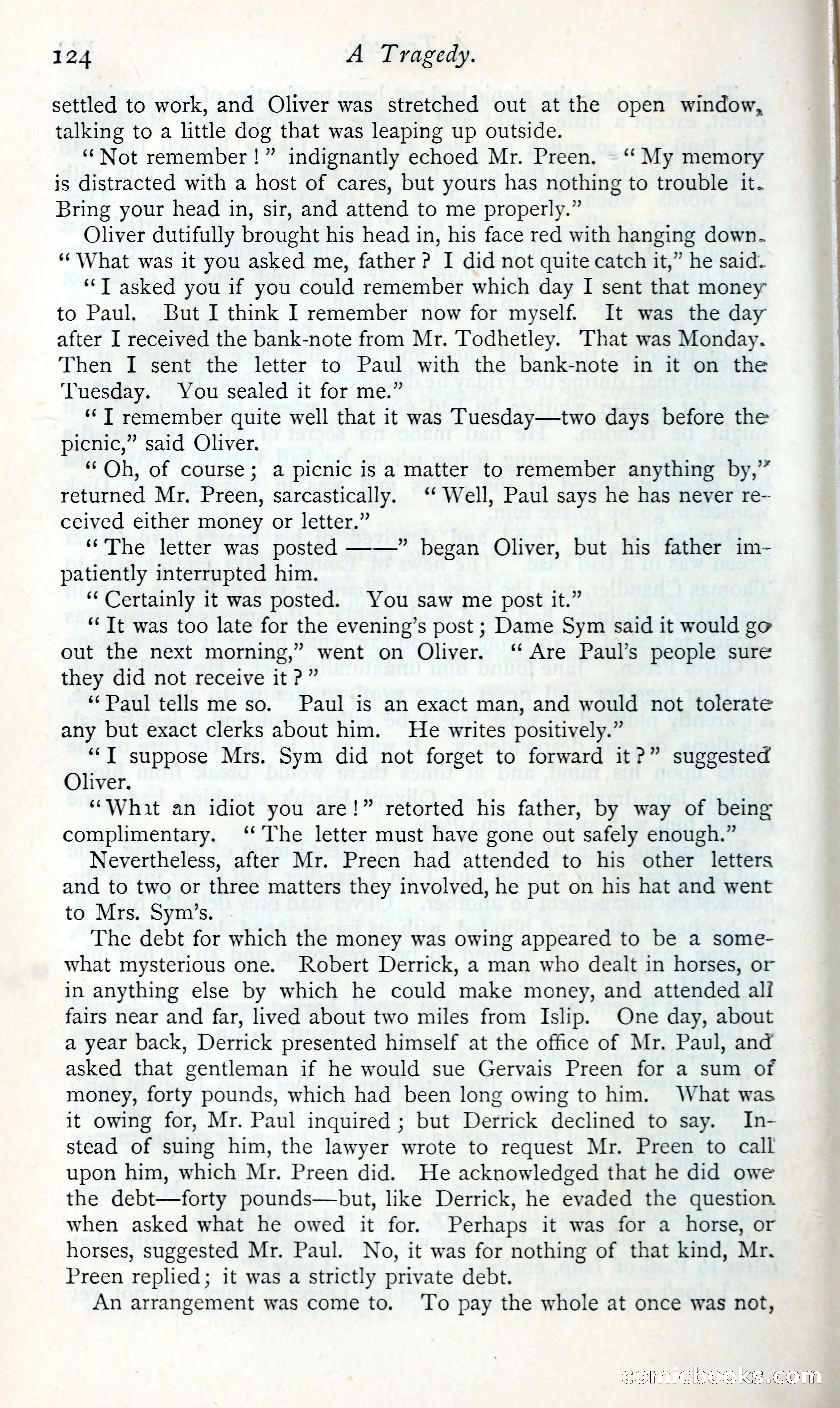
A restored page from Pulp Fiction, 1865. Page through the whole issue in the reader above.
📄 Transcribed text from this page (OCR, searchable)
Machine-transcribed from the original scan — historical spelling and the odd misread are preserved.
124 A Tragedy. settled to work, and Oliver was stretched out at the open window, talking to a little dog that was leaping up outside. “Not remember!” indignantly echoed Mr. Preen. — ‘‘ My memory is distracted with a host of cares, but yours has nothing to trouble it. Bring your head in, sir, and attend to me properly.” Oliver dutifully brought his head in, his face red with hanging down. ‘‘' What was it you asked me, father ? I did not quite catch it,” he said. ‘T asked you if you could remember which day I sent that money to Paul. But I think I remember now for myself. It was the day after I received the bank-note from Mr. Todhetley. That was Monday. Then I sent the letter to Paul with the bank-note in it on the Tuesday. You sealed it for me.” ‘*T remember quite well that it was Tuesday—two days before the picnic,” said Oliver. “ Oh, of course; a picnic is a matter to remember anything by,” returned Mr. Preen, sarcastically. ‘‘ Well, Paul says he has never re- ceived either money or letter.” “The letter was posted ———” began Oliver, but his father im- patiently interrupted him. ‘‘ Certainly it was posted. You saw me post it.” “It was too late for the evening’s post ; Dame Sym said it would go out the next morning,” went on Oliver. ‘‘ Are Paul’s people sure they did not receive it P” ‘Paul tells me so. Paul is an exact man, and would not tolerate any but exact clerks about him. He writes positively.” ““T suppose Mrs. Sym did not forget to forward it?” suggested Oliver. “Whit an idiot you are!” retorted his father, by way of being complimentary. ‘‘ The letter must have gone out safely enough.” Nevertheless, after Mr. Preen had attended to his other letters and to two or three matters they involved, he put on his hat and went to Mrs. Sym’s. The debt for which the money was owing appeared to be a some- what mysterious one. Robert Derrick, a man who dealt in horses, or in anything else by which he could make money, and attended alf fairs near and far, lived about two miles from Islip. One day, about a year back, Derrick presented himself at the office of Mr. Paul, and asked that gentleman if he would sue Gervais Preen for a sum of money, forty pounds, which had been long owing to him. What was it owing for, Mr. Paul inquired ; but Derrick declined to say. In- stead of suing him, the lawyer wrote to request Mr. Preen to call upon him, which Mr. Preen did. He acknowledged that he did owe the debt—forty pounds—but, like Derrick, he evaded the question. when asked what he owed it for. Perhaps it was for a horse, or horses, suggested Mr. Paul. No, it was for nothing of that kind, Mr. Preen replied; it was a strictly private debt. An arrangement was come to. To pay the whole at once was not, CORMICLOOOKS (EC) m