
Pulp Fiction, 1865 · page 122 of 400
The Argosy — page 122: what you’re looking at
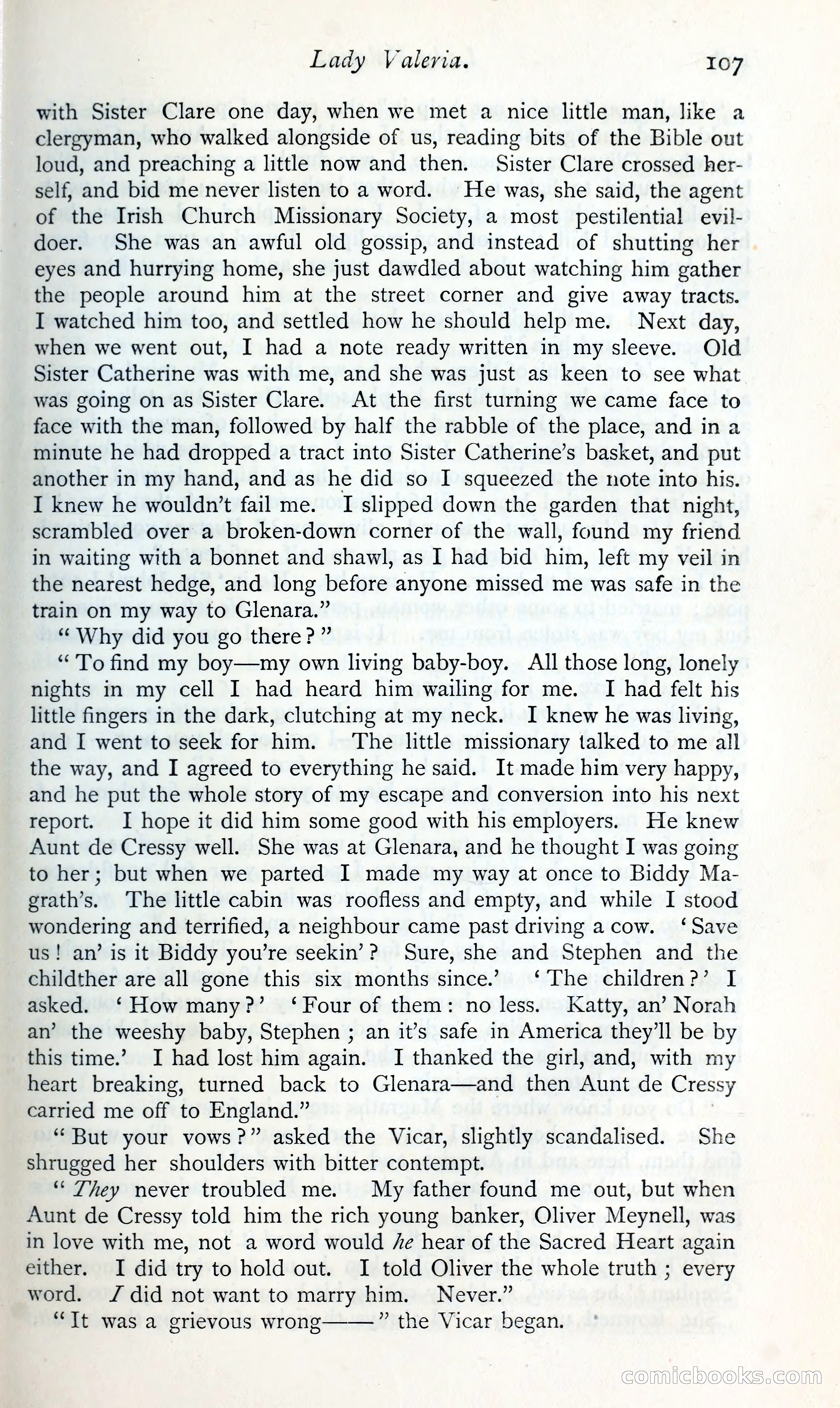
A restored page from Pulp Fiction, 1865. Page through the whole issue in the reader above.
📄 Transcribed text from this page (OCR, searchable)
Machine-transcribed from the original scan — historical spelling and the odd misread are preserved.
Lady Valeria. 107 with Sister Clare one day, when we met a nice little man, like a clergyman, who walked alongside of us, reading bits of the Bible out loud, and preaching a little now and then. Sister Clare crossed her- self, and bid me never listen to a word. He was, she said, the agent of the Irish Church Missionary Society, a most pestilential evil- doer. She was an awful old gossip, and instead of shutting her eyes and hurrying home, she just dawdled about watching him gather the people around him at the street corner and give away tracts. I watched him too, and settled how he should help me. Next day, when we went out, I had a note ready written in my sleeve. Old Sister Catherine was with me, and she was just as keen to see what was going on as Sister Clare. At the first turning we came face to face with the man, followed by half the rabble of the place, and in a minute he had dropped a tract into Sister Catherine’s basket, and put another in my hand, and as he did so I squeezed the note into his. I knew he wouldn’t fail me. I slipped down the garden that night, scrambled over a broken-down corner of the wall, found my friend in waiting with a bonnet and shawl, as I had bid him, left my veil in the nearest hedge, and long before anyone missed me was safe in the train on my way to Glenara.” “Why did you go there?” “To find my boy—my own living baby-boy. All those long, lonely nights in my cell I had heard him wailing for me. I had felt his little fingers in the dark, clutching at my neck. I knew he was living, and I went to seek for him. The little missionary talked to me all the way, and I agreed to everything he said. It made him very happy, and he put the whole story of my escape and conversion into his next report. I hope it did him some good with his employers. He knew Aunt de Cressy well. She was at Glenara, and he thought I was going to her; but when we parted I made my way at once to Biddy Ma- grath’s. ‘The little cabin was roofless and empty, and while I stood wondering and terrified, a neighbour came past driving acow. ‘Save us! an’ is it Biddy you’re seekin’? Sure, she and Stephen and the childther are all gone this six months since.’ ‘The children?’ I asked. ‘How many?’ ‘Four of them: no less. Katty, an’ Norah an’ the weeshy baby, Stephen ; an it’s safe in America they’ll be by this time.’ I had lost him again. I thanked the girl, and, with my heart breaking, turned back to Glenara—and then Aunt de Cressy carried me off to England.” “But your vows?” asked the Vicar, slightly scandalised. She shrugged her shoulders with bitter contempt. “They never troubled me. My father found me out, but when Aunt de Cressy told him the rich young banker, Oliver Meynell, was in love with me, not a word would /e hear of the Sacred Heart again either. I did try to hold out. I told Oliver the whole truth ; every word. / did not want to marry him. Never.” “It was a grievous wrong ” the Vicar began. COMIC OOO (GO im