
Pulp Fiction, 1865 · page 347 of 400
The Argosy — page 347: what you’re looking at
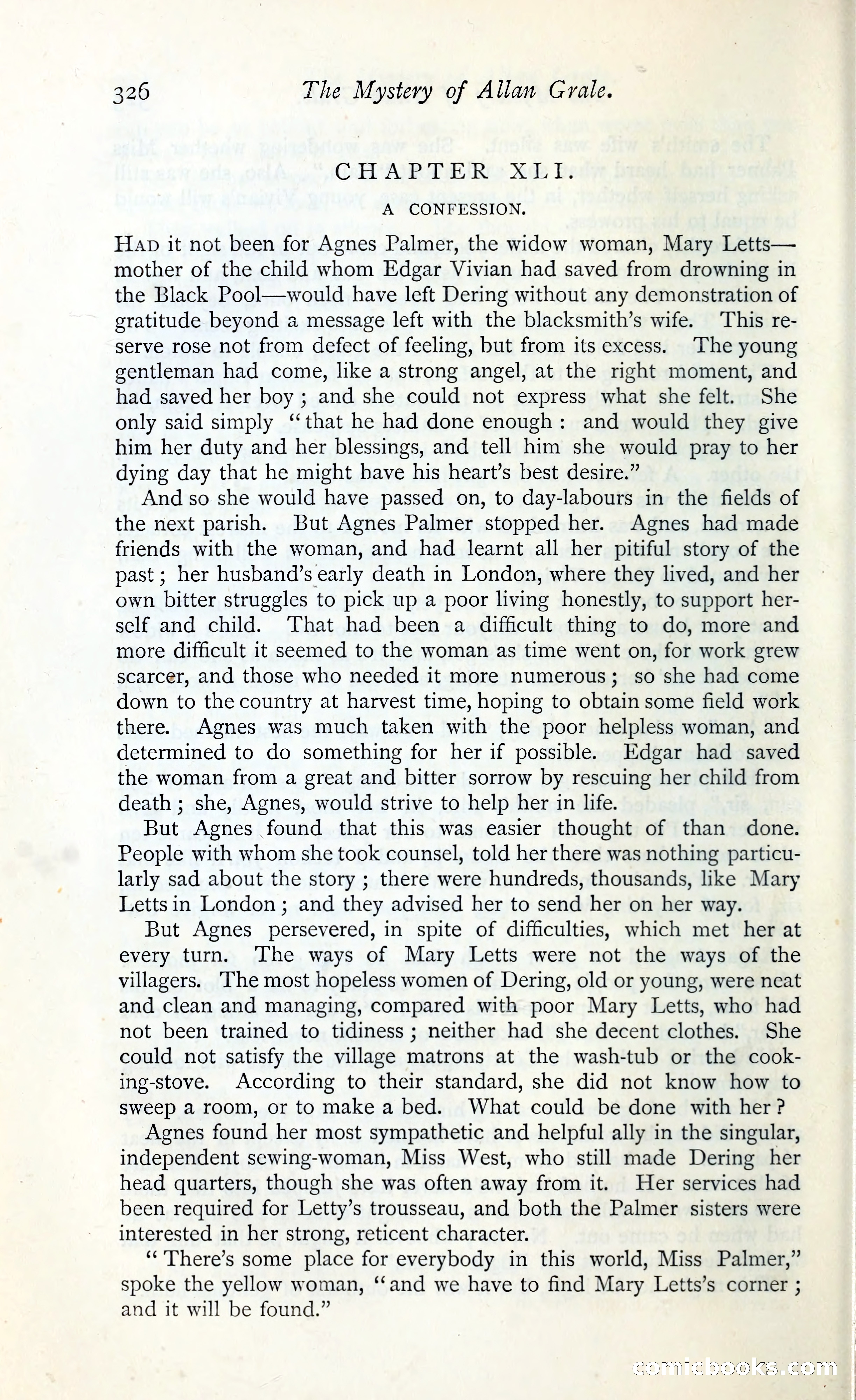
A restored page from Pulp Fiction, 1865. Page through the whole issue in the reader above.
📄 Transcribed text from this page (OCR, searchable)
Machine-transcribed from the original scan — historical spelling and the odd misread are preserved.
326 The Mystery of Allan Grale. CHARTER: Xe Ik A CONFESSION. Hap it not been for Agnes Palmer, the widow woman, Mary Letts— mother of the child whom Edgar Vivian had saved from drowning in the Black Pool—would have left Dering without any demonstration of gratitude beyond a message left with the blacksmith’s wife. This re- serve rose not from defect of feeling, but from its excess. The young gentleman had come, like a strong angel, at the right moment, and had saved her boy ; and she could not express what she felt. She only said simply ‘“‘that he had done enough: and would they give him her duty and her blessings, and tell him she would pray to her dying day that he might have his heart’s best desire.” And so she would have passed on, to day-labours in the fields of the next parish. But Agnes Palmer stopped her. Agnes had made friends with the woman, and had learnt all her pitiful story of the past ; her husband’s early death in London, where they lived, and her own bitter struggles to pick up a poor living honestly, to support her- self and child. That had been a difficult thing to do, more and more difficult it seemed to the woman as time went on, for work grew scarcer, and those who needed it more numerous; so she had come down to thecountry at harvest time, hoping to obtain some field work there. Agnes was much taken with the poor helpless woman, and determined to do something for her if possible. Edgar had saved the woman from a great and bitter sorrow by rescuing her child from death ; she, Agnes, would strive to help her in life. But Agnes found that this was easier thought of than done. People with whom she took counsel, told her there was nothing particu- larly sad about the story ; there were hundreds, thousands, like Mary Lettsin London ; and they advised her to send her on her way. But Agnes persevered, in spite of difficulties, which met her at every turn. The ways of Mary Letts were not the ways of the villagers. ‘The most hopeless women of Dering, old or young, were neat and clean and managing, compared with poor Mary Letts, who had not been trained to tidiness ; neither had she decent clothes. She could not satisfy the village matrons at the wash-tub or the cook- ing-stove. According to their standard, she did not know how to sweep a room, or to make a bed. What could be done with her? Agnes found her most sympathetic and helpful ally in the singular, independent sewing-woman, Miss West, who still made Dering her head quarters, though she was often away from it. Her services had been required for Letty’s trousseau, and both the Palmer sisters were interested in her strong, reticent character. ‘“‘'There’s some place for everybody in this world, Miss Palmer,” spoke the yellow woman, ‘‘and we have to find Mary Letts’s corner ; and it will be found.” ECORNICLOOKS»€©