
Pulp Fiction, 1865 · page 303 of 400
The Argosy — page 303: what you’re looking at
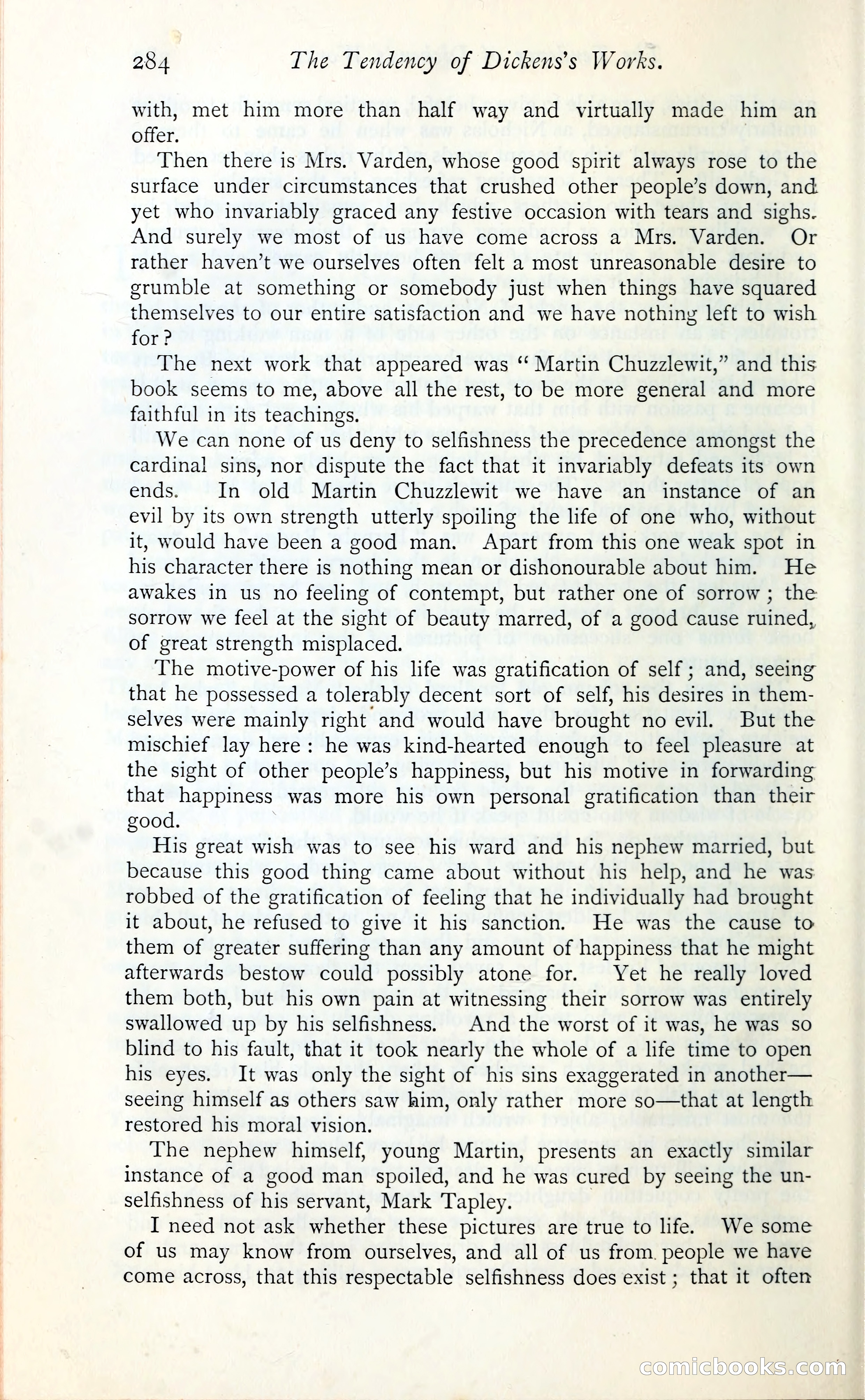
A restored page from Pulp Fiction, 1865. Page through the whole issue in the reader above.
📄 Transcribed text from this page (OCR, searchable)
Machine-transcribed from the original scan — historical spelling and the odd misread are preserved.
284 The Tendency of Dickens’s Works. with, met him more than half way and virtually made him an offer. | Then there is Mrs. Varden, whose good spirit always rose to the surface under circumstances that crushed other people’s down, and yet who invariably graced any festive occasion with tears and sighs. And surely we most of us have come across a Mrs. Varden. Or rather haven’t we ourselves often felt a most unreasonable desire to grumble at something or somebody just when things have squared themselves to our entire satisfaction and we have nothing left to wish for? The next work that appeared was ‘‘ Martin Chuzzlewit,” and this book seems to me, above all the rest, to be more general and more faithful in its teachings. We can none of us deny to selfishness the precedence amongst the cardinal sins, nor dispute the fact that it invariably defeats its own ends. In old Martin Chuzzlewit we have an instance of an evil by its own strength utterly spoiling the life of one who, without it, would have been a good man. Apart from this one weak spot in his character there is nothing mean or dishonourable about him. He awakes in us no feeling of contempt, but rather one of sorrow ; the sorrow we feel at the sight of beauty marred, of a good cause ruined, of great strength misplaced. The motive-power of his life was gratification of self ; and, seeing that he possessed a tolerably decent sort of self, his desires in them- selves were mainly right and would have brought no evil. But the mischief lay here: he was kind-hearted enough to feel pleasure at the sight of other people’s happiness, but his motive in forwarding that happiness was more his own personal gratification than their good. | His great wish was to see his ward and his nephew married, but because this good thing came about without his help, and he was robbed of the gratification of feeling that he individually had brought it about, he refused to give it his sanction. He was the cause to them of greater suffering than any amount of happiness that he might afterwards bestow could possibly atone for. Yet he really loved them both, but his own pain at witnessing their sorrow was entirely swallowed up by his selfishness. And the worst of it was, he was so blind to his fault, that it took nearly the whole of a life time to open his eyes. It was only the sight of his sins exaggerated in another— seeing himself as others saw him, only rather more so—that at length restored his moral vision. The nephew himself, young Martin, presents an exactly similar instance of a good man spoiled, and he was cured by seeing the un- selfishness of his servant, Mark Tapley. I need not ask whether these pictures are true to life. We some of us may know from ourselves, and all of us from. people we have come across, that this respectable selfishness does exist ; that it often (9) COM 0)(0)(0)| KS, (E(0)