
Pulp Fiction, 1865 · page 251 of 400
The Argosy — page 251: what you’re looking at
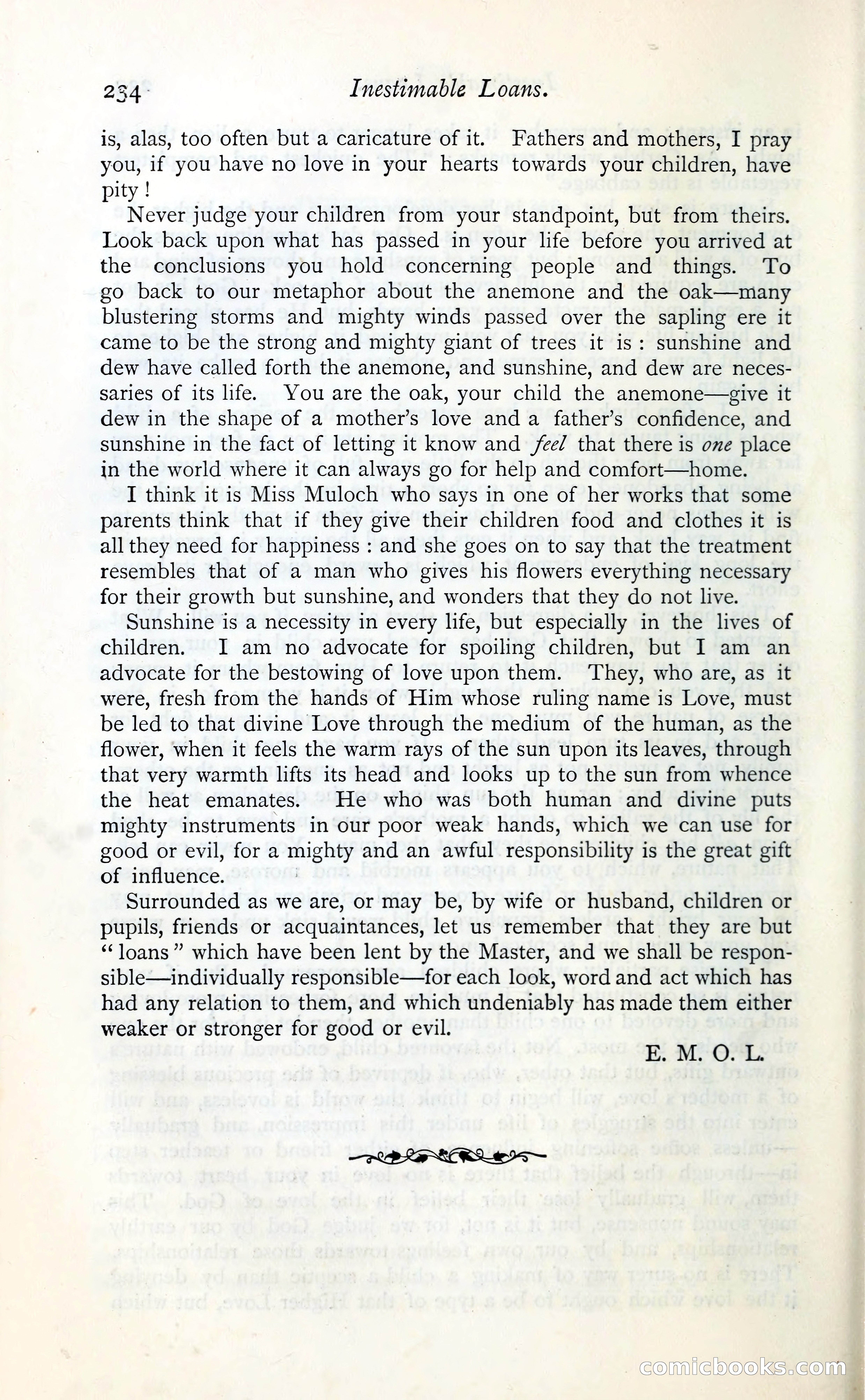
A restored page from Pulp Fiction, 1865. Page through the whole issue in the reader above.
📄 Transcribed text from this page (OCR, searchable)
Machine-transcribed from the original scan — historical spelling and the odd misread are preserved.
234) Inestimable Loans. is, alas, too often but a caricature of it. Fathers and mothers, I pray you, if you have no love in your hearts towards your children, have pity! Never judge your children from your standpoint, but from theirs. Look back upon what has passed in your life before you arrived at the conclusions you hold concerning people and things. To go back to our metaphor about the anemone and the oak—many blustering storms and mighty winds passed over the sapling ere it came to be the strong and mighty giant of trees it is: sunshine and dew have called forth the anemone, and sunshine, and dew are neces- saries of its life. You are the oak, your child the anemone—give it dew in the shape of a mother’s love and a father’s confidence, and sunshine in the fact of letting it know and /ee/ that there is ove place in the world where it can always go for help and comfort—home. I think it is Miss Muloch who says in one of her works that some parents think that if they give their children food and clothes it is all they need for happiness : and she goes on to say that the treatment resembles that of a man who gives his flowers everything necessary for their growth but sunshine, and wonders that they do not live. Sunshine is a necessity in every life, but especially in the lives of children. I am no advocate for spoiling children, but I am an advocate for the bestowing of love upon them. They, who are, as it were, fresh from the hands of Him whose ruling name is Love, must be led to that divine Love through the medium of the human, as the flower, when it feels the warm rays of the sun upon its leaves, through that very warmth lifts its head and looks up to the sun from whence the heat emanates. He who was both human and divine puts mighty instruments in our poor weak hands, which we can use for good or evil, for a mighty and an awful responsibility is the great gift of influence. Surrounded as we are, or may be, by wife or husband, children or pupils, friends or acquaintances, let us remember that they are but ‘‘loans” which have been lent by the Master, and we shall be respon- sible—individually responsible—for each look, word and act which has had any relation to them, and which undeniably has made them either weaker or stronger for good or evil. E. M. O.-L. GOMIIGDOOKsS (EO)