
Pulp Fiction, 1865 · page 238 of 400
The Argosy — page 238: what you’re looking at
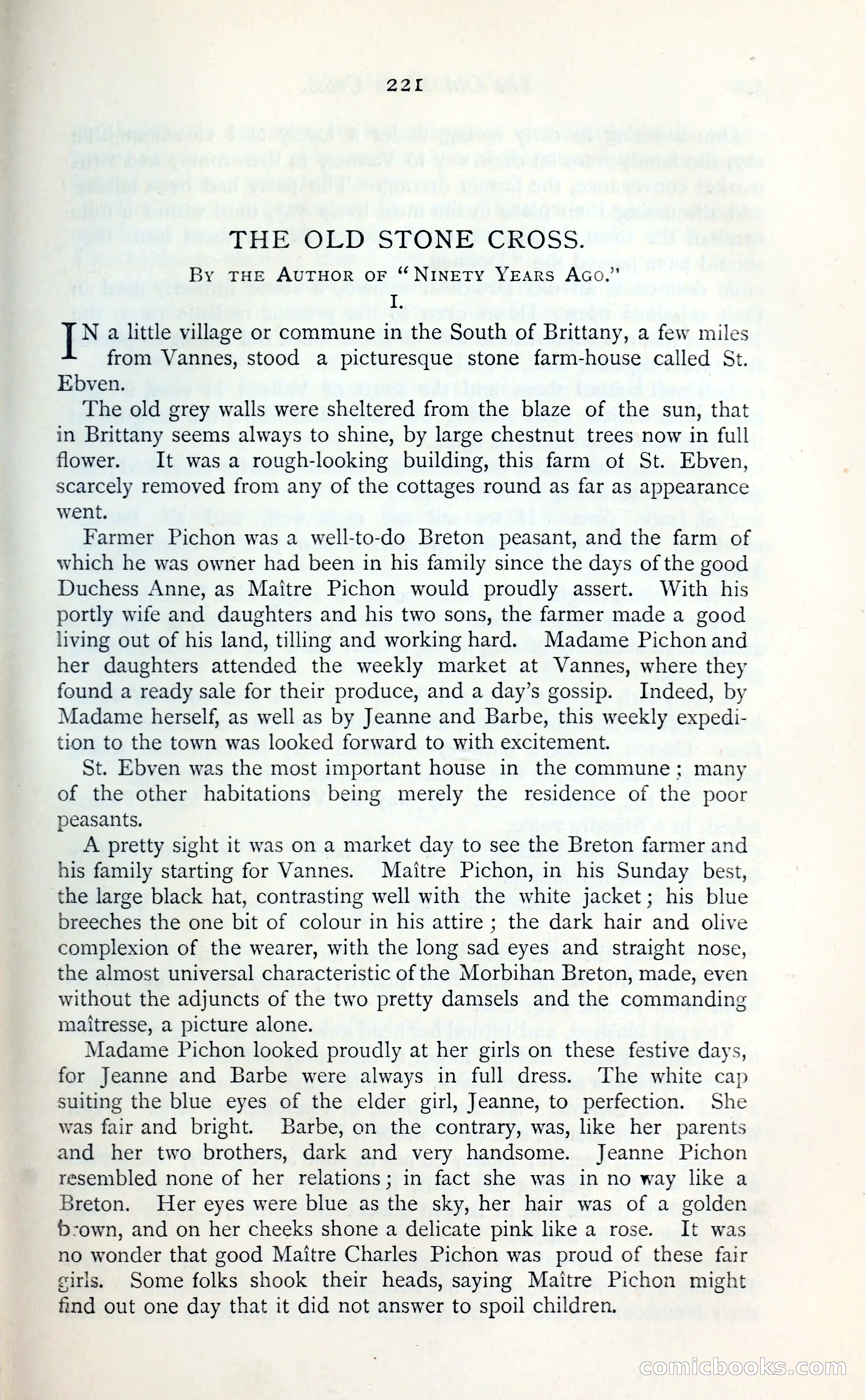
A restored page from Pulp Fiction, 1865. Page through the whole issue in the reader above.
📄 Transcribed text from this page (OCR, searchable)
Machine-transcribed from the original scan — historical spelling and the odd misread are preserved.
221 THE OLD STONE CROSS. By THE AUTHOR OF “NINETY YEARS AGO.” I. |S a little village or commune in the South of Brittany, a few miles from Vannes, stood a picturesque stone farm-house called St. Ebven. The old grey walls were sheltered from the blaze of the sun, that in Brittany seems always to shine, by large chestnut trees now in full flower. It was a rough-looking building, this farm of St. Ebven, scarcely removed from any of the cottages round as far as appearance went. Farmer Pichon was a well-to-do Breton peasant, and the farm of which he was owner had been in his family since the days of the good Duchess Anne, as Maitre Pichon would proudly assert. With his portly wife and daughters and his two sons, the farmer made a good living out of his land, tilling and working hard. Madame Pichon and her daughters attended the weekly market at Vannes, where they found a ready sale for their produce, and a day’s gossip. Indeed, by Madame herself, as well as by Jeanne and Barbe, this weekly expedi- tion to the town was looked forward to with excitement. St. Ebven was the most important house in the commune; many of the other habitations being merely the residence of the poor peasants. A pretty sight it was on a market day to see the Breton farmer and his family starting for Vannes. Maitre Pichon, in his Sunday best, the large black hat, contrasting well with the white jacket; his blue breeches the one bit of colour in his attire ; the dark hair and olive complexion of the wearer, with the long sad eyes and straight nose, the almost universal characteristic of the Morbihan Breton, made, even without the adjuncts of the two pretty damsels and the commanding maitresse, a picture alone. Madame Pichon looked proudly at her girls on these festive days, for Jeanne and Barbe were always in full dress. ‘The white cap suiting the blue eyes of the elder girl, Jeanne, to perfection. She was fair and bright. Barbe, on the contrary, was, like her parents and her two brothers, dark and very handsome. Jeanne Pichon resembled none of her relations; in fact she was in no way like a Breton. Her eyes were blue as the sky, her hair was of a golden Drown, and on her cheeks shone a delicate pink like a rose. It was no wonder that good Maitre Charles Pichon was proud of these fair cirls, Some folks shook their heads, saying Maitre Pichon might find out one day that it did not answer to spoil children. CONIClOO© SS (CO) an