
Pulp Fiction, 1865 · page 222 of 400
The Argosy — page 222: what you’re looking at
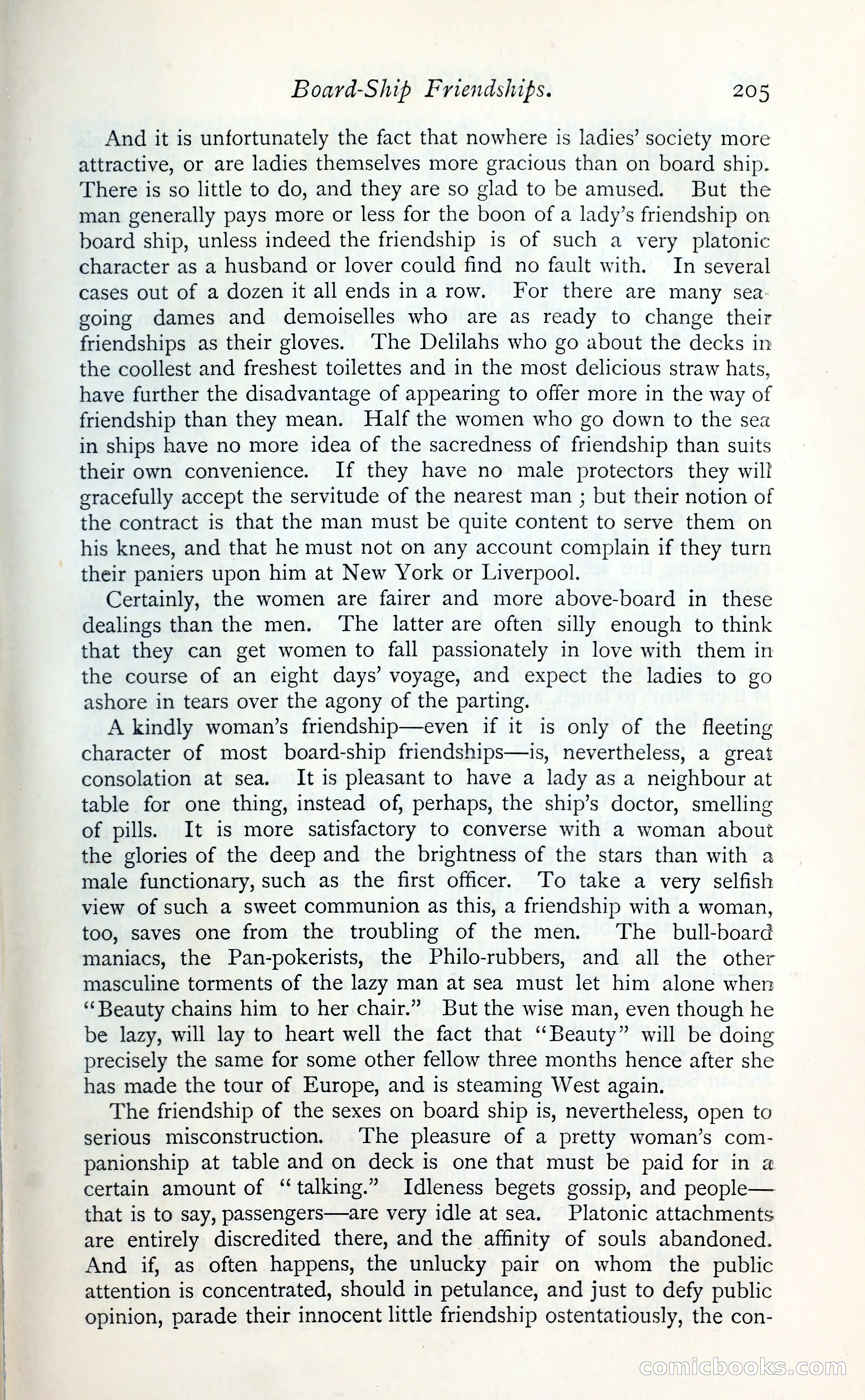
A restored page from Pulp Fiction, 1865. Page through the whole issue in the reader above.
📄 Transcribed text from this page (OCR, searchable)
Machine-transcribed from the original scan — historical spelling and the odd misread are preserved.
Board-Ship Friendships. 205 And it is unfortunately the fact that nowhere 1s ladies’ society more attractive, or are ladies themselves more gracious than on board ship. There is so little to do, and they are so glad to be amused. But the man generally pays more or less for the boon of a lady’s friendship on board ship, unless indeed the friendship is of such a very platonic character as a husband or lover could find no fault with. In several cases out of a dozen it all ends ina row. For there are many sea going dames and demoiselles who are as ready to change their friendships as their gloves. ‘The Delilahs who go about the decks in the coollest and freshest toilettes and in the most delicious straw hats, have further the disadvantage of appearing to offer more in the way of friendship than they mean. Half the women who go down to the sea in ships have no more idea of the sacredness of friendship than suits their own convenience. If they have no male protectors they will gracefully accept the servitude of the nearest man ; but their notion of the contract is that the man must be quite content to serve them on his knees, and that he must not on any account complain if they turn their paniers upon him at New York or Liverpool. Certainly, the women are fairer and more above-board in these dealings than the men. ‘The latter are often silly enough to think that they can get women to fall passionately in love with them in the course of an eight days’ voyage, and expect the ladies to go ashore in tears over the agony of the parting. A kindly woman’s friendship—even if it is only of the fleeting character of most board-ship friendships—is, nevertheless, a great consolation at sea. It is pleasant to have a lady as a neighbour at table for one thing, instead of, perhaps, the ship’s doctor, smelling of pills. It is more satisfactory to converse with a woman about the glories of the deep and the brightness of the stars than with a male functionary, such as the first officer. To take a very selfish view of such a sweet communion as this, a friendship with a woman, too, saves one from the troubling of the men. The _ bull-board maniacs, the Pan-pokerists, the Philo-rubbers, and all the other masculine torments of the lazy man at sea must let him alone when ‘Beauty chains him to her chair.” But the wise man, even though he be lazy, will lay to heart well the fact that “‘Beauty” will be doing precisely the same for some other fellow three months hence after she has made the tour of Europe, and is steaming West again. The friendship of the sexes on board ship is, nevertheless, open to serious misconstruction. The pleasure of a pretty woman’s com- panionship at table and on deck is one that must be paid for in a certain amount of “talking.” Idleness begets gossip, and people— that is to say, passengers—are very idle at sea. Platonic attachments are entirely discredited there, and the affinity of souls abandoned. And if, as often happens, the unlucky pair on whom the public attention is concentrated, should in petulance, and just to defy public opinion, parade their innocent little friendship ostentatiously, the con- COnniclooolkks (CO)