
Pulp Fiction, 1865 · page 170 of 400
The Argosy — page 170: what you’re looking at
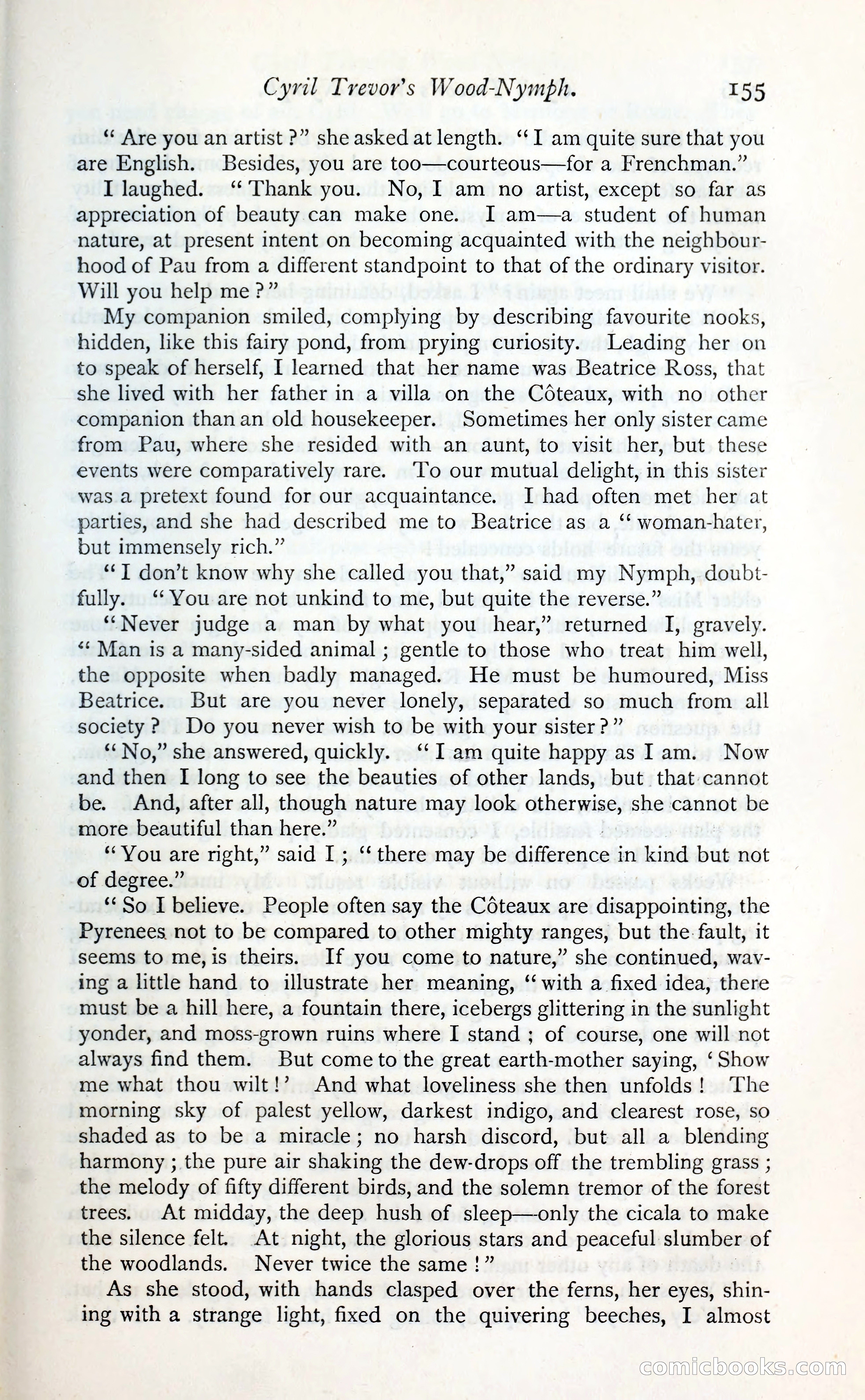
A restored page from Pulp Fiction, 1865. Page through the whole issue in the reader above.
📄 Transcribed text from this page (OCR, searchable)
Machine-transcribed from the original scan — historical spelling and the odd misread are preserved.
Cyril Tvevor’s Wood-Nymph. 155 *‘ Are you an artist P” sheasked at length. ‘‘I am quite sure that you are English. Besides, you are too—courteous—for a Frenchman.” I laughed. ‘Thank you. No, I am no artist, except so far as appreciation of beauty can make one. I am—a student of human nature, at present intent on becoming acquainted with the neighbour- hood of Pau from a different standpoint to that of the ordinary visitor. Will you help me ?” My companion smiled, complying by describing favourite nooks, hidden, like this fairy pond, from prying curiosity. Leading her on to speak of herself, I learned that her name was Beatrice Ross, that she lived with her father in a villa on the Coteaux, with no other companion thanan old housekeeper. Sometimes her only sister came from Pau, where she resided with an aunt, to visit her, but these events were comparatively rare. ‘To our mutual delight, in this sister was a pretext found for our acquaintance. I had often met her at parties, and she had described me to Beatrice as a ‘‘ woman-hater, but immensely rich.” “IT don’t know why she called you that,” said my Nymph, doubt- fully. ‘‘ You are not unkind to me, but quite the reverse.” ‘“Never judge a man by what you hear,” returned I, gravely. ‘* Man is a many-sided animal ; gentle to those who treat him well, the opposite when badly managed. He must be humoured, Miss Beatrice. But are you never lonely, separated so much from all society ? Do you never wish to be with your sister ?” “No,” she answered, quickly. ‘‘I am quite happy asI am. Now and then I long to see the beauties of other lands, but that cannot be. And, after all, though nature may look otherwise, she cannot be more beautiful than here.” | “Vou are right,” said I; ‘‘ there may be difference in kind but not of degree.” *<So I believe. People often say the Coteaux are disappointing, the Pyrenees not to be compared to other mighty ranges, but the. fault, it seems to me,is theirs. If you come to nature,” she continued, wav- ing a little hand to illustrate her meaning, “‘ with a fixed idea, there must be a hill here, a fountain there, icebergs glittering in the sunlight yonder, and moss-grown ruins where I stand ; of course, one will not always find them. But come to the great earth-mother saying, ‘Show me what thou wilt!’ And what loveliness she then unfolds! The morning sky of palest yellow, darkest indigo, and clearest rose, so shaded as to be a miracle; no harsh discord, but all a blending harmony ; the pure air shaking the dew-drops off the trembling grass ; the melody of fifty different birds, and the solemn tremor of the forest trees. At midday, the deep hush of sleep—only the cicala to make the silence felt. At night, the glorious stars and peaceful slumber of the woodlands. Never twice the same!” As she stood, with hands clasped over the ferns, her eyes, shin- ing with a strange light, fixed on the quivering beeches, I almost CoOnniclooolkks (CO)