
Pulp Fiction, 1865 · page 162 of 400
The Argosy — page 162: what you’re looking at
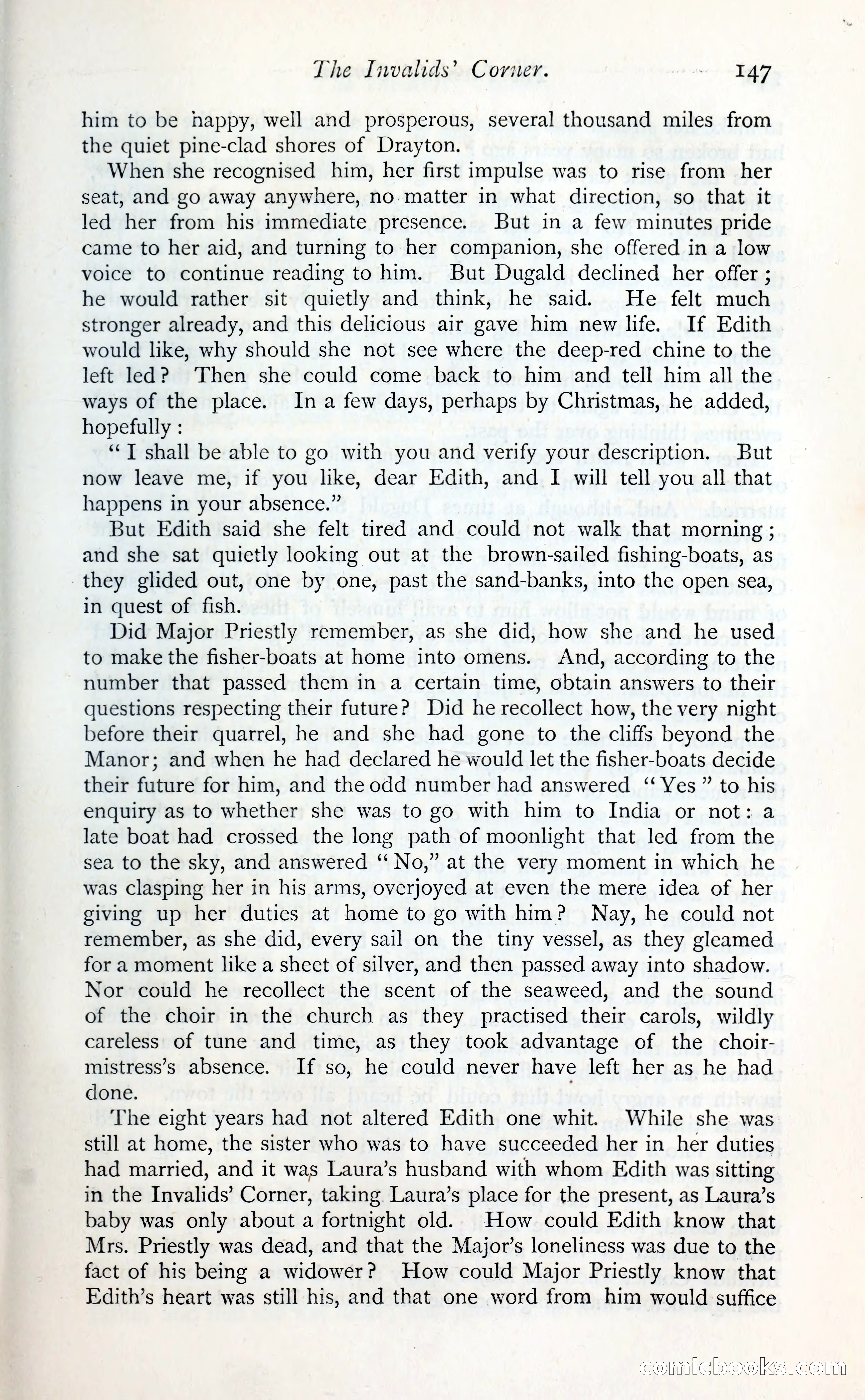
A restored page from Pulp Fiction, 1865. Page through the whole issue in the reader above.
📄 Transcribed text from this page (OCR, searchable)
Machine-transcribed from the original scan — historical spelling and the odd misread are preserved.
The Invalids’ Corner. - Tg him to be happy, well and prosperous, several thousand miles from the quiet pine-clad shores of Drayton. When she recognised him, her first impulse was to rise from her seat, and go away anywhere, no matter in what direction, so that it led her from his immediate presence. But in a few minutes pride came to her aid, and turning to her companion, she offered in a low voice to continue reading to him. But Dugald declined her offer ; he would rather sit quietly and think, he said. He felt much stronger already, and this delicious air gave him new life. If Edith would like, why should she not see where the deep-red chine to the left led? ‘Then she could come back to him and tell him all the ways of the place. Ina few days, perhaps by Christmas, he added, hopefully : “T shall be able to go with you and verify your description. But now leave me, if you like, dear Edith, and I will tell you all that happens in your absence.” But Edith said she felt tired and could not walk that morning ; and she sat quietly looking out at the brown-sailed fishing-boats, as they glided out, one by one, past the sand-banks, into the open sea, in quest of fish. Did Major Priestly remember, as she did, how she and he used to make the fisher-boats at home into omens. And, according to the number that passed them in a certain time, obtain answers to their questions respecting their future? Did he recollect how, the very night before their quarrel, he and she had gone to the cliffs beyond the Manor; and when he had declared he would let the fisher-boats decide their future for him, and the odd number had answered ‘‘ Yes ” to his enquiry as to whether she was to go with him to India or not: a late boat had crossed the long path of moonlight that led from the sea to the sky, and answered “‘ No,” at the very moment in which he was clasping her in his arms, overjoyed at even the mere idea of her giving up her duties at home to go with him? Nay, he could not remember, as she did, every sail on the tiny vessel, as they gleamed fora moment like a sheet of silver, and then passed away into shadow. Nor could he recollect the scent of the seaweed, and the sound of the choir in the church as they practised their carols, wildly careless of tune and time, as they took advantage of the choir- mistress’s absence. If so, he could never have left her as he had done. The eight years had not altered Edith one whit. While she was still at home, the sister who was to have succeeded her in her duties had married, and it was Laura’s husband with whom Edith was sitting in the Invalids’ Corner, taking Laura’s place for the present, as Laura’s baby was only about a fortnight old. How could Edith know that Mrs. Priestly was dead, and that the Major’s loneliness was due to the fact of his being a widower? How could Major Priestly know that Edith’s heart was still his, and that one word from him would suffice CoOnniclooolkks (CO)