
Pulp Fiction, 1865 · page 160 of 400
The Argosy — page 160: what you’re looking at
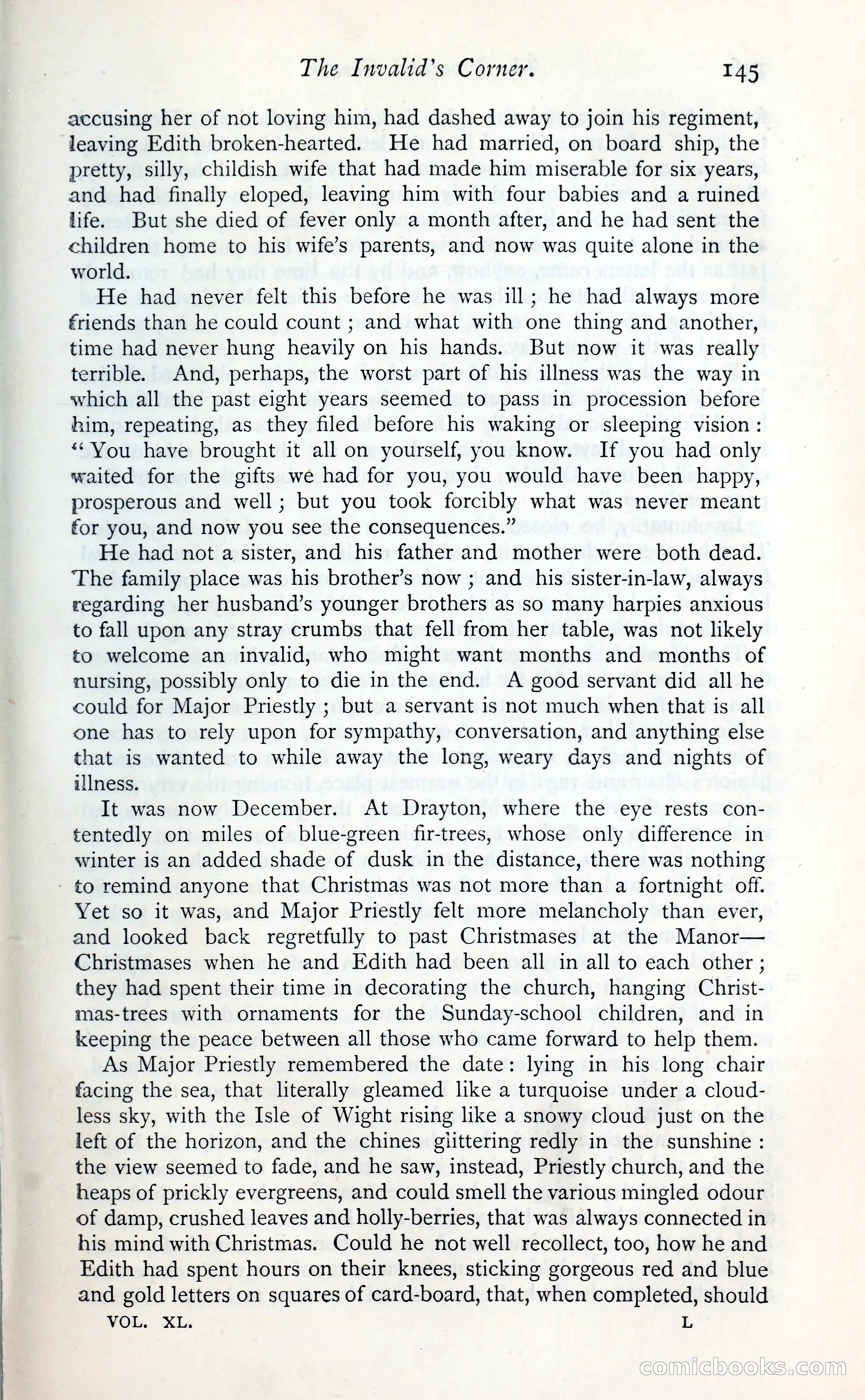
A restored page from Pulp Fiction, 1865. Page through the whole issue in the reader above.
📄 Transcribed text from this page (OCR, searchable)
Machine-transcribed from the original scan — historical spelling and the odd misread are preserved.
EEE i. eaaaaaSYS”— —_—_- The Invalid’s Corner. I45 accusing her of not loving him, had dashed away to join his regiment, leaving Edith broken-hearted. He had married, on board ship, the pretty, silly, childish wife that had made him miserable for six years, and had finally eloped, leaving him with four babies and a ruined life. But she died of fever only a month after, and he had sent the children home to his wife’s parents, and now was quite alone in the world. He had never felt this before he was ill; he had always more friends than he could count ; and what with one thing and another, time had never hung heavily on his hands. But now it was really terrible. And, perhaps, the worst part of his illness was the way in which all the past eight years seemed to pass in procession before him, repeating, as they filed before his waking or sleeping vision: “You have brought it all on yourself, you know. If you had only waited for the gifts we had for you, you would have been happy, prosperous and well; but you took forcibly what was never meant for you, and now you see the consequences.” He had not a sister, and his father and mother were both dead. The family place was his brother’s now ; and _ his sister-in-law, always regarding her husband’s younger brothers as so many harpies anxious to fall upon any stray crumbs that fell from her table, was not likely to welcome an invalid, who might want months and months of mursing, possibly only to die in the end. A good servant did all he could for Major Priestly ; but a servant is not much when that is all one has to rely upon for sympathy, conversation, and anything else that is wanted to while away the long, weary days and nights of illness. It was now December. At Drayton, where the eye rests con- tentedly on miles of blue-green fir-trees, whose only difference in winter is an added shade of dusk in the distance, there was nothing - to remind anyone that Christmas was not more than a fortnight off. Yet so it was, and Major Priestly felt more melancholy than ever, and looked back regretfully to past Christmases at the Manor— Christmases when he and Edith had been all in all to each other ; they had spent their time in decorating the church, hanging Christ- mas-trees with ornaments for the Sunday-school children, and in keeping the peace between all those who came forward to help them. As Major Priestly remembered the date: lying in his long chair facing the sea, that literally gleamed like a turquoise under a cloud- less sky, with the Isle of Wight rising like a snowy cloud just on the left of the horizon, and the chines glittering redly in the sunshine : the view seemed to fade, and he saw, instead, Priestly church, and the heaps of prickly evergreens, and could smell the various mingled odour of damp, crushed leaves and holly-berries, that was always connected in his mind with Christmas. Could he not well recollect, too, how he and Edith had spent hours on their knees, sticking gorgeous red and blue and gold letters on squares of card-board, that, when completed, should VOL. XL. L CoOnniclooolkks (ei Q)