
Pulp Fiction, 1865 · page 155 of 400
The Argosy — page 155: what you’re looking at
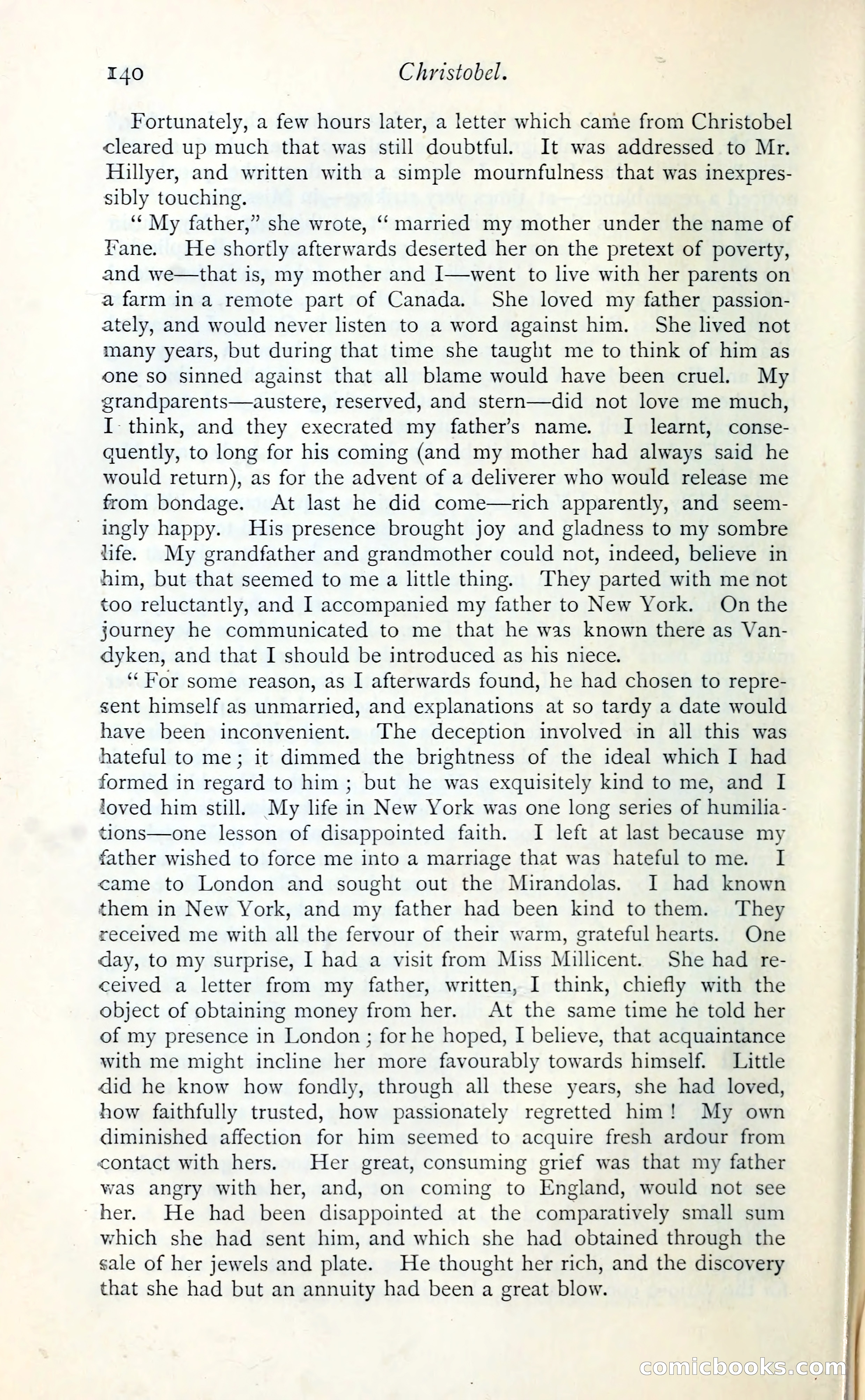
A restored page from Pulp Fiction, 1865. Page through the whole issue in the reader above.
📄 Transcribed text from this page (OCR, searchable)
Machine-transcribed from the original scan — historical spelling and the odd misread are preserved.
I40 Christobel. Fortunately, a few hours later, a letter which came from Christobel cleared up much that was still doubtful. It was addressed to Mr. Hillyer, and written with a simple mournfulness that was inexpres- sibly touching. ‘““ My father,” she wrote, ‘‘ married my mother under the name of ane. He shortly afterwards deserted her on the pretext of poverty, and we—that is, my mother and I—went to live with her parents on a farm ina remote part of Canada. She loved my father passion- ately, and would never listen to a word against him. She lived not many years, but during that time she taught me to think of him as one so sinned against that all blame would have been cruel. My grandparents—austere, reserved, and stern—did not love me much, I- think, and they execrated my father’s name. I learnt, conse- quently, to long for his coming (and my mother had always said he would return), as for the advent of a deliverer who would release me from bondage. At last he did come—rich apparently, and seem- ingly happy. His presence brought joy and gladness to my sombre life. My grandfather and grandmother could not, indeed, believe in him, but that seemed to me a little thing. They parted with me not too reluctantly, and I accompanied my father to New York. On the journey he communicated to me that he was known there as Van- dyken, and that I should be introduced as his niece. ‘For some reason, as I afterwards found, he had chosen to repre- sent himself as unmarried, and explanations at so tardy a date would have been inconvenient. ‘The deception involved in all this was hateful to me; it dimmed the brightness of the ideal which I had formed in regard to him; but he was exquisitely kind to me, and I loved him still. My life in New York was one long series of humilia- tions—one lesson of disappointed faith. I left at last because my father wished to force me into a marriage that was hatefulto me. I came to London and sought out the Mirandolas. I had known them in New York, and my father had been kind tothem. ‘They received me with all the fervour of their warm, grateful hearts. One day, to my surprise, I had a visit from Miss Millicent. She had re- ceived a letter from my father, written, I think, chiefly with the object of obtaining money from her. At the same time he told her of my presence in London ; for he hoped, I believe, that acquaintance with me might incline her more favourably towards himself. Little did he know how fondly, through all these years, she had loved, how faithfully trusted, how passionately regretted him! My own diminished affection for him seemed to acquire fresh ardour from contact with hers. Her great, consuming grief was that my father was angry with her, and, on coming to England, would not see her. He had been disappointed at the comparatively small sum which she had sent him, and which she had obtained through the sale of her jewels and plate. He thought her rich, and the discovery that she had but an annuity had been a great blow. CONIC OO KS co