
Pulp Fiction, 1865 · page 148 of 400
The Argosy — page 148: what you’re looking at
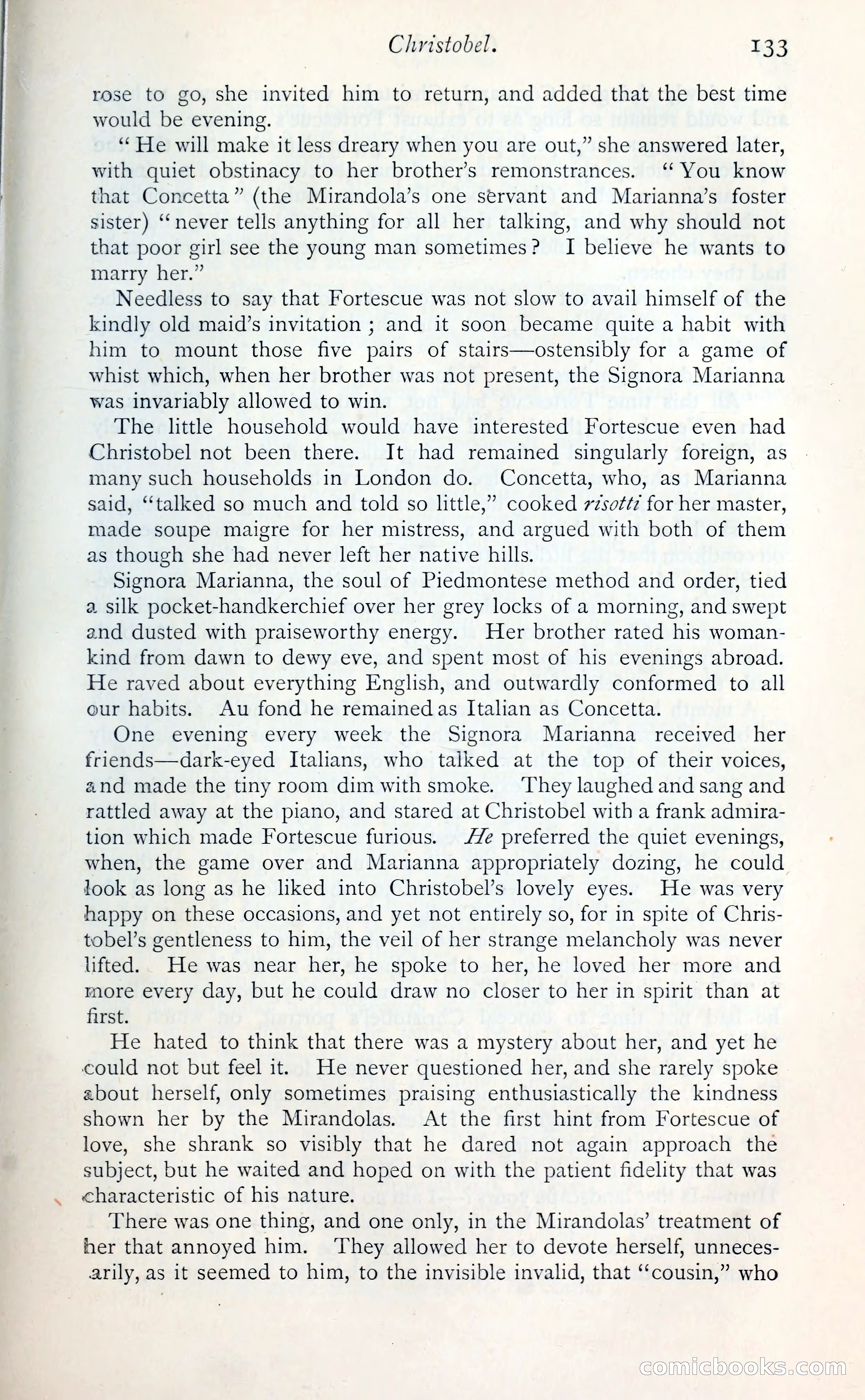
A restored page from Pulp Fiction, 1865. Page through the whole issue in the reader above.
📄 Transcribed text from this page (OCR, searchable)
Machine-transcribed from the original scan — historical spelling and the odd misread are preserved.
Christobel. 133 rose to go, she invited him to return, and added that the best time would be evening. “He will make it less dreary when you are out,” she answered later, with quiet obstinacy to her brother’s remonstrances. ‘“ You know that Concetta” (the Mirandola’s one servant and Marianna’s foster sister) “never tells anything for all her talking, and why should not that poor girl see the young man sometimes? I believe he wants to marry her.” Needless to say that Fortescue was not slow to avail himself of the kindly old maid’s invitation ; and it soon became quite a habit with him to mount those five pairs of stairs—ostensibly for a game of whist which, when her brother was not present, the Signora Marianna was invariably allowed to win. The lttle household would have interested Fortescue even had Christobel not been there. It had remained singularly foreign, as many such households in London do. Concetta, who, as Marianna said, ‘talked so much and told so little,” cooked vzsottz for her master, made soupe maigre for her mistress, and argued with both of them as though she had never left her native hills. Signora Marianna, the soul of Piedmontese method and order, tied a silk pocket-handkerchief over her grey locks of a morning, and swept and dusted with praiseworthy energy. Her brother rated his woman- kind from dawn to dewy eve, and spent most of his evenings abroad. He raved about everything English, and outwardly conformed to all our habits. Au fond he remainedas Italian as Concetta. One evening every week the Signora Marianna received her friends—dark-eyed Italians, who talked at the top of their voices, and made the tiny room dim with smoke. They laughed and sang and rattled away at the piano, and stared at Christobel with a frank admira- tion which made Fortescue furious. //e preferred the quiet evenings, when, the game over and Marianna appropriately dozing, he could look as long as he liked into Christobel’s lovely eyes. He was very happy on these occasions, and yet not entirely so, for in spite of Chris- tobel’s gentleness to him, the veil of her strange melancholy was never lifted.. He was near her, he spoke to her, he loved her more and more every day, but he could draw no closer to her in spirit than at first. He hated to think that there was a mystery about her, and yet he could not but feel it. He never questioned her, and she rarely spoke — about herself, only sometimes praising enthusiastically the kindness shown her by the Mirandolas. At the first hint from Fortescue of love, she shrank so visibly that he dared not again approach the subject, but he waited and hoped on with the patient fidelity that was characteristic of his nature. There was one thing, and one only, in the Mirandolas’ treatment of her that annoyed him. ‘They allowed her to devote herself, unneces- arily, as it seemed to him, to the invisible invalid, that ‘‘cousin,” who (A) COA NOOKS (CO) am