
Pulp Fiction, 1865 · page 133 of 400
The Argosy — page 133: what you’re looking at
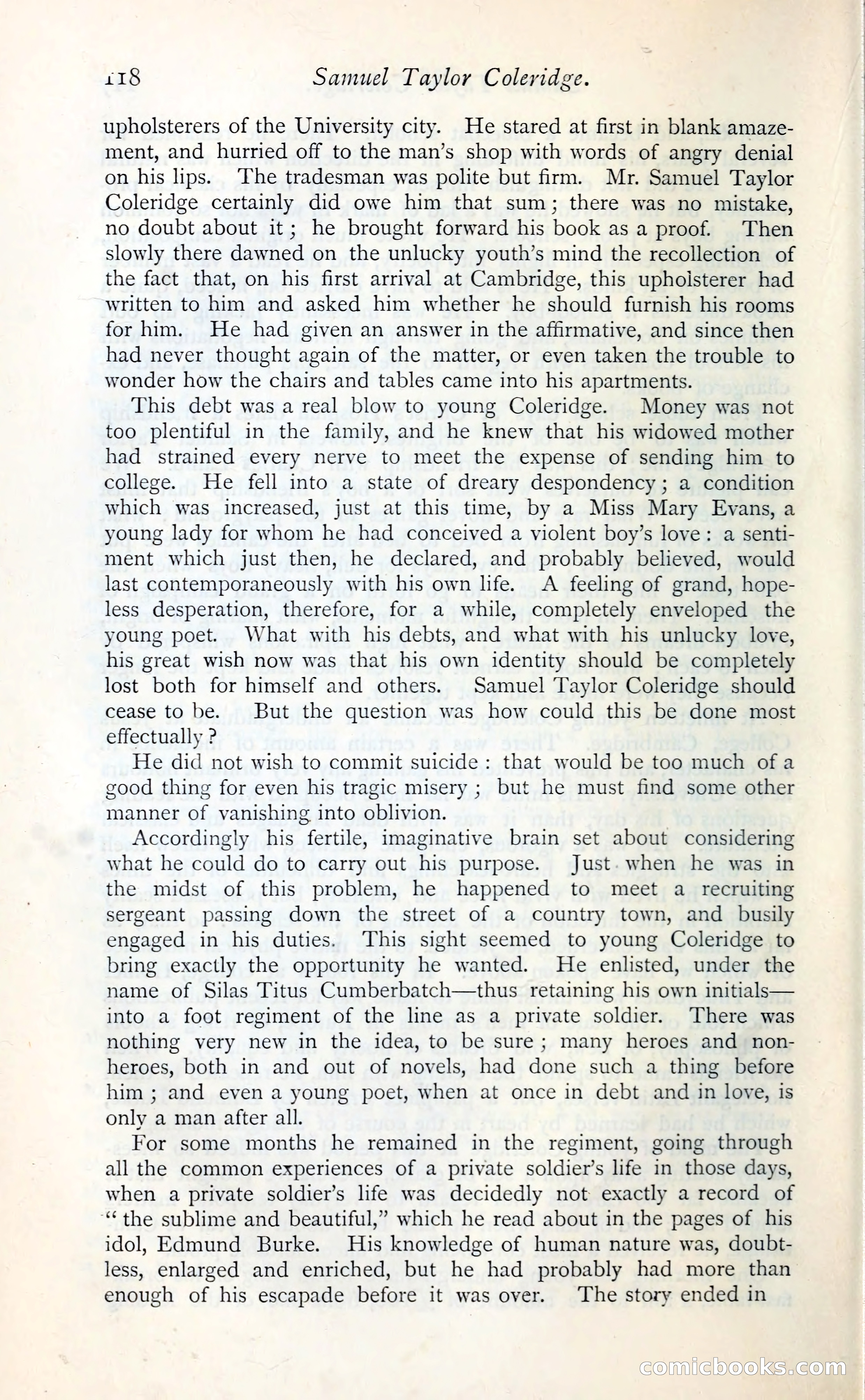
A restored page from Pulp Fiction, 1865. Page through the whole issue in the reader above.
📄 Transcribed text from this page (OCR, searchable)
Machine-transcribed from the original scan — historical spelling and the odd misread are preserved.
118 Samuel Taylor Coleridge. upholsterers of the University city. He stared at first in blank amaze- ment, and hurried off to the man’s shop with words of angry denial on his lips. ‘The tradesman was polite but firm. Mr. Samuel Taylor Coleridge certainly did owe him that sum; there was no mistake, no doubt about it; he brought forward his book as a proof. Then slowly there dawned on the unlucky youth’s mind the recollection of the fact that, on his first arrival at Cambridge, this uphoisterer had written to him and asked him whether he should furnish his rooms for him. He had given an answer in the affirmative, and since then had never thought again of the matter, or even taken the trouble to wonder how the chairs and tables came into his apartments. This debt was a real blow to young Coleridge. Money was not too plentiful in the family, and he knew that his widowed mother had strained every nerve to meet the expense of sending him to college. He fell into a state of dreary despondency ; a condition which was increased, just at this time, by a Miss Mary Evans, a young lady for whom he had conceived a violent boy’s love: a senti- ment which just then, he declared, and probably believed, would last contemporaneously with his own life. A feeling of grand, hope- less desperation, therefore, for a while, completely enveloped the young poet. What with his debts, and what with his unlucky love, his great wish now was that his own identity should be completely lost both for himself and others. Samuel Taylor Coleridge should cease to be. But the question was how could this be done most effectually ? He did not wish to commit suicide: that would be too much ofa good thing for even his tragic misery ; but he must find some other manner of vanishing into oblivion. Accordingly his fertile, imaginative brain set about considering what he could do to carry out his purpose. Just. when he was in the midst of this problem, he happened to meet a recruiting sergeant passing down the street of a country town, and busily engaged in his duties. This sight seemed to young Coleridge to bring exactly the opportunity he wanted. He enlisted, under the name of Silas Titus Cumberbatch—thus retaining his own initials— into a foot regiment of the line as a private soldier. There was nothing very new in the idea, to be sure; many heroes and non- heroes, both in and out of novels, had done such a thing before him ; and even a young poet, when at once in debt and in love, is only a man after all. For some months he remained in the regiment, going through all the common experiences of a private soldier’s life in those days, when a private soldier’s life was decidedly not exactly a record of “the sublime and beautiful,” which he read about in the pages of his idol, Edmund Burke. His knowledge of human nature was, doubt- less, enlarged and enriched, but he had probably had more than enough of his escapade before it was over. The story ended in CORNICE NOOO KS. (E0)