
Pulp Fiction, 1865 · page 105 of 400
The Argosy — page 105: what you’re looking at
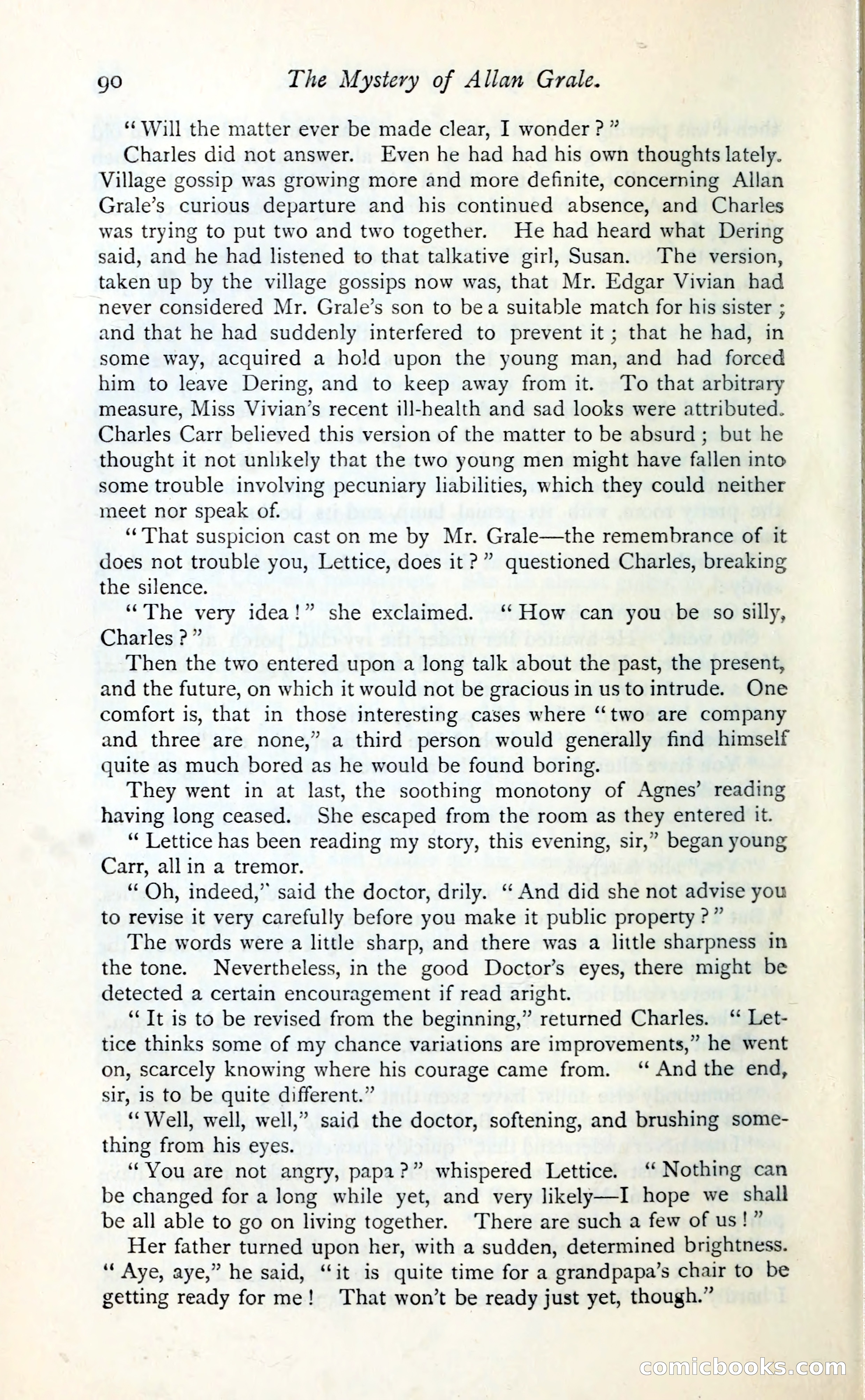
A restored page from Pulp Fiction, 1865. Page through the whole issue in the reader above.
📄 Transcribed text from this page (OCR, searchable)
Machine-transcribed from the original scan — historical spelling and the odd misread are preserved.
go The Mystery of Allan Grale. ‘Will the matter ever be made clear, I wonder ? ” Charles did not answer. Even he had had his own thoughts lately. Village gossip was growing more and more definite, concerning Allan Grale’s curious departure and his continued absence, and Charles was trying to put two and two together. He had heard what Dering said, and he had listened to that talkative girl, Susan. The version, taken up by the village gossips now was, that Mr. Edgar Vivian had never considered Mr. Grale’s son to bea suitable match for his sister ; and that he had suddenly interfered to prevent it ; that he had, in some way, acquired a hold upon the young man, and had forced him to leave Dering, and to keep away from it. To that arbitrary measure, Miss Vivian’s recent ill-health and sad looks were attributed. Charles Carr believed this version of the matter to be absurd; but he thought it not unlikely that the two young men might have fallen into some trouble involving pecuniary liabilities, which they could neither meet nor speak of. “That suspicion caston me by Mr. Grale—the remembrance of it does not trouble you, Lettice, does it?” questioned Charles, breaking the silence. “The very idea!” she exclaimed. ‘‘ How can you be so silly, Charles ? ” Then the two entered upon a long talk about the past, the present, and the future, on which it would not be gracious in us to intrude. One comfort is, that in those interesting cases where “‘two are company and three are none,” a third person would generally find himself quite as much bored as he would be found boring. They went in at last, the soothing monotony of Agnes’ reading having long ceased. She escaped from the room as they entered it. “ Lettice has been reading my story, this evening, sir,” began young Carr, all in a tremor. “Oh, indeed,” said the doctor, drily. ‘‘ And did she not advise you to revise it very carefully before you make it public property ?” The words were a little sharp, and there was a little sharpness in the tone. Nevertheless, in the good Doctor’s eyes, there might be detected a certain encouragement if read aright. “Tt is to be revised from the beginning,” returned Charles. “ Let- tice thinks some of my chance variations are improvements,” he went on, scarcely knowing where his courage came from. ‘And the end, sir, 1s to be quite different.” “Well, well, well,” said the doctor, softening, and brushing some- thing from his eyes. “You are not angry, papa?” whispered Lettice. ‘‘ Nothing can be changed for a long while yet, and very likely—I hope we shall be all able to go on living together. There are such a few of us!” Her father turned upon her, with a sudden, determined brightness. ‘ Aye, aye,” he said, “it is quite time for a grandpapa’s chair to be getting ready for me! That won’t be ready just yet, though.” CONNIClOOKS (E(©) m