
Pulp Fiction, 1865 · page 341 of 400
The Argosy — page 341: what you’re looking at
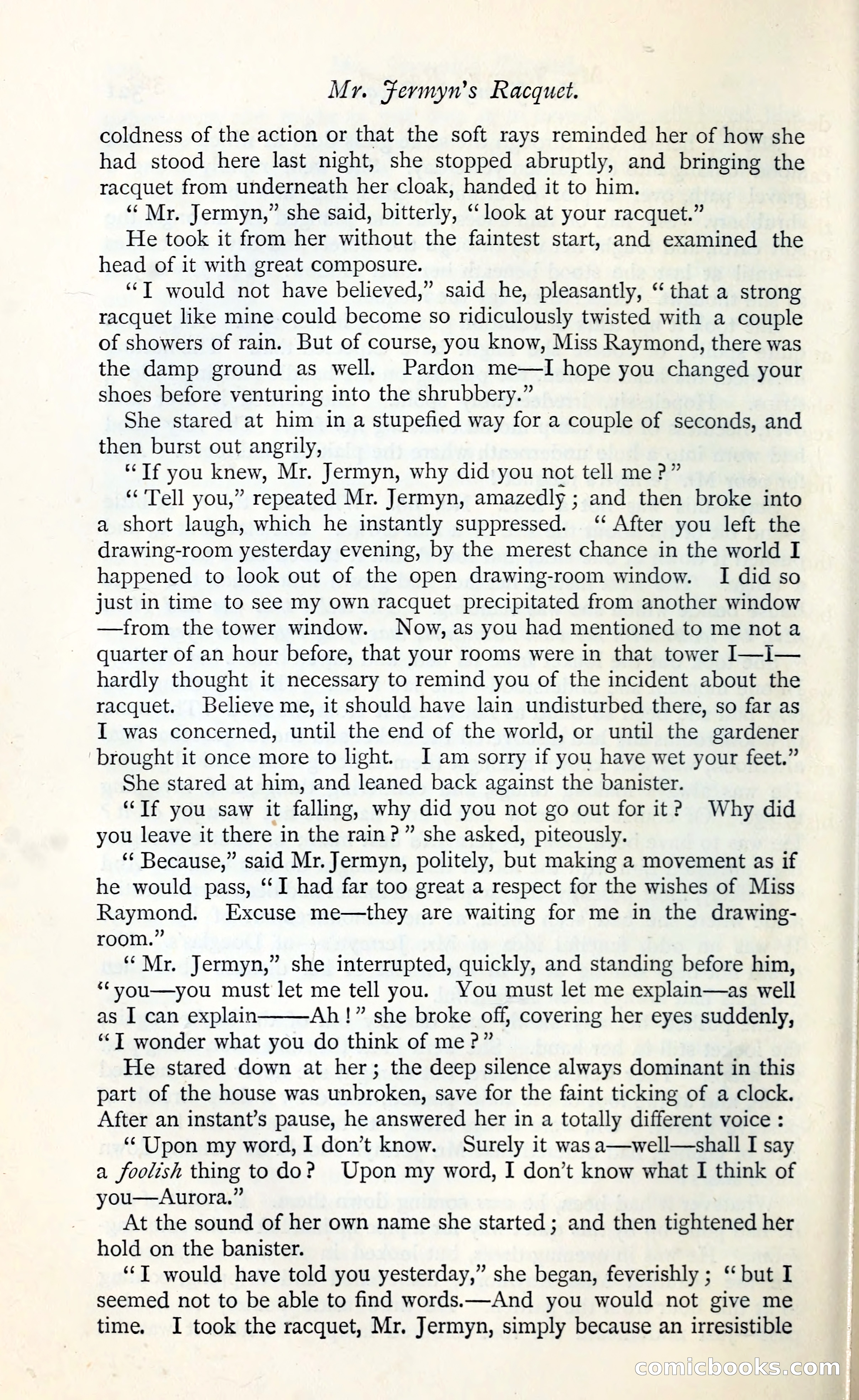
A restored page from Pulp Fiction, 1865. Page through the whole issue in the reader above.
📄 Transcribed text from this page (OCR, searchable)
Machine-transcribed from the original scan — historical spelling and the odd misread are preserved.
Mr. Fermyn’s Racquet. coldness of the action or that the soft rays reminded her of how she had stood here last night, she stopped abruptly, and bringing the racquet from underneath her cloak, handed it to him. ‘‘ Mr. Jermyn,” she said, bitterly, “look at your racquet.” He took it from her without the faintest start, and examined the head of it with great composure. ‘““T would not have believed,” said he, pleasantly, ‘‘ that a strong racquet like mine could become so ridiculously twisted with a couple of showers of rain. But of course, you know, Miss Raymond, there was the damp ground as well. Pardon me—I hope you changed your shoes before venturing into the shrubbery.” She stared at him in a stupefied way for a couple of seconds, and then burst out angrily, “Tf you knew, Mr. Jermyn, why did you not tell me?” “Tell you,” repeated Mr. Jermyn, amazedly ; and then broke into a short laugh, which he instantly suppressed. ‘“‘ After you left the drawing-room yesterday evening, by the merest chance in the world I happened to look out of the open drawing-room window. I did so just in time to see my own racquet precipitated from another window —from the tower window. Now, as you had mentioned to me not a quarter of an hour before, that your rooms were in that tower I—I— hardly thought it necessary to remind you of the incident about the racquet. Believe me, it should have lain undisturbed there, so far as I was concerned, until the end of the world, or until the gardener brought it once more to light. I am sorry if you have wet your feet.” She stared at him, and leaned back against the banister. “Tf you saw it falling, why did you not go out for it? Why did you leave it there in the rain?” she asked, piteously. ‘¢ Because,” said Mr. Jermyn, politely, but making a movement as if he would pass, ‘‘I had far too great a respect for the wishes of Miss Raymond. Excuse me—they are waiting for me in the drawing- room.” “Mr. Jermyn,” she interrupted, quickly, and standing before him, ‘“you—you must let me tell you. You must let me explain—as well as I can explain Ah!” she broke off, covering her eyes suddenly, “T wonder what you do think of me?” He stared down at her; the deep silence always dominant in this part of the house was unbroken, save for the faint ticking of a clock. After an instant’s pause, he answered her in a totally different voice : ‘ Upon my word, I don’t know. Surely it was a—well—shall I say a foolish thing todo? Upon my word, I don’t know what I think of you—Aurora.” At the sound of her own name she started; and then tightened her hold on the banister. ‘T would have told you yesterday,” she began, feverishly ; ‘‘ but I seemed not to be able to find words.—And you would not give me time. I took the racquet, Mr. Jermyn, simply because an irresistible COMMICLOOOKS eC)