
Pulp Fiction, 1865 · page 338 of 400
The Argosy — page 338: what you’re looking at
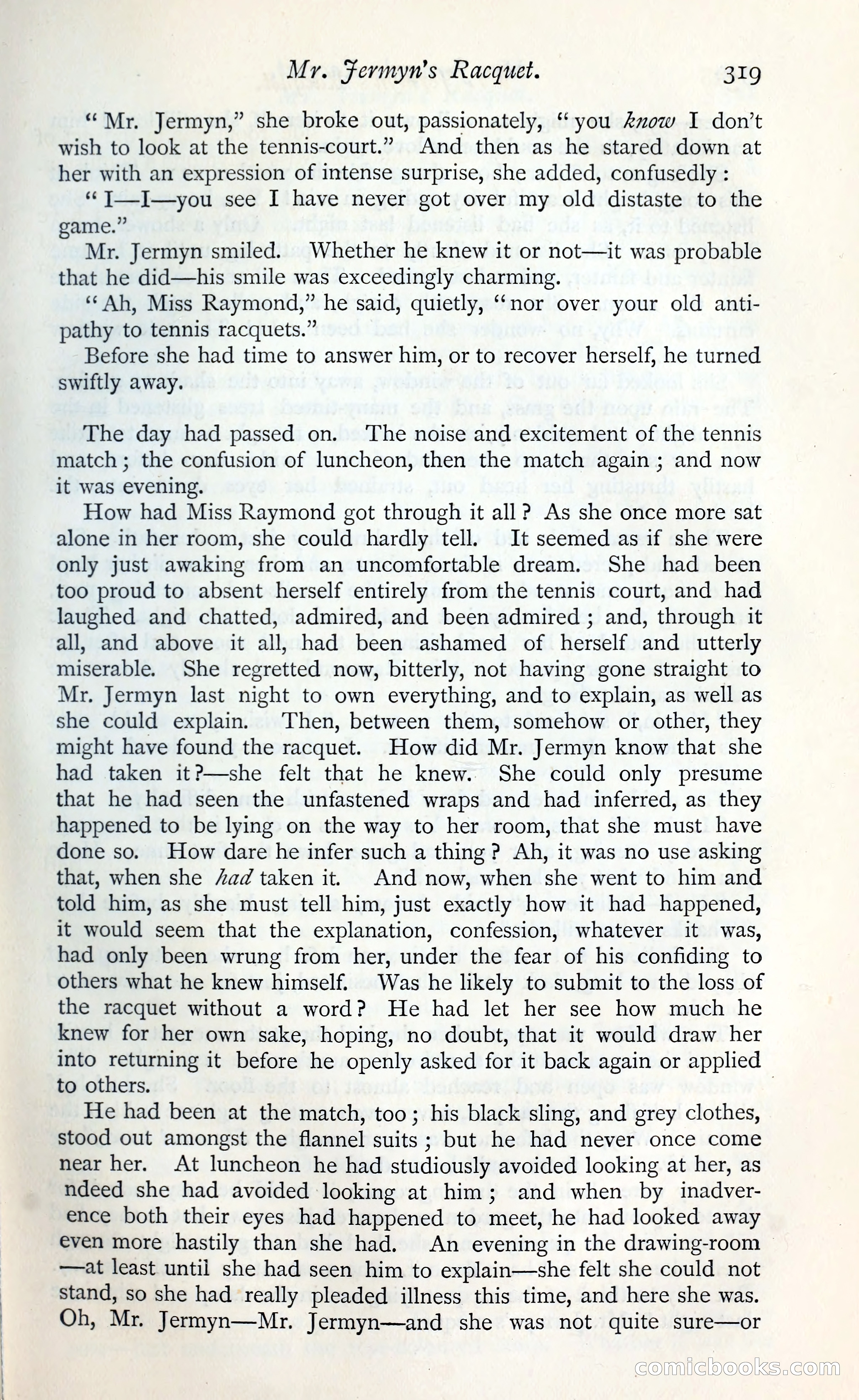
A restored page from Pulp Fiction, 1865. Page through the whole issue in the reader above.
📄 Transcribed text from this page (OCR, searchable)
Machine-transcribed from the original scan — historical spelling and the odd misread are preserved.
Mr. Fermyn’s Racquet. 319 “Mr. Jermyn,” she broke out, passionately, ‘you Asow I don’t wish to look at the tennis-court.” And then as he stared down at her with an expression of intense surprise, she added, confusedly : ‘¢J—J—-you see I have never got over my old distaste to the game.” Mr. Jermyn smiled. Whether he knew it or not—it was probable that he did—his smile was exceedingly charming. ‘* Ah, Miss Raymond,” he said, quietly, ‘‘nor over your old anti- pathy to tennis racquets.” Before she had time to answer him, or to recover herself, he turned swiftly away. The day had passed on. ‘The noise and excitement of the tennis match ; the confusion of luncheon, then the match again; and now it was evening. How had Miss Raymond got through it all ? As she once more sat alone in her room, she could hardly tell. It seemed as if she were only just awaking from an uncomfortable dream. She had been too proud to absent herself entirely from the tennis court, and had laughed and chatted, admired, and been admired ; and, through it all, and above it all, had been ashamed of herself and utterly miserable. She regretted now, bitterly, not having gone straight to Mr. Jermyn last night to own everything, and to explain, as well as she could explain. Then, between them, somehow or other, they might have found the racquet. How did Mr. Jermyn know that she had taken it?—she felt that he knew. She could only presume that he had seen the unfastened wraps and had inferred, as they happened to be lying on the way to her room, that she must have done so. How dare he infer such a thing P Ah, it was no use asking that, when she Aad taken it. And now, when she went to him and told him, as she must tell him, just exactly how it had happened, it would seem that the explanation, confession, whatever it was, had only been wrung from her, under the fear of his confiding to others what he knew himself. Was he likely to submit to the loss of the racquet without a word? He had let her see how much he knew for her own sake, hoping, no doubt, that it would draw her into returning it before he openly asked for it back again or applied ~ to others. He had been at the match, too; his black sling, and grey clothes, stood out amongst the flannel suits; but he had never once come near her. At luncheon he had studiously avoided looking at her, as ndeed she had avoided looking at him; and when by inadver- ence both their eyes had happened to meet, he had looked away €ven more hastily than she had. An evening in the drawing-room —at least until she had seen him to explain—she felt she could not stand, so she had really pleaded illness this time, and here she was. Oh, Mr. Jermyn—Mr. Jermyn—and she was not quite sure—or COnniclooolkks (SO) an