
Pulp Fiction, 1865 · page 313 of 400
The Argosy — page 313: what you’re looking at
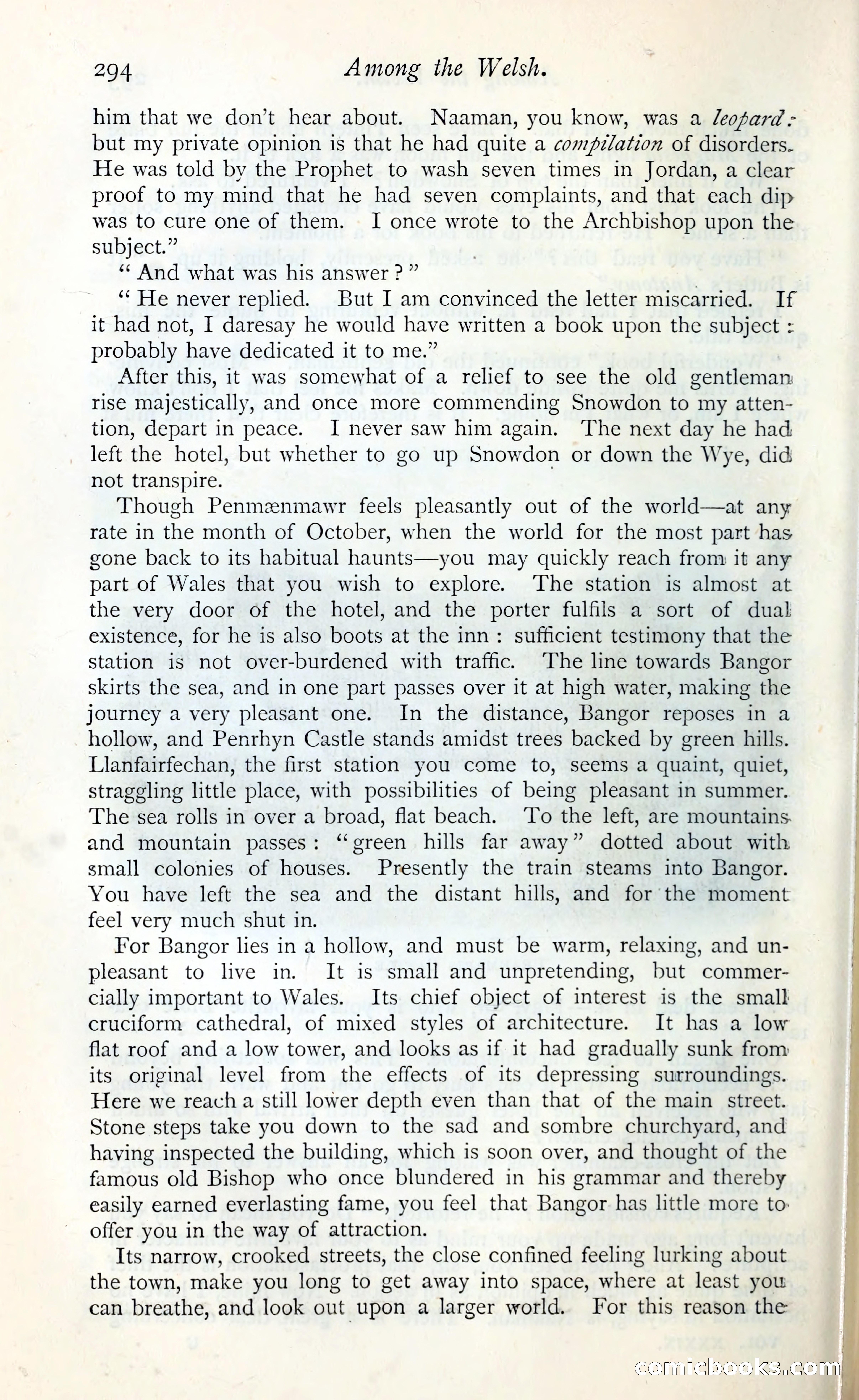
A restored page from Pulp Fiction, 1865. Page through the whole issue in the reader above.
📄 Transcribed text from this page (OCR, searchable)
Machine-transcribed from the original scan — historical spelling and the odd misread are preserved.
294 Among the Welsh. him that we don’t hear about. Naaman, you know, was a leopard - but my private opinion is that he had quite a compz/ation of disorders. He was told by the Prophet to wash seven times in Jordan, a clear proof to my mind that he had seven complaints, and that each dip was to cure one of them. I once wrote to the Archbishop upon the subject.” : ‘And what was his answer ?” ‘He never replied. But I am convinced the letter miscarried. If it had not, I daresay he would Lae written a book upon the subject =: probably have dedicated it to me.’ After this, it was somewhat of a relief to see the old gentleman rise majestically, and once more commending Snowdon to my atten- tion, depart in peace. [I never saw him again. The next day he had left the hotel, but whether to go up Snowdon or down the Wye, did not transpire. Though Penmznmawr feels pleasantly out of the world—at any rate in the month of October, when the world for the most part has gone back to its habitual haunts—you may quickly reach from it any part of Wales that you wish to explore. ‘The station is almost at the very door of the hotel, and the porter fulfils a sort of dual existence, for he is also boots at the inn: sufficient testimony that the Station is not over-burdened with traffic. ‘The line towards Bangor skirts the sea, and in one part passes over it at high water, making the journey a very pleasant one. In the distance, Bangor reposes in a hollow, and Penrhyn Castle stands amidst trees backed by green hills. Lianfairfechan, the first station you come to, seems a quaint, quiet, straggling little place, with possibilities of being pleasant in summer. The sea rolls in over a broad, flat beach. ‘To tte left, are mountains. and mountain passes: ‘‘green hills far away” dotted about with small colonies of houses. Presently the train steams into Bangor. You have left the sea and the distant hills, and for the moment feel very much shut in. For Bangor lies in a hollow, and must be warm, relaxing, and un- pleasant to live in. It is small and unpretending, but commer- cially important to Wales. Its chief object of interest is the small cruciform cathedral, of mixed styles of architecture. It has a low flat roof and a low tower, and looks as if it had gradually sunk from its original level from the effects of its depressing surroundings. Here we reach a still lower depth even than that of the main street. Stone steps take you down to the sad and sombre churchyard, and having inspected the building, which is soon over, and thought of the famous old Bishop who once blundered in his grammar and thereby easily earned everlasting fame, you feel that Bangor has little more to: offer you in the way of attraction. Its narrow, crooked streets, the close confined feeling lurking about the town, make you long to get away into space, where at least you can breathe, and look out upon a larger world. For this reason the CORNIC LOOKS eC)