
Pulp Fiction, 1865 · page 310 of 400
The Argosy — page 310: what you’re looking at
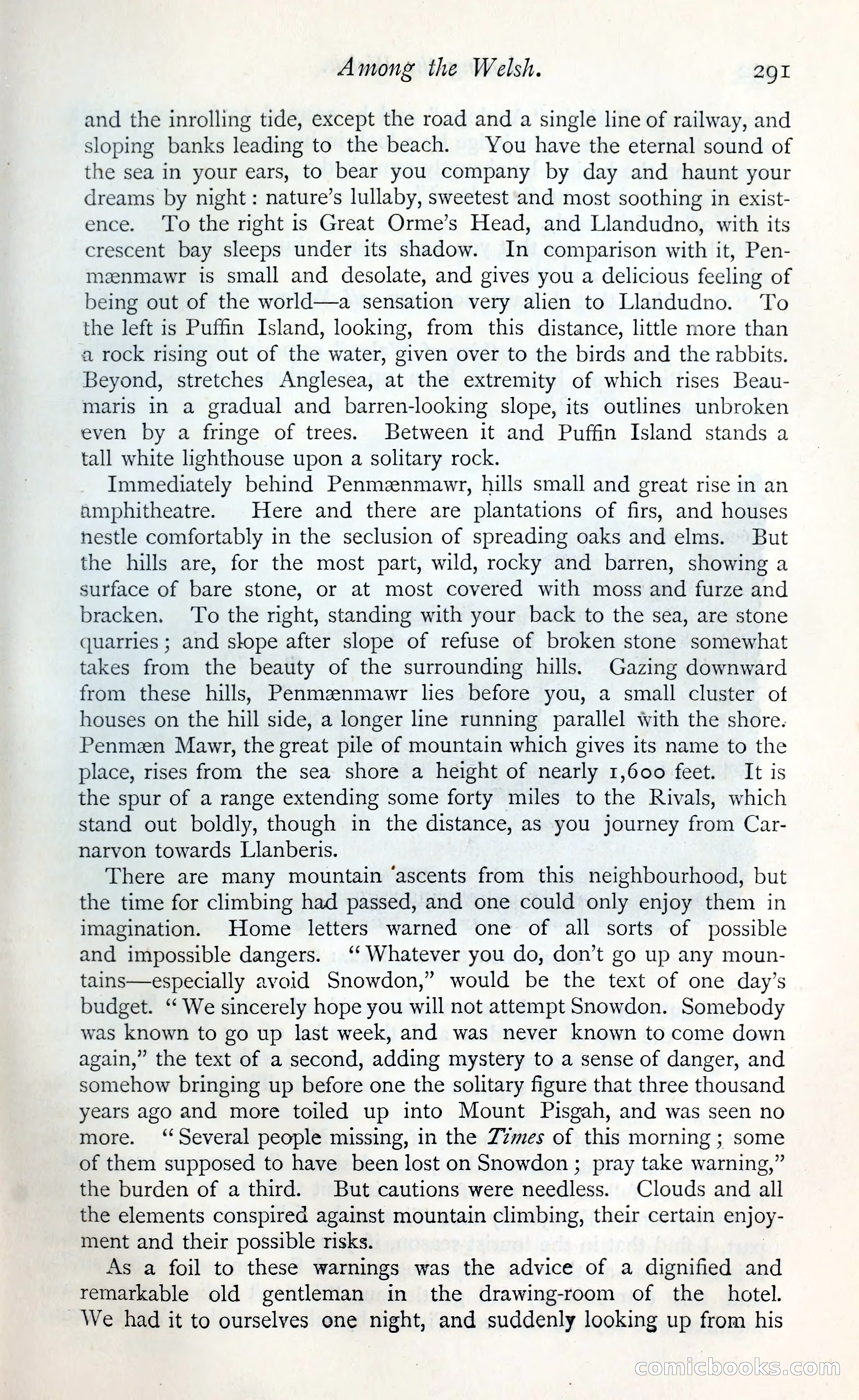
A restored page from Pulp Fiction, 1865. Page through the whole issue in the reader above.
📄 Transcribed text from this page (OCR, searchable)
Machine-transcribed from the original scan — historical spelling and the odd misread are preserved.
Among the Welsh. 2Qg1 and the inrolling tide, except the road and a single line of railway, and sloping banks leading to the beach. You have the eternal sound of the sea in your ears, to bear you company by day and haunt your dreams by night: nature’s lullaby, sweetest and most soothing in exist- ence. To the right is Great Orme’s Head, and Llandudno, with its crescent bay sleeps under its shadow. In comparison with it, Pen- meenmawr is small and desolate, and gives you a delicious feeling of being out of the world—a sensation very alien to Llandudno. To the left is Puffin Island, looking, from this distance, little more than a rock rising out of the water, given over to the birds and the rabbits. Beyond, stretches Anglesea, at the extremity of which rises Beau- maris in a gradual and barren-looking slope, its outlines unbroken even by a fringe of trees. Between it and Puffin Island stands a tall white lighthouse upon a solitary rock. Immediately behind Penmznmawr, hills small and great rise in an amphitheatre. Here and there are plantations of firs, and houses nestle comfortably in the seclusion of spreading oaks and elms. But the hills are, for the most part, wild, rocky and barren, showing a surface of bare stone, or at most covered with moss and furze and bracken. ‘To the right, standing with your back to the sea, are stone quarries ; and slope after slope of refuse of broken stone somewhat takes from the beauty of the surrounding hills. Gazing downward from these hills, Penmzenmawr les before you, a small cluster of houses on the hill side, a longer line running parallel with the shore. Penmzen Mawr, the great pile of mountain which gives its name to the place, rises from the sea shore a height of nearly 1,600 feet. It is the spur of a range extending some forty miles to the Rivals, which stand out boldly, though in the distance, as you journey from Car- narvon towards Llanberis. There are many mountain ‘ascents from this neighbourhood, but the time for climbing had passed, and one could only enjoy them in imagination. Home letters warned one of all sorts of possible and impossible dangers. ‘‘ Whatever you do, don’t go up any moun- tains—especially avoid Snowdon,” would be the text of one day’s budget. ‘“‘ We sincerely hope you will not attempt Snowdon. Somebody was known to go up last week, and was never known to come down again,” the text of a second, adding mystery to a sense of danger, and somehow bringing up before one the solitary figure that three thousand years ago and more toiled up into Mount Pisgah, and was seen no more. ‘Several people missing, in the Zzmes of this morning ; some of them supposed to have been lost on Snowdon ; pray take warning,” the burden of a third. But cautions were needless. Clouds and all the elements conspired against mountain climbing, their certain enjoy- ment and their possible risks. As a foil to these warnings was the advice of a dignified and remarkable old gentleman in the drawing-room of the hotel. We had it to ourselves one night, and suddenly looking up from his COnniclooks (SO) an