
Pulp Fiction, 1865 · page 308 of 400
The Argosy — page 308: what you’re looking at
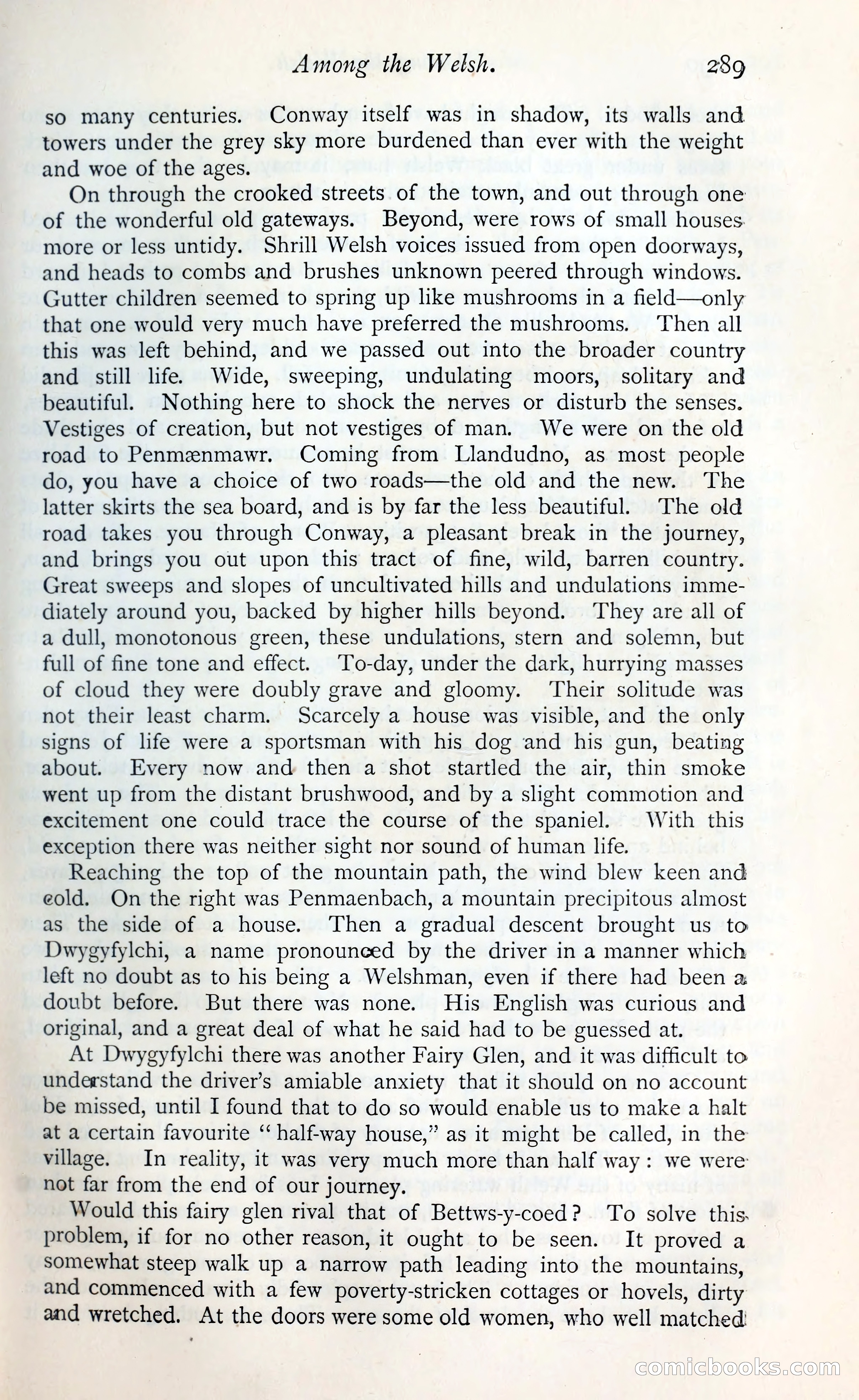
A restored page from Pulp Fiction, 1865. Page through the whole issue in the reader above.
📄 Transcribed text from this page (OCR, searchable)
Machine-transcribed from the original scan — historical spelling and the odd misread are preserved.
Among the Welsh. 289 so many centuries. Conway itself was in shadow, its walls and towers under the grey sky more burdened than ever with the weight and woe of the ages. On through the crooked streets of the town, and out through one of the wonderful old gateways. Beyond, were rows of small houses. more or less untidy. Shrill Welsh voices issued from open doorways, and heads to combs and brushes unknown peered through windows. Gutter children seemed to spring up like mushrooms in a field—only that one would very much have preferred the mushrooms. ‘Then all this was left behind, and we passed out into the broader country and still life. Wide, sweeping, undulating moors, solitary and beautiful. Nothing here to shock the nerves or disturb the senses. Vestiges of creation, but not vestiges of man. We were on the old road to Penmzenmawr. Coming from Llandudno, as most people do, you have a choice of two roads—the old and the new. The latter skirts the sea board, and is by far the less beautiful. The old road takes you through Conway, a pleasant break in the journey, and brings you out upon this tract of fine, wild, barren country. Great sweeps and slopes of uncultivated hills and undulations imme- diately around you, backed by higher hills beyond. They are all of a dull, monotonous green, these undulations, stern and solemn, but full of fine tone and effect. To-day, under the dark, hurrying masses of cloud they were doubly grave and gloomy. ‘Their solitude was not their least charm. Scarcely a house was visible, and the only signs of life were a sportsman with his dog and his gun, beating about. Every now and then a shot startled the air, thin smoke went up from the distant brushwood, and by a slight commotion and excitement one could trace the course of the spaniel. With this exception there was neither sight nor sound of human life. Reaching the top of the mountain path, the wind blew keen and eold. On the right was Penmaenbach, a mountain precipitous almost as the side of a house. ‘Then a gradual descent brought us to Dwygyfylchi, a name pronounced by the driver in a manner which left no doubt as to his being a Welshman, even if there had been a doubt before. But there was none. His English was curious and original, and a great deal of what he said had to be guessed at. At Dwygyfylchi there was another Fairy Glen, and it was difficult to understand the driver’s amiable anxiety that it should on no account be missed, until I found that to do so would enable us to make a halt at a certain favourite “‘ half-way house,” as it might be called, in the village. In reality, it was very much more than half way: we were not far from the end of our journey. Would this fairy glen rival that of Bettws-y-coed? To solve this. problem, if for no other reason, it ought to be seen. It proved a somewhat steep walk up a narrow path leading into the mountains, and commenced with a few poverty-stricken cottages or hovels, dirty and wretched. At the doors were some old women, who well matched: CORNICLOOO© cS (SO) am