
Pulp Fiction, 1865 · page 274 of 400
The Argosy — page 274: what you’re looking at
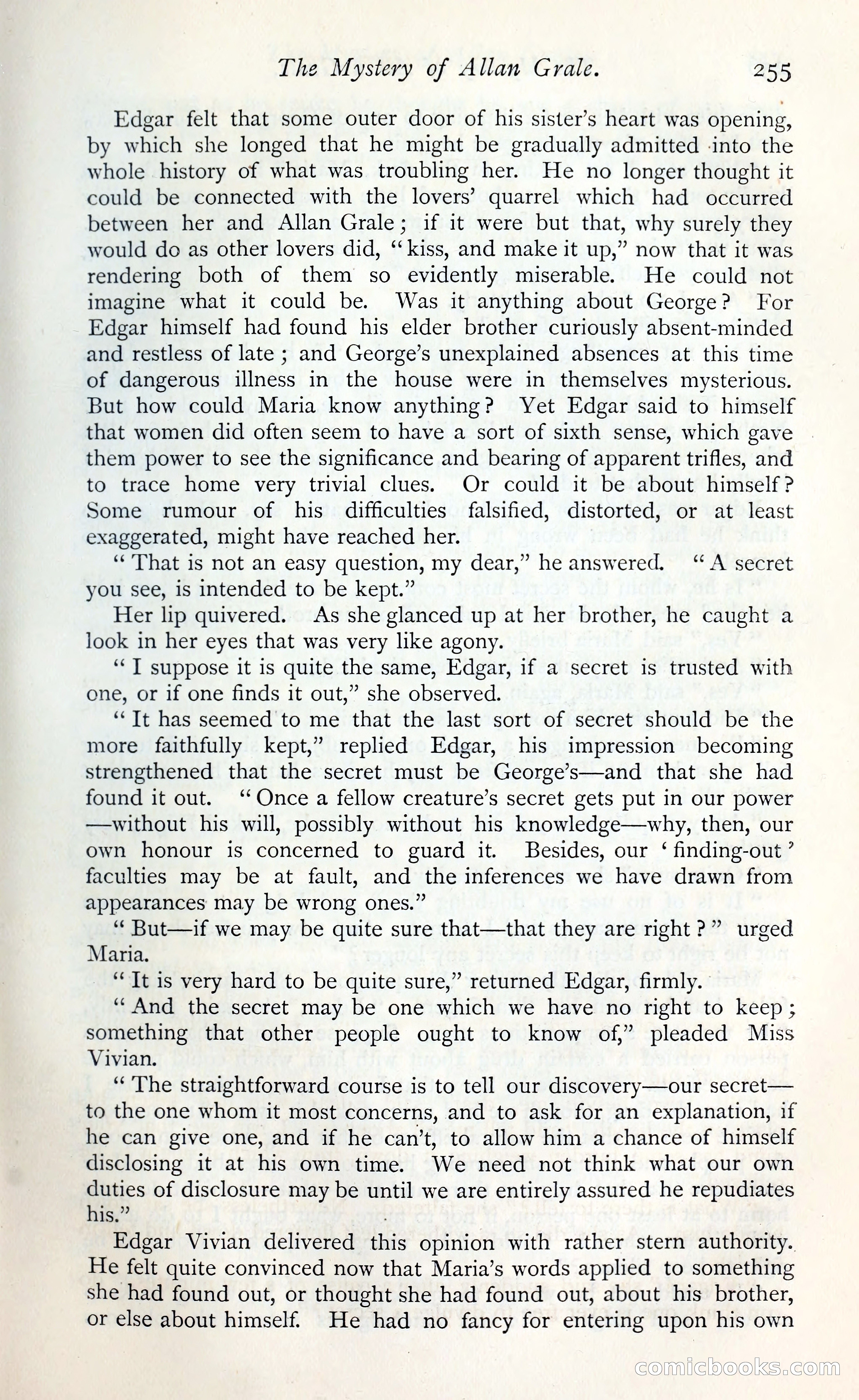
A restored page from Pulp Fiction, 1865. Page through the whole issue in the reader above.
📄 Transcribed text from this page (OCR, searchable)
Machine-transcribed from the original scan — historical spelling and the odd misread are preserved.
The Mystery of Allan Grale. 255 Edgar felt that some outer door of his sister’s heart was opening, by which she longed that he might be gradually admitted into the whole history of what was troubling her. He no longer thought it could be connected with the lovers’ quarrel which had occurred between her and Allan Grale; if it were but that, why surely they would do as other lovers did, ‘‘ kiss, and make it up,” now that it was rendering both of them so evidently miserable. He could not imagine what it could be. Was it anything about George? For Edgar himself had found his elder brother curiously absent-minded and restless of late ; and George’s unexplained absences at this time of dangerous illness in the house were in themselves mysterious. But how could Maria know anything? Yet Edgar said to himself that women did often seem to have a sort of sixth sense, which gave them power to see the significance and bearing of apparent trifles, and to trace home very trivial clues. Or could it be about himself? Some rumour of his difficulties falsified, distorted, or at least exaggerated, might have reached her. ‘That is not an easy question, my dear,” he answered. “A secret you see, is intended to be kept.” Her lip quivered. As she glanced up at her brother, he caught a look in her eyes that was very like agony. ‘““T suppose it is quite the same, Edgar, if a secret is trusted with one, or if one finds it out,” she observed. “It has seemed to me that the last sort of secret should be the more faithfully kept,” replied Edgar, his impression becoming strengthened that the secret must be George’s—and that she had found it out. ‘Once a fellow creature’s secret gets put in our power —without his will, possibly without his knowledge—why, then, our own honour is concerned to guard it. Besides, our ‘ finding-out ’ faculties may be at fault, and the inferences we have drawn from appearances may be wrong ones.” ‘“‘ But—if we may be quite sure that—that they are right ?” urged Maria. “It is very hard to be quite sure,” returned Edgar, firmly. ‘“And the secret may be one which we have no right to keep; something that other people ought to know of,” pleaded Miss Vivian. “The straightforward course is to tell our discovery—our secret— to the one whom it most concerns, and to ask for an explanation, if he can give one, and if he can’t, to allow him a chance of himself disclosing it at his own time. We need not think what our own duties of disclosure may be until we are entirely assured he repudiates his.” 3 Edgar Vivian delivered this opinion with rather stern authority. He felt quite convinced now that Maria’s words applied to something she had found out, or thought she had found out, about his brother, or else about himself. He had no fancy for entering upon his own COmicoooks.c©