
Pulp Fiction, 1865 · page 260 of 400
The Argosy — page 260: what you’re looking at
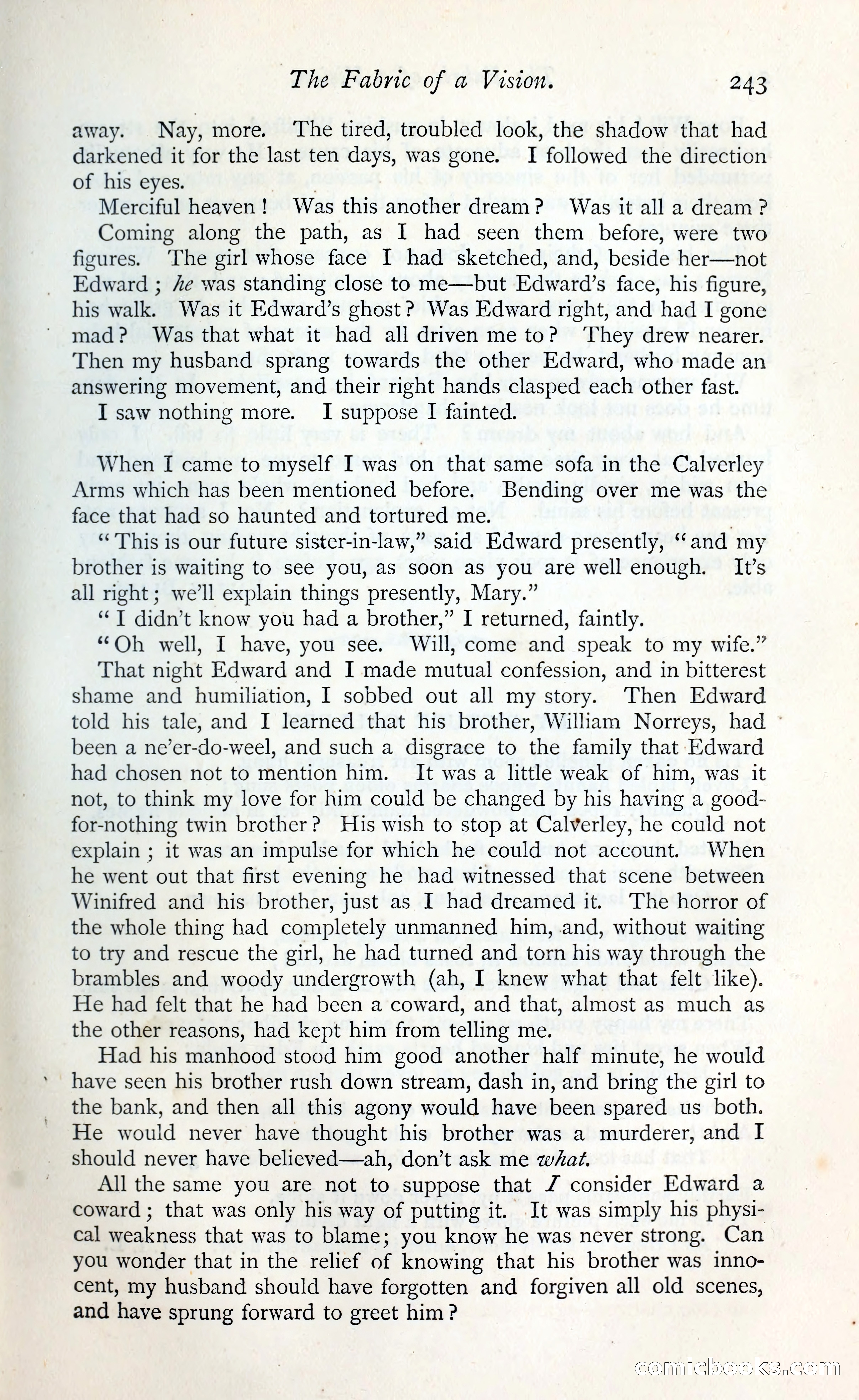
A restored page from Pulp Fiction, 1865. Page through the whole issue in the reader above.
📄 Transcribed text from this page (OCR, searchable)
Machine-transcribed from the original scan — historical spelling and the odd misread are preserved.
The Fabric of a Vision. 243 away. Nay, more. The tired, troubled look, the shadow that had darkened it for the last ten days, was gone. I followed the direction of his eyes. , Merciful heaven! Was this another dream? Was it all a dream? Coming along the path, as I had seen them before, were two figures. The girl whose face I had sketched, and, beside her—not Edward ; Ae was standing close to me—but Edward’s face, his figure, his walk. Was it Edward’s ghost? Was Edward right, and had I gone mad? Was that what it had all driven meto? ‘They drew nearer. Then my husband sprang towards the other Edward, who made an answering movement, and their right hands clasped each other fast. I saw nothing more. I suppose I fainted. When I came to myself I was on that same sofa in the Calverley Arms which has been mentioned before. Bending over me was the face that had so haunted and tortured me. | “This is our future sister-in-law,” said Edward presently, ‘and my brother is waiting to see you, as soon as you are well enough. It’s all right; we’ll explain things presently, Mary.” “T didn’t know you had a brother,” I returned, faintly. “Oh well, I have, you see. Will, come and speak to my wife.” That night Edward and I made mutual confession, and in bitterest shame and humiliation, I sobbed out all my story. Then Edward told his tale, and I learned that his brother, William Norreys, had © been a ne’er-do-weel, and such a disgrace to the family that Edward had chosen not to mention him. It wasa little weak of him, was it not, to think my love for him could be changed by his having a good- for-nothing twin brother? His wish to stop at Calverley, he could not explain ; it was an impulse for which he could not account. When he went out that first evening he had witnessed that scene between Winifred and his brother, just as I had dreamed it. ‘The horror of the whole thing had completely unmanned him, and, without waiting to try and rescue the girl, he had turned and torn his way through the brambles and woody undergrowth (ah, I knew what that felt like). He had felt that he had been a coward, and that, almost as much as the other reasons, had kept him from telling me. Had his manhood stood him good another half minute, he would have seen his brother rush down stream, dash in, and bring the girl to the bank, and then all this agony would have been spared us both. He would never have thought his brother was a murderer, and I should never have believed—ah, don’t ask me what. All the same you are not to suppose that / consider Edward a coward ; that was only his way of putting it. It was simply his physi- cal weakness that was to blame; you know he was never strong. Can you wonder that in the relief of knowing that his brother was inno- cent, my husband should have forgotten and forgiven all old scenes, and have sprung forward to greet him? COMICDOOKS (SO)