
Pulp Fiction, 1865 · page 239 of 400
The Argosy — page 239: what you’re looking at
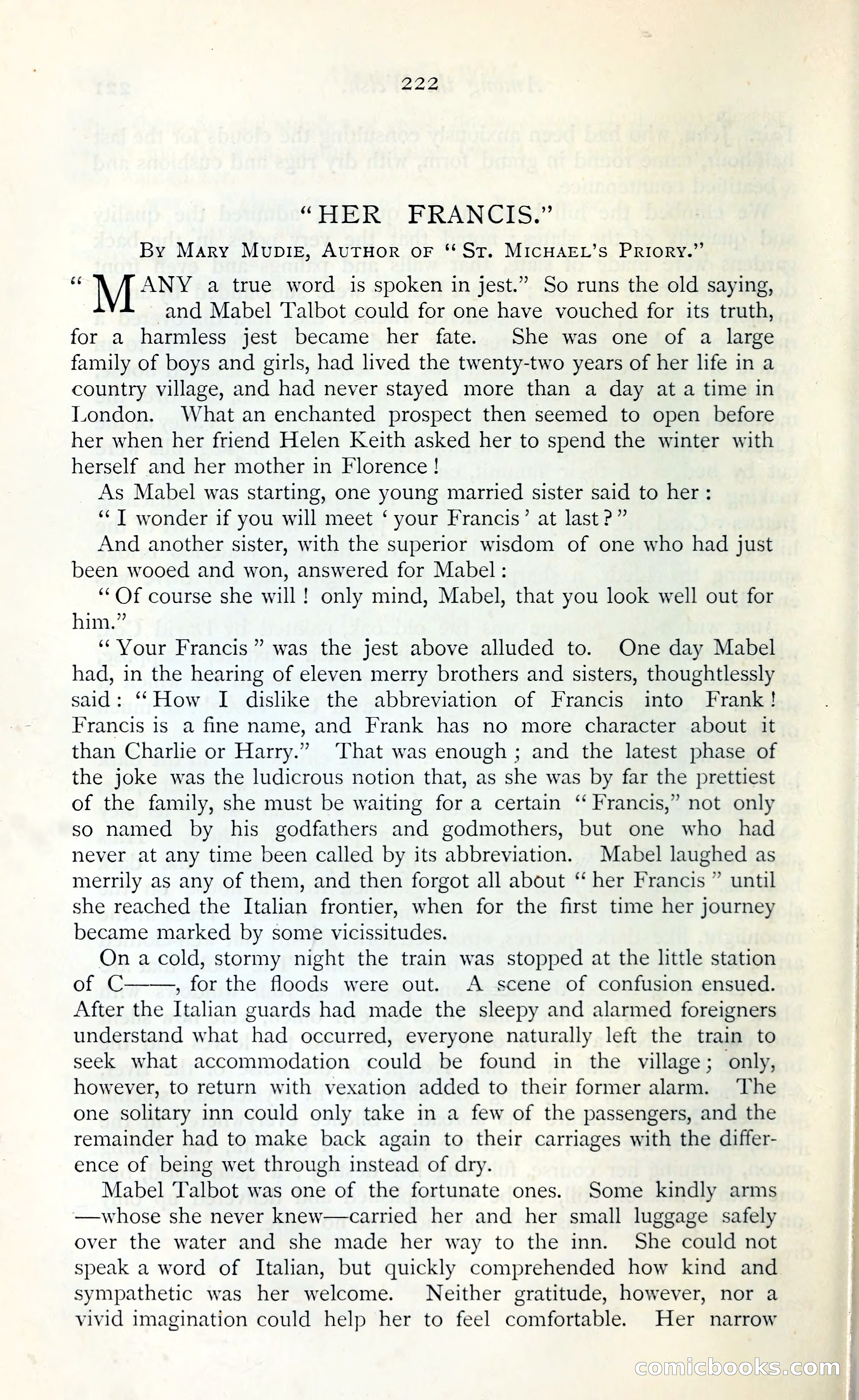
A restored page from Pulp Fiction, 1865. Page through the whole issue in the reader above.
📄 Transcribed text from this page (OCR, searchable)
Machine-transcribed from the original scan — historical spelling and the odd misread are preserved.
222, “HER FRANCIS.” By Mary Mupi£e, AuTHOR oF ** St. MICHAEL’S PRIORY.”’ es MAY a true word is spoken in jest.” So runs the old saying, -and Mabel Talbot could for one have vouched for its truth, for a harmless jest became her fate. She was one of a large family of boys and girls, had lived the twenty-two years of her life in a country village, and had never stayed more than a day ata time in Tondon. What an enchanted prospect then seemed to open before her when her friend Helen Keith asked her to spend the winter with herself and her mother in Florence! As Mabel was starting, one young married sister said to her: “Tl wonder if you will meet ‘ your Francis’ at last ?” And another sister, with the superior wisdom of one who had just been wooed and won, answered for Mabel: “Of course she will! only mind, Mabel, that you look well out for him.” “Your Francis” was the jest above alluded to. One day Mabel had, in the hearing of eleven merry brothers and sisters, thoughtlessly said: ‘‘How I dislike the abbreviation of Francis into Frank! Francis is a fine name, and Frank has no more character about it than Charlie or Harry.” ‘That was enough ; and the latest phase of the joke was the ludicrous notion that, as she was by far the prettiest of the family, she must be waiting for a certain “ Francis,” not only so named by his godfathers and godmothers, but one who had never at any time been called by its abbreviation. Mabel laughed as merrily as any of them, and then forgot all about “ her Francis ” until she reached the Italian frontier, when for the first time her journey became marked by some vicissitudes. On a cold, stormy night the train was stopped at the little station of C——, for the floods were out. A scene of confusion ensued. After the Italian guards had made the sleepy and alarmed foreigners understand what had occurred, everyone naturally left the train to seek what accommodation could be found in the village; only, however, to return with vexation added to their former alarm. ‘The one solitary inn could only take in a few of the passengers, and the remainder had to make back again to their carriages with the differ- ence of being wet through instead of dry. Mabel Talbot was one of the fortunate ones. Some kindly arms —whose she never knew—carried her and her small luggage safely over the water and she made her way to the inn. She could not speak a word of Italian, but quickly comprehended how kind and sympathetic was her welcome. Neither gratitude, however, nor a vivid imagination could help her to feel comfortable. Her narrow EOMIGIOOKS (EO) aa)