
Pulp Fiction, 1865 · page 196 of 400
The Argosy — page 196: what you’re looking at
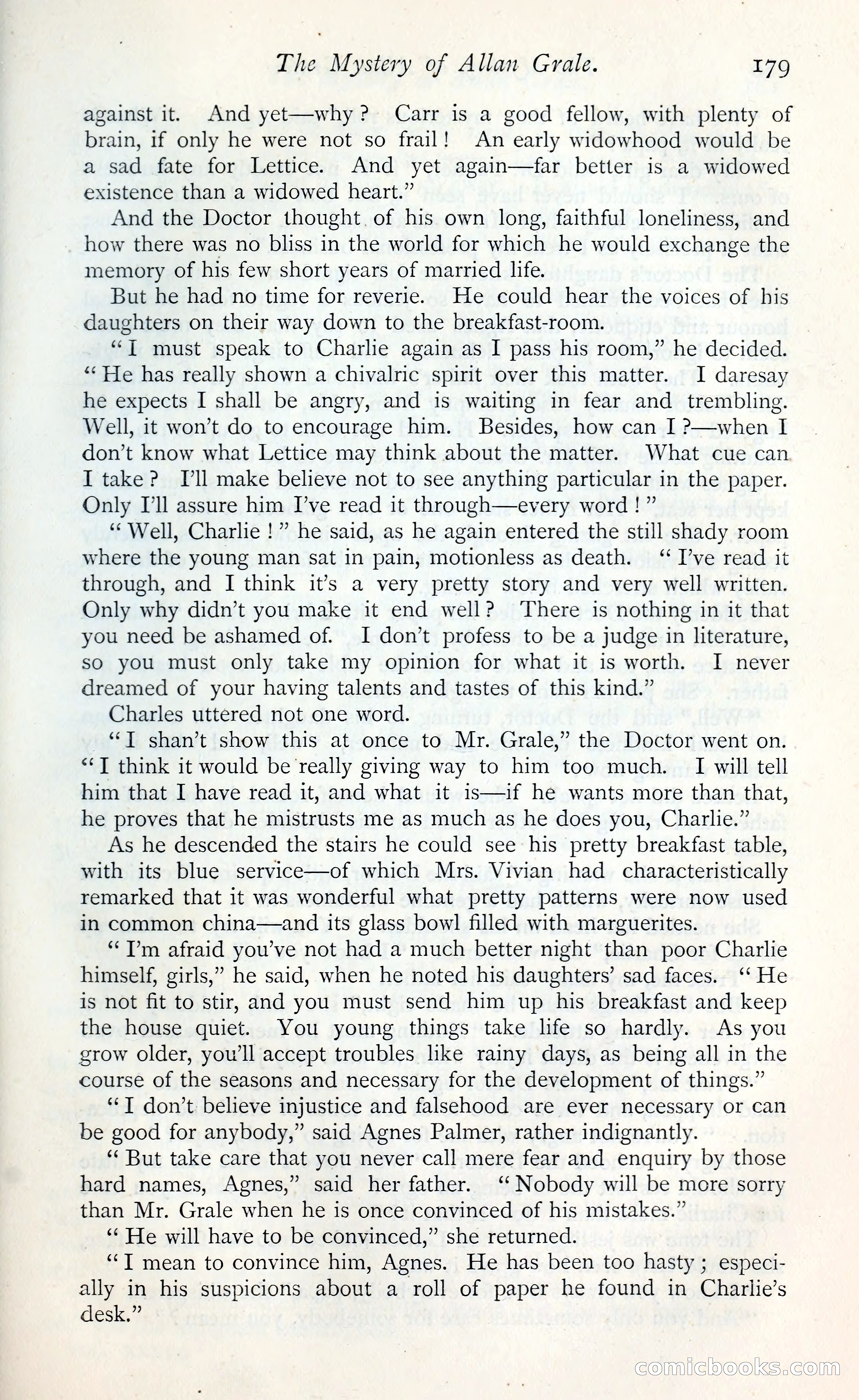
A restored page from Pulp Fiction, 1865. Page through the whole issue in the reader above.
📄 Transcribed text from this page (OCR, searchable)
Machine-transcribed from the original scan — historical spelling and the odd misread are preserved.
The Mystery of Allan Grale. 179 against it And yet—why? Carr is a good fellow, with plenty of brain, if only he were not so frail! An early widowhood would be a sad fate for Lettice. And yet again—far better is a widowed existence than a widowed heart.” And the Doctor thought. of his own long, faithful loneliness, and how there was no bliss in the world for which he would exchange the memory of his few short years of married life. But he had no time for reverie. He could hear the voices of his daughters on their way down to the breakfast-room. “| must speak to Charlie again as I pass his room,” he decided. “He has really shown a chivalric spirit over this matter. I daresay he expects I shall be angry, and is waiting in fear and trembling. Well, it won’t do to encourage him. Besides, how can I ?—when | don’t know what Lettice may think about the matter. What cue can I take? Ill make believe not to see anything particular in the paper. Only I'll assure him I’ve read it through—every word ! ” ‘Well, Charlie!” he said, as he again entered the still shady room where the young man sat in pain, motionless as death. “I’ve read it through, and I think it’s a very pretty story and very well written. Only why didn’t you make it end well? There is nothing in it that you need be ashamed of. I don’t profess to be a judge in literature, so you must only take my opinion for what it is worth. I never dreamed of your having talents and tastes of this kind.” Charles uttered not one word. ~“T shan’t show this at once to Mr. Grale,” the Doctor went on. **J think it would be really giving way to him too much. I will tell him that I have read it, and what it is—if he wants more than that, he proves that he mistrusts me as much as he does you, Charlie.” As he descended the stairs he could see his pretty breakfast table, with its blue service—of which Mrs. Vivian had characteristically remarked that it was wonderful what pretty patterns were now used in common china—and its glass bowl filled with marguerites. “T’m afraid you’ve not had a much better night than poor Charlie himself, girls,” he said, when he noted his daughters’ sad faces. ‘“‘ He is not fit to stir, and you must send him up his breakfast and keep the house quiet. You young things take hfe so hardly. As you grow older, yow'll accept troubles like rainy days, as being all in the course of the seasons and necessary for the development of things.” ‘“‘T don’t believe injustice and falsehood are ever necessary or can be good for anybody,” said Agnes Palmer, rather indignantly. “ But take care that you never call mere fear and enquiry by those hard names, Agnes,” said her father. ‘‘ Nobody will be more sorry than Mr. Grale when he is once convinced of his mistakes.” : ‘“‘ He will have to be convinced,” she returned. ‘‘T mean to convince him, Agnes. He has been too hasty ; especi- ally in his suspicions about a roll of paper he found in Charlie’s desk.” CORnNIClOOKS (CO)