
Pulp Fiction, 1865 · page 156 of 400
The Argosy — page 156: what you’re looking at
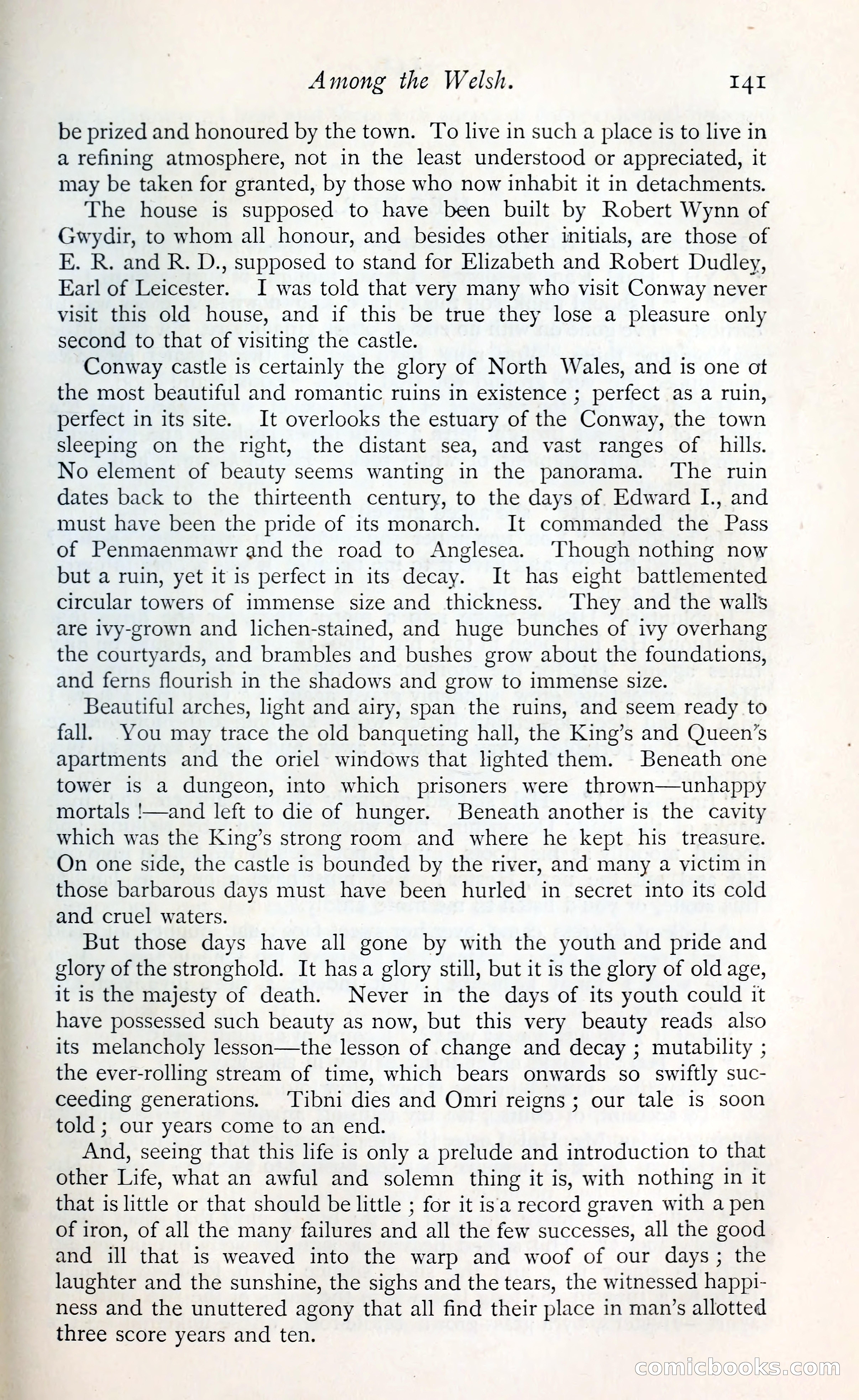
A restored page from Pulp Fiction, 1865. Page through the whole issue in the reader above.
📄 Transcribed text from this page (OCR, searchable)
Machine-transcribed from the original scan — historical spelling and the odd misread are preserved.
Among the Welsh. I4I be prized and honoured by the town. To live in such a place is to live in a refining atmosphere, not in the least understood or appreciated, it may be taken for granted, by those who now inhabit it in detachments. The house is supposed to have been built by Robert Wynn of Gwydir, to whom all honour, and besides other initials, are those of E. R. and R. D., supposed to stand for Elizabeth and a ee Dudley, Earl of Peter. I was told that very many who visit Conway never visit this old house, and if this be true they lose a pleasure only second to that of visiting the castle. Conway castle is certainly the glory of North Wales, and is one ot the most beautiful and romantic ruins in existence ; perfect as a ruin, perfect in its site. It overlooks the estuary of the Conway, the town sleeping on the right, the distant sea, and vast ranges of hills. No element of beauty seems wanting in the panorama. ‘The ruin dates back to the thirteenth century, to the days of. Edward I., and must have been the pride of its monarch. It commanded the Pass of Penmaenmawr and the road to Anglesea. ‘Though nothing now but a ruin, yet it is perfect in its decay. It has eight battlemented circular towers of immense size and thickness. They and the walls are ivy-grown and lichen-stained, and huge bunches of ivy overhang the courtyards, and brambles and bushes grow about the foundations, and ferns flourish in the shadows and grow to immense size. Beautiful arches, light and airy, span the ruins, and seem ready to fall. You may trace the old banqueting hall, the King’s and Queen’s apartments and the oriel windows that hghted them. Beneath one tower is a dungeon, into which prisoners were thrown—unhappy mortals !—and left to die of hunger. Beneath another is the cavity which was the King’s strong room and where he kept his treasure. On one side, the castle is bounded by the river, and many a victim in those barbarous days must have been hurled in secret into its cold and cruel waters. But those days have all gone by with the youth and pride and glory of the stronghold. It hasa glory still, but it is the glory of old age, it is the majesty of death. Never in the days of its youth could it have possessed such beauty as now, but this very beauty reads also its melancholy lesson—the lesson of change and decay ; mutability ; the ever-rolling stream of time, which bears onwards so swiftly suc- ceeding generations. ‘Tibni dies and Omri reigns; our tale is soon told; our years come to an end. And, seeing that this life is only a prelude and introduction to that other Life, what an awful and solemn thing it is, with nothing in it that is little or that should be little ; for it isa record graven with a pen of iron, of all the many failures and all the few successes, all the good. and ill that is weaved into the warp and woof of our days; the laughter and the sunshine, the sighs and the tears, the witnessed happi- ness and the unuttered agony that all find their place in man’s allotted three score years and ten. GoOmlGoaooks (SO