
Pulp Fiction, 1865 · page 114 of 400
The Argosy — page 114: what you’re looking at
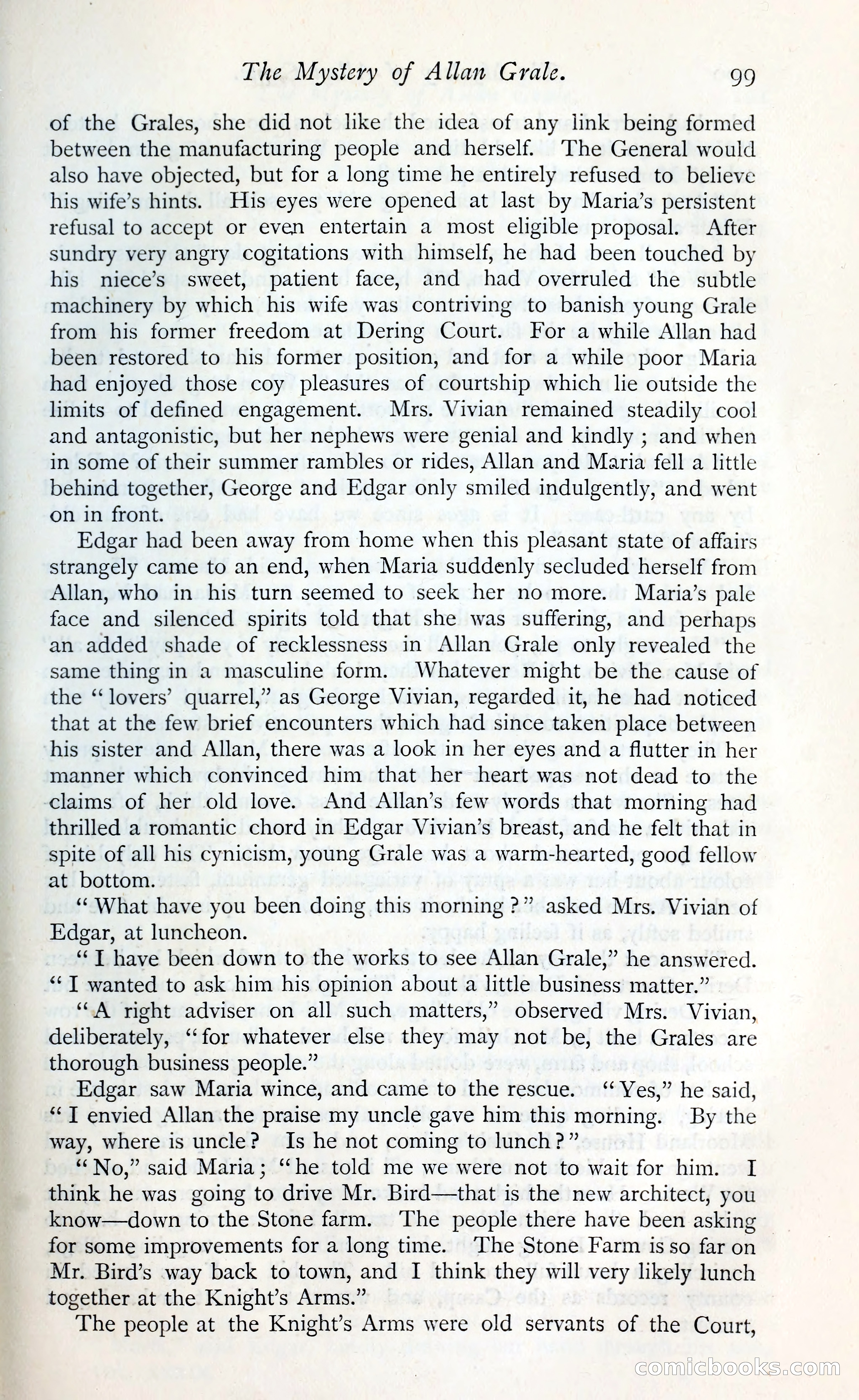
A restored page from Pulp Fiction, 1865. Page through the whole issue in the reader above.
📄 Transcribed text from this page (OCR, searchable)
Machine-transcribed from the original scan — historical spelling and the odd misread are preserved.
The Mystery of Allan Grale. 99 of the Grales, she did not like the idea of any link being formed between the manufacturing people and herself. ‘The General would also have objected, but for a long time he entirely refused to believe his wife’s hints. His eyes were opened at last by Maria’s persistent refusal to accept or even entertain a most eligible proposal. After sundry very angry cogitations with himself, he had been touched by his niece’s sweet, patient face, and had overruled the subtle machinery by which his wife was contriving to banish young Grale from his former freedom at Dering Court. For a while Allan had been restored to his former position, and for a while poor Maria had enjoyed those coy pleasures of courtship which le outside the limits of defined engagement. Mrs. Vivian remained steadily cool and antagonistic, but her nephews were genial and kindly ; and when in some of their summer rambles or rides, Allan and Maria fell a little behind together, George and Edgar only smiled indulgently, and went on in front. Edgar had been away from home when this pleasant state of affairs strangely came to an end, when Maria suddenly secluded herself from Allan, who in his turn seemed to seek her no more. Maria’s pale face and silenced spirits told that she was suffering, and perhaps an added shade of recklessness in Allan Grale only revealed the same thing in a masculine form. Whatever might be the cause of the “ lovers’ quarrel,” as George Vivian, regarded it, he had noticed that at the few brief encounters which had since taken place between his sister and Allan, there was a look in her eyes and a flutter in her manner which convinced him that her heart was not dead to the claims of her old love. And Allan’s few words that morning had thrilled a romantic chord in Edgar Vivian’s breast, and he felt that in spite of all his cynicism, young Grale was a warm-hearted, good fellow at bottom. ‘What have you been doing this morning ?” asked Mrs. Vivian of Edgar, at luncheon. ‘‘T have been down to the works to see Allan Grale,” he answered. ‘* ] wanted to ask him his opinion about a little business matter.” ‘“A right adviser on all such matters,” observed Mrs. Vivian, deliberately, ‘“‘for whatever else they may not be, the Grales are thorough business people.” Edgar saw Maria wince, and came to the rescue. ‘‘ Yes,” he said, “‘T envied Allan the praise my uncle gave him this morning. By the way, where is uncle? Is he not coming to lunch?” “No,” said Maria; ‘“‘he told me we were not to wait for him. I think he was going to drive Mr. Bird—that is the new architect, you know—down to the Stone farm. The people there have been asking for some improvements for a long time. ‘The Stone Farm is so far on Mr. Bird’s way back to town, and I think they will very likely lunch together at the Knight’s Arms.” The people at the Knight’s Arms were old servants of the Court, CORDNICLIOO <S (SO)