
Pulp Fiction, 1865 · page 108 of 400
The Argosy — page 108: what you’re looking at
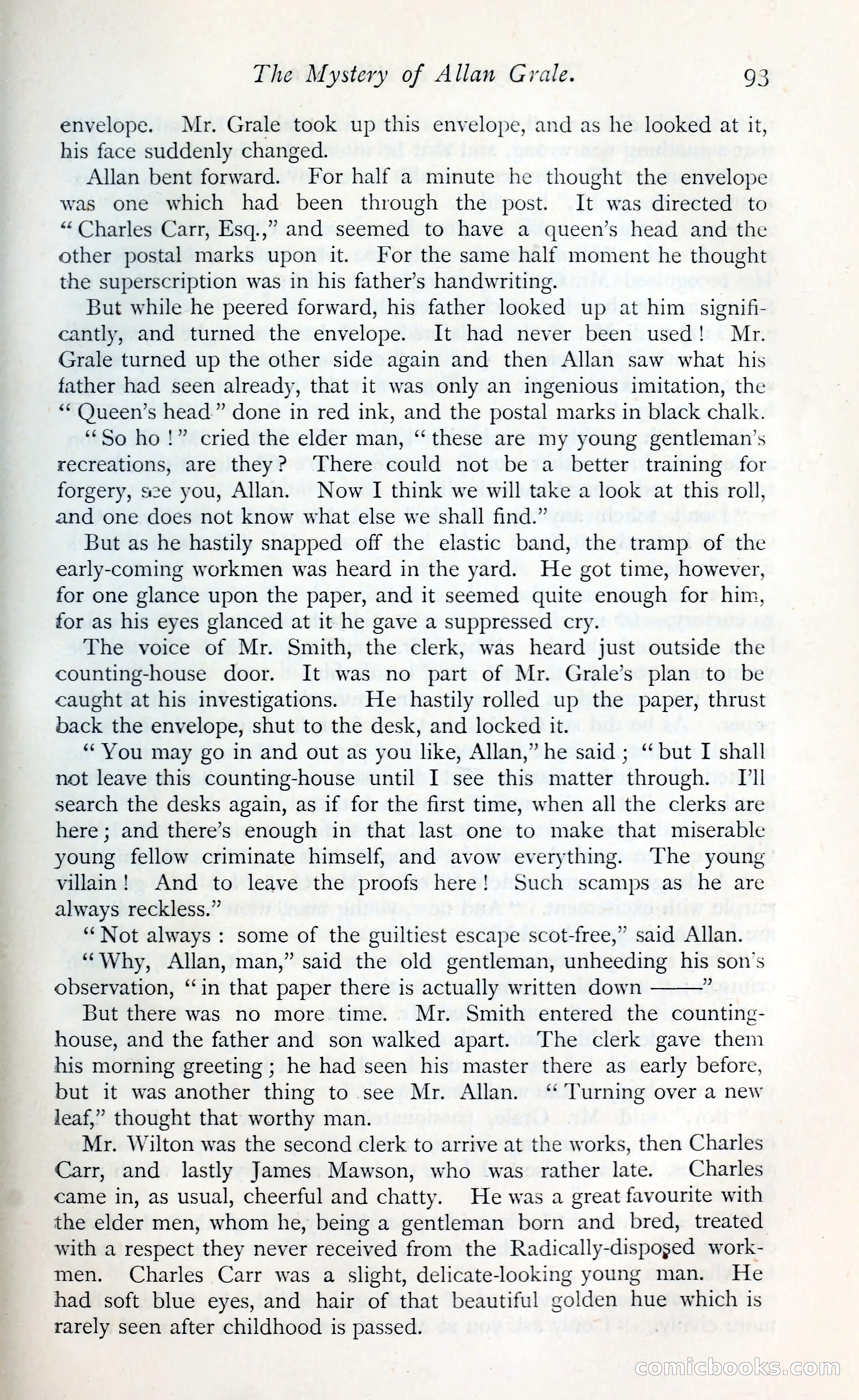
A restored page from Pulp Fiction, 1865. Page through the whole issue in the reader above.
📄 Transcribed text from this page (OCR, searchable)
Machine-transcribed from the original scan — historical spelling and the odd misread are preserved.
The Mystery of Allan Grale. 93 envelope. Mr. Grale took up this envelope, and as he looked at it, his face suddenly changed. Allan bent forward. For half a minute he thought the envelope was one which had been through the post. It was directed to “Charles Carr, Esq.,” and seemed to have a queen’s head and the other postal marks upon it. For the same half moment he thought the superscription was in his father’s handwriting. But while he peered forward, his father looked up at him signifi- cantly, and turned the envelope. It had never been used! Mr. Grale turned up the other side again and then Allan saw what his father had seen already, that it was only an ingenious imitation, the ““Queen’s head.” done in red ink, and the postal marks in black chalk. ‘So ho!” cried the elder man, ‘‘ these are my young gentleman’s recreations, are they? ‘There could not be a better training for forgery, see you, Allan. Now I think we will take a look at this roll, and one does not know what else we shall find.” But as he hastily snapped off the elastic band, the tramp of the early-coming workmen was heard in the yard. He got time, however, for one glance upon the paper, and it seemed quite enough for him, for as his eyes glanced at it he gave a suppressed cry. The voice of Mr. Smith, the clerk, was heard just outside the counting-house door. It was no part of Mr. Grale’s plan to be caught at his investigations. He hastily rolled up the paper, thrust back the envelope, shut to the desk, and locked it. “You may go in and out as you like, Allan,” he said ; * but I shall not leave this counting-house until I see this matter through. [ll search the desks again, as if for the first time, when all the clerks are here ; and there’s enough in that last one to make that miserable young fellow criminate himself, and avow everything. The young villain! And to leave the proofs here! Such scamps as he are always reckless.” “Not always: some of the guiltiest escape scot-free,” said Allan. “Why, Allan, man,” said the old gentleman, unheeding his son’s observation, ‘‘in that paper there is actually written down ———” But there was no more time. Mr. Smith entered the counting- house, and the father and son walked apart. The clerk gave them his morning greeting ; he had seen his master there as early before, but it was another thing to see Mr. Allan. ‘“ Turning over a new leaf,” thought that worthy man. Mr. Wilton was the second clerk to arrive at the works, then Charles Carr, and lastly James Mawson, who was rather late. Charles came in, as usual, cheerful and chatty. He was a great favourite with the elder men, whom he, being a gentleman born and bred, treated with a respect they never received from the Radically-dispoged work- men. Charles Carr was a slight, delicate-looking young man. He had soft blue eyes, and hair of that beautiful golden hue which is rarely seen after childhood is passed. COM ) NOOKS (C(O)