
Pulp Fiction, 1865 · page 92 of 399
The Argosy — page 92: what you’re looking at
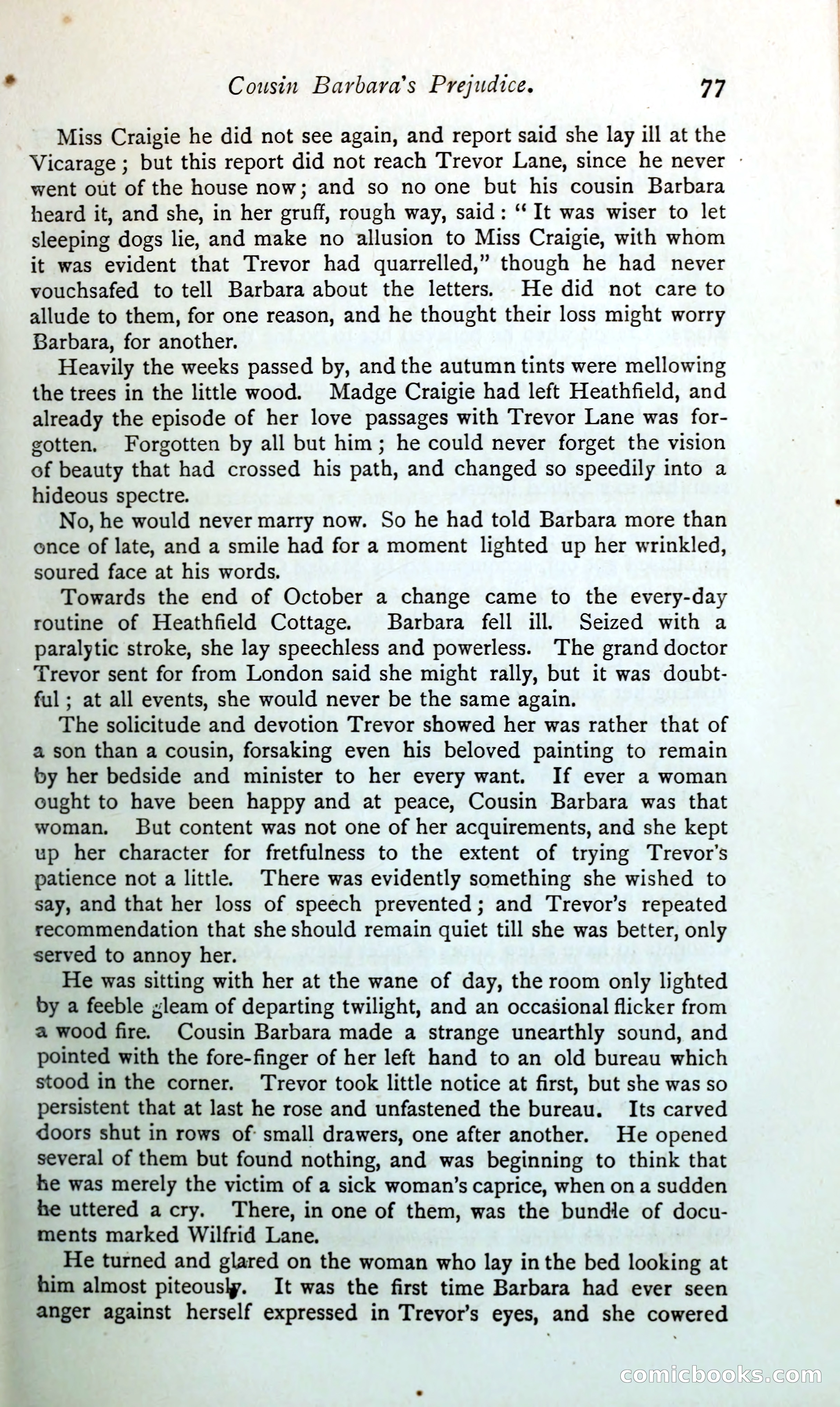
A restored page from Pulp Fiction, 1865. Page through the whole issue in the reader above.
📄 Transcribed text from this page (OCR, searchable)
Machine-transcribed from the original scan — historical spelling and the odd misread are preserved.
Cousin Barbara’s Prejudice. 77 Miss Craigie he did not see again, and report said she lay ill at the Vicarage ; but this report did not reach Trevor Lane, since he never - went out of the house now; and so no one but his cousin Barbara heard it, and she, in her gruff, rough way, said: “‘ It was wiser to let sleeping dogs lie, and make no allusion to Miss Craigie, with whom it was evident that Trevor had quarrelled,” though he had never vouchsafed to tell Barbara about the letters. He did not care to allude to them, for one reason, and he thought their loss might worry Barbara, for another. Heavily the weeks passed by, and the autumn tints were mellowing the trees in the little wood. Madge Craigie had left Heathfield, and already the episode of her love passages with Trevor Lane was for- gotten. Forgotten by all but him; he could never forget the vision of beauty that had crossed his path, and changed so speedily into a hideous spectre. No, he would never marry now. So he had told Barbara more than ence of late, and a smile had for a moment lighted up her wrinkled, soured face at his words. Towards the end of October a change came to the every-day routine of Heathfield Cottage. Barbara fell ill. Seized with a paralytic stroke, she lay speechless and powerless. ‘The grand doctor Trevor sent for from London said she might rally, but it was doubt- ful ; at all events, she would never be the same again. The solicitude and devotion Trevor showed her was rather that of a son than a cousin, forsaking even his beloved painting to remain by her bedside and minister to her every want. If ever a woman ought to have been happy and at peace, Cousin Barbara was that woman. But content was not one of her acquirements, and she kept up her character for fretfulness to the extent of trying Trevor's patience not a little. There was evidently something she wished to say, and that her loss of speech prevented; and Trevor’s repeated recommendation that she should remain quiet till she was better, only served to annoy her. He was sitting with her at the wane of day, the room only lighted _ by a feeble zleam of departing twilight, and an occasional flicker from a wood fire. Cousin Barbara made a strange unearthly sound, and pointed with the fore-finger of her left hand to an old bureau which stood in the corner. Trevor took little notice at first, but she was so persistent that at last he rose and unfastened the bureau. Its carved doors shut in rows of: small drawers, one after another. He opened several of them but found nothing, and was beginning to think that he was merely the victim of a sick woman’s caprice, when on a sudden he uttered acry. There, in one of them, was the bundle of docu- ments marked Wilfrid Lane. He turned and glared on the woman who lay in the bed looking at him almost piteously. It was the first time Barbara had ever seen anger against herself expressed in Trevor’s eyes, and she cowered Gomichoo (E©) m