
Pulp Fiction, 1865 · page 76 of 399
The Argosy — page 76: what you’re looking at
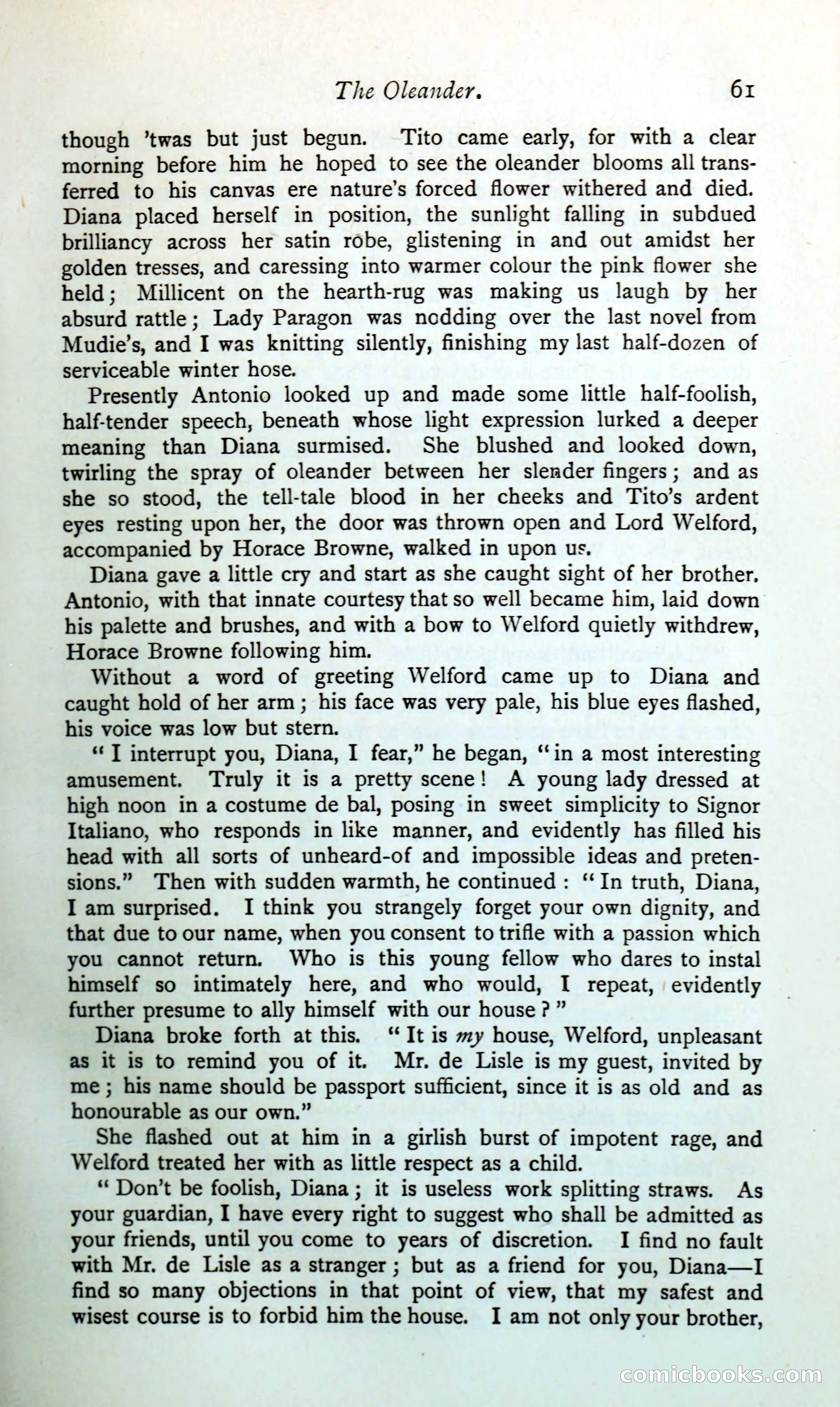
A restored page from Pulp Fiction, 1865. Page through the whole issue in the reader above.
📄 Transcribed text from this page (OCR, searchable)
Machine-transcribed from the original scan — historical spelling and the odd misread are preserved.
The Oleander. 61 though ’twas but just begun. Tito came early, for with a clear morning before him he hoped to see the oleander blooms all trans- ferred to his canvas ere nature’s forced flower withered and died. Diana placed herself in position, the sunlight falling in subdued brilliancy across her satin robe, glistening in and out amidst her golden tresses, and caressing into warmer colour the pink flower she held; Millicent on the hearth-rug was making us laugh by her absurd rattle; Lady Paragon was nodding over the last novel from Mudie’s, and I was knitting silently, finishing my last half-dozen of serviceable winter hose. Presently Antonio looked up and made some little half-foolish, half-tender speech, beneath whose light expression lurked a deeper meaning than Diana surmised. She blushed and looked down, twirling the spray of oleander between her slender fingers; and as she so stood, the tell-tale blood in her cheeks and Tito’s ardent eyes resting upon her, the door was thrown open and Lord Welford, accompanied by Horace Browne, walked in upon us. Diana gave a little cry and start as she caught sight of her brother. Antonio, with that innate courtesy that so well became him, laid down his palette and brushes, and with a bow to Welford quietly withdrew, Horace Browne following him. Without a word of greeting Welford came up to Diana and caught hold of her arm; his face was very pale, his blue eyes flashed, his voice was low but stern. “‘T interrupt you, Diana, I fear,” he began, ‘‘in a most interesting amusement. Truly it is a pretty scene! A young lady dressed at high noon in a costume de bal, posing in sweet simplicity to Signor Italiano, who responds in like manner, and evidently has filled his head with all sorts of unheard-of and impossible ideas and preten- sions.” Then with sudden warmth, he continued: ‘In truth, Diana, I am surprised. I think you strangely forget your own dignity, and that due to our name, when you consent to trifle with a passion which you cannot return. Who is this young fellow who dares to instal himself so intimately here, and who would, I repeat, evidently further presume to ally himself with our house ? ” Diana broke forth at this. “It is my house, Welford, unpleasant as it is to remind you of it. Mr. de Lisle is my guest, invited by me ; his name should be passport sufficient, since it is as old and as honourable as our own.” She flashed out at him in a girlish burst of impotent rage, and Welford treated her with as little respect as a child. “ Don’t be foolish, Diana; it is useless work splitting straws. As your guardian, I have every right to suggest who shall be admitted as your friends, until you come to years of discretion. I find no fault with Mr. de Lisle as a stranger ; but as a friend for you, Diana—I find so many objections in that point of view, that my safest and wisest course is to forbid him the house. I am not only your brother, CONNIE OOS (E(©) m