
Pulp Fiction, 1865 · page 298 of 399
The Argosy — page 298: what you’re looking at
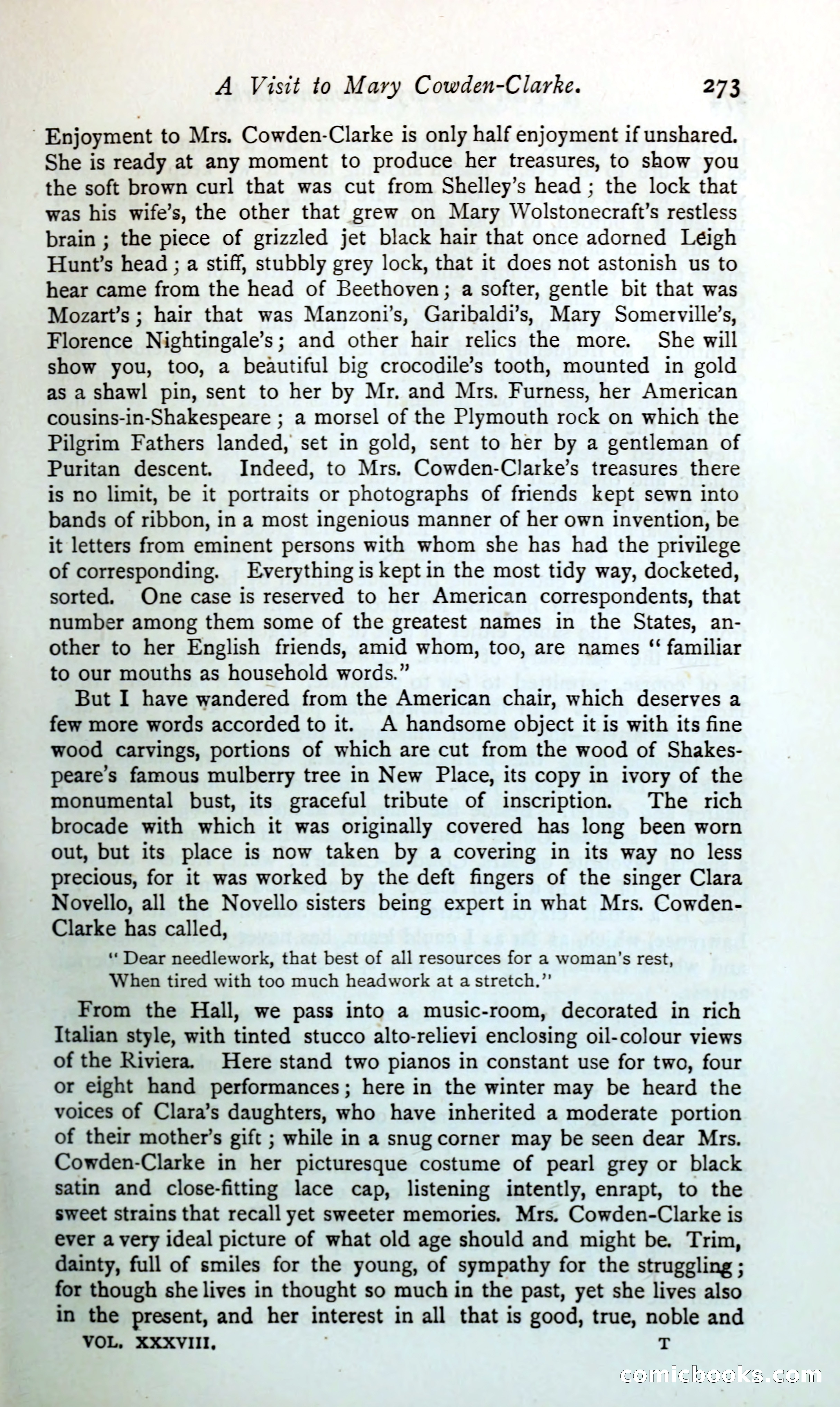
A restored page from Pulp Fiction, 1865. Page through the whole issue in the reader above.
📄 Transcribed text from this page (OCR, searchable)
Machine-transcribed from the original scan — historical spelling and the odd misread are preserved.
A Visit to Mary Cowden-Clarke. 273 Enjoyment to Mrs. Cowden-Clarke is only half enjoyment if unshared. She is ready at any moment to produce her treasures, to show you the soft brown curl that was cut from Shelley’s head ; the lock that was his wife’s, the other that grew on Mary Wolstonecraft’s restless brain ; the piece of grizzled jet black hair that once adorned Léigh Hunt’s head ; a stiff, stubbly grey lock, that it does not astonish us to hear came from the head of Beethoven; a softer, gentle bit that was Mozart’s ; hair that was Manzoni’s, Garibaldi’s, Mary Somerville’s, Florence Nightingale’s; and other hair relics the more. She will show you, too, a beautiful big crocodile’s tooth, mounted in gold as a shawl pin, sent to her by Mr. and Mrs. Furness, her American cousins-in-Shakespeare ; a morsel of the Plymouth rock on which the Pilgrim Fathers landed, set in gold, sent to her by a gentleman of Puritan descent. Indeed, to Mrs. Cowden-Clarke’s treasures there is no limit, be it portraits or photographs of friends kept sewn into bands of ribbon, in a most ingenious manner of her own invention, be it letters from eminent persons with whom she has had the privilege of corresponding. Everything is kept in the most tidy way, docketed, sorted. One case is reserved to her American correspondents, that number among them some of the greatest names in the States, an- other to her English friends, amid whom, too, are names ‘“‘ familiar to our mouths as household words.” But I have wandered from the American chair, which deserves a few more words accorded to it. A handsome object it is with its fine wood carvings, portions of which are cut from the wood of Shakes- peare’s famous mulberry tree in New Place, its copy in ivory of the monumental bust, its graceful tribute of inscription. The rich brocade with which it was originally covered has long been worn out, but its place is now taken by a covering in its way no less precious, for it was worked by the deft fingers of the singer Clara Novello, all the Novello sisters being expert in what Mrs. Cowden- Clarke has called, “ Dear needlework, that best of all resources for a woman’s rest, When tired with too much headwork at a stretch.”’ From the Hall, we pass into a music-room, decorated in rich Italian style, with tinted stucco alto-relievi enclosing oil-colour views of the Riviera. Here stand two pianos in constant use for two, four or eight hand performances; here in the winter may be heard the voices of Clara’s daughters, who have inherited a moderate portion of their mother’s gift ; while in a snug corner may be seen dear Mrs. Cowden-Clarke in her picturesque costume of pearl grey or black satin and close-fitting lace cap, listening intently, enrapt, to the sweet strains that recall yet sweeter memories. Mrs. Cowden-Clarke is ever a very ideal picture of what old age should and might be. Trim, dainty, full of smiles for the young, of sympathy for the struggling ; for though she lives in thought so much in the past, yet she lives also in the present, and her interest in all that is good, true, noble and VOL, XXXVIII, | T EOE OOO KS Eco