
Pulp Fiction, 1865 · page 160 of 399
The Argosy — page 160: what you’re looking at
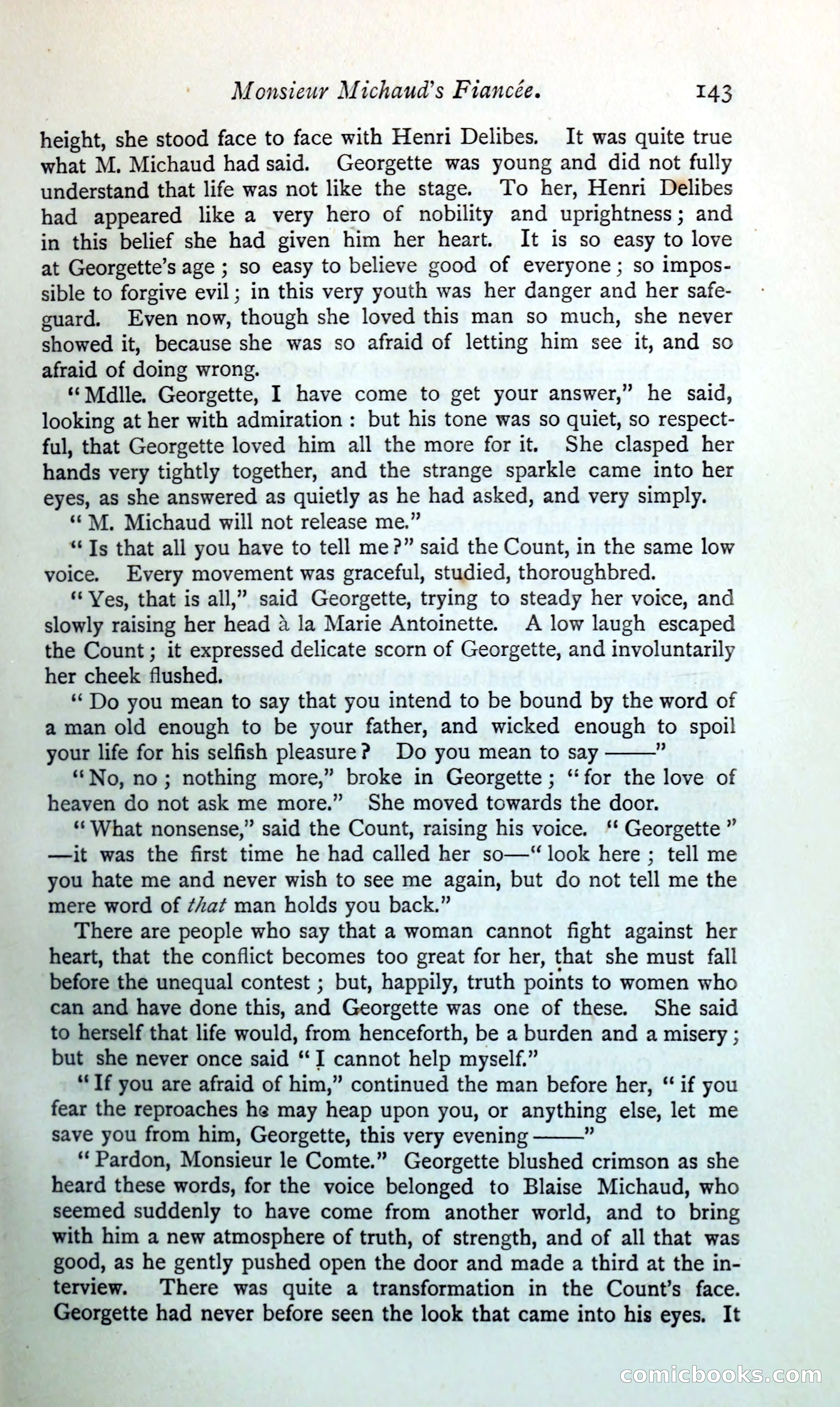
A restored page from Pulp Fiction, 1865. Page through the whole issue in the reader above.
📄 Transcribed text from this page (OCR, searchable)
Machine-transcribed from the original scan — historical spelling and the odd misread are preserved.
Monsieur Michaud’s Fiancee. 143 height, she stood face to face with Henri Delibes. It was quite true what M. Michaud had said. Georgette was young and did not fully understand that life was not like the stage. To her, Henri Delibes had appeared like a very hero of nobility and uprightness; and in this belief she had given him her heart. It is so easy to love at Georgette’s age ; so easy to believe good of everyone; so impos- sible to forgive evil; in this very youth was her danger and her safe- guard. Even now, though she loved this man so much, she never showed it, because she was so afraid of letting him see it, and so afraid of doing wrong. ‘‘Mdlle. Georgette, I have come to get your answer,” he said, looking at her with admiration: but his tone was so quiet, so respect- ful, that Georgette loved him all the more for it. She clasped her hands very tightly together, and the strange sparkle came into her eyes, as she answered as quietly as he had asked, and very simply. ‘Mf. Michaud will not release me.” “Ts that all you have to tell me?” said the Count, in the same low voice. Every movement was graceful, studied, thoroughbred. “Ves, that is all,” said Georgette, trying to steady her voice, and slowly raising her head a la Marie Antoinette. A low laugh escaped the Count; it expressed delicate scorn of Georgette, and involuntarily her cheek flushed. ‘Do you mean to say that you intend to be bound by the word of a man old enough to be your father, and wicked enough to spoil your life for his selfish pleasure? Do you mean to say y “No, no; nothing more,” broke in Georgette; “for the love of heaven do not ask me more.” She moved towards the door. ‘What nonsense,” said the Count, raising his voice. ‘‘ Georgette” —it was the first time he had called her so—“ look here ; tell me you hate me and never wish to see me again, but do not tell me the mere word of /Za¢ man holds you back.” There are people who say that a woman cannot fight against her heart, that the conflict becomes too great for her, that she must fall before the unequal contest ; but, happily, truth points to women who can and have done this, and Georgette was one of these. She said to herself that life would, from henceforth, be a burden and a misery ; but she never once said “JI cannot help myself.” “Tf you are afraid of him,” continued the man before her, “ if you fear the reproaches he may heap upon you, or anything else, let me save you from him, Georgette, this very evening 7 ‘Pardon, Monsieur le Comte.” Georgette blushed crimson as she heard these words, for the voice belonged to Blaise Michaud, who seemed suddenly to have come from another world, and to bring with him a new atmosphere of truth, of strength, and of all that was good, as he gently pushed open the door and made a third at the in- _terview. There was quite a transformation in the Count’s face. Georgette had never before seen the look that came into his eyes. It Gomichoo (E(@) m