
Pulp Fiction, 1865 · page 154 of 399
The Argosy — page 154: what you’re looking at
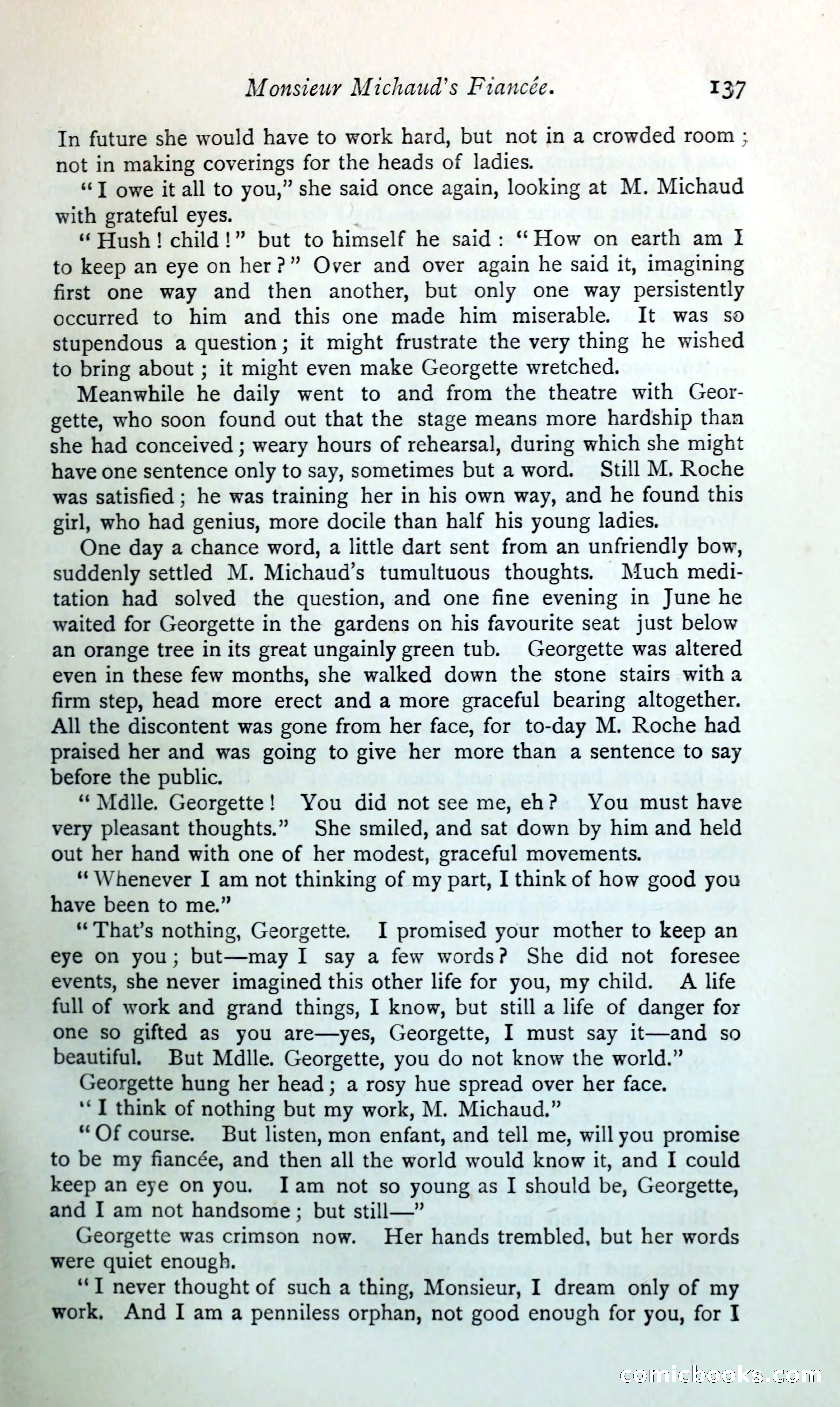
A restored page from Pulp Fiction, 1865. Page through the whole issue in the reader above.
📄 Transcribed text from this page (OCR, searchable)
Machine-transcribed from the original scan — historical spelling and the odd misread are preserved.
Monsieur Michaud’s Fiancée. 137 In future she would have to work hard, but not in a crowded room ; not in making coverings for the heads of ladies. “‘T owe it all to you,” she said once again, looking at M. Michaud with grateful eyes. | “Hush! child!” but to himself he said: ‘How on earth am } to keep an eye on her?” Over and over again he said it, imagining first one way and then another, but only one way persistently occurred to him and this one made him miserable. It was so stupendous a question; it might frustrate the very thing he wished to bring about ; it might even make Georgette wretched. Meanwhile he daily went to and from the theatre with Geor- gette, who soon found out that the stage means more hardship than she had conceived ; weary hours of rehearsal, during which she might have one sentence only to say, sometimes but a word. Still M. Roche was satisfied ; he was training her in his own way, and he found this girl, who had genius, more docile than half his young ladies. One day a chance word, a little dart sent from an unfriendly bow, suddenly settled M. Michaud’s tumultuous thoughts. Much medi- tation had solved the question, and one fine evening in June he waited for Georgette in the gardens on his favourite seat just below an orange tree in its great ungainly green tub. Georgette was altered even in these few months, she walked down the stone stairs witha firm step, head more erect and a more graceful bearing altogether. All the discontent was gone from her face, for to-day M. Roche had praised her and was going to give her more than a sentence to say before the public. “Mdlle. Georgette! You did not see me, eh? You must have very pleasant thoughts.” She smiled, and sat down by him and held out her hand with one of her modest, graceful movements. ‘Whenever I am not thinking of my part, I think of how good you have been to me.” “That’s nothing, Georgette. I promised your mother to keep an eye on you; but—mayI say a few words? She did not foresee events, she never imagined this other life for you, my child. A life full of work and grand things, I know, but still a life of danger for one so gifted as you are—yes, Georgette, I must say it—and so beautiful. But Mdlle. Georgette, you do not know the world.” Georgette hung her head; a rosy hue spread over her face. ‘‘] think of nothing but my work, M. Michaud.” “Of course. But listen, mon enfant, and tell me, will you promise to be my fiancée, and then all the world would know it, and I could keep an eye on you. Iam not so young as I should be, Georgette, and I am not handsome; but still—” Georgette was crimson now. Her hands trembled, but her words were quiet enough. ‘I never thought of such a thing, Monsieur, I dream only of my work, And I am a penniless orphan, not good enough for you, for I Gomichboo (E(@) m