
Pulp Fiction, 1865 · page 150 of 399
The Argosy — page 150: what you’re looking at
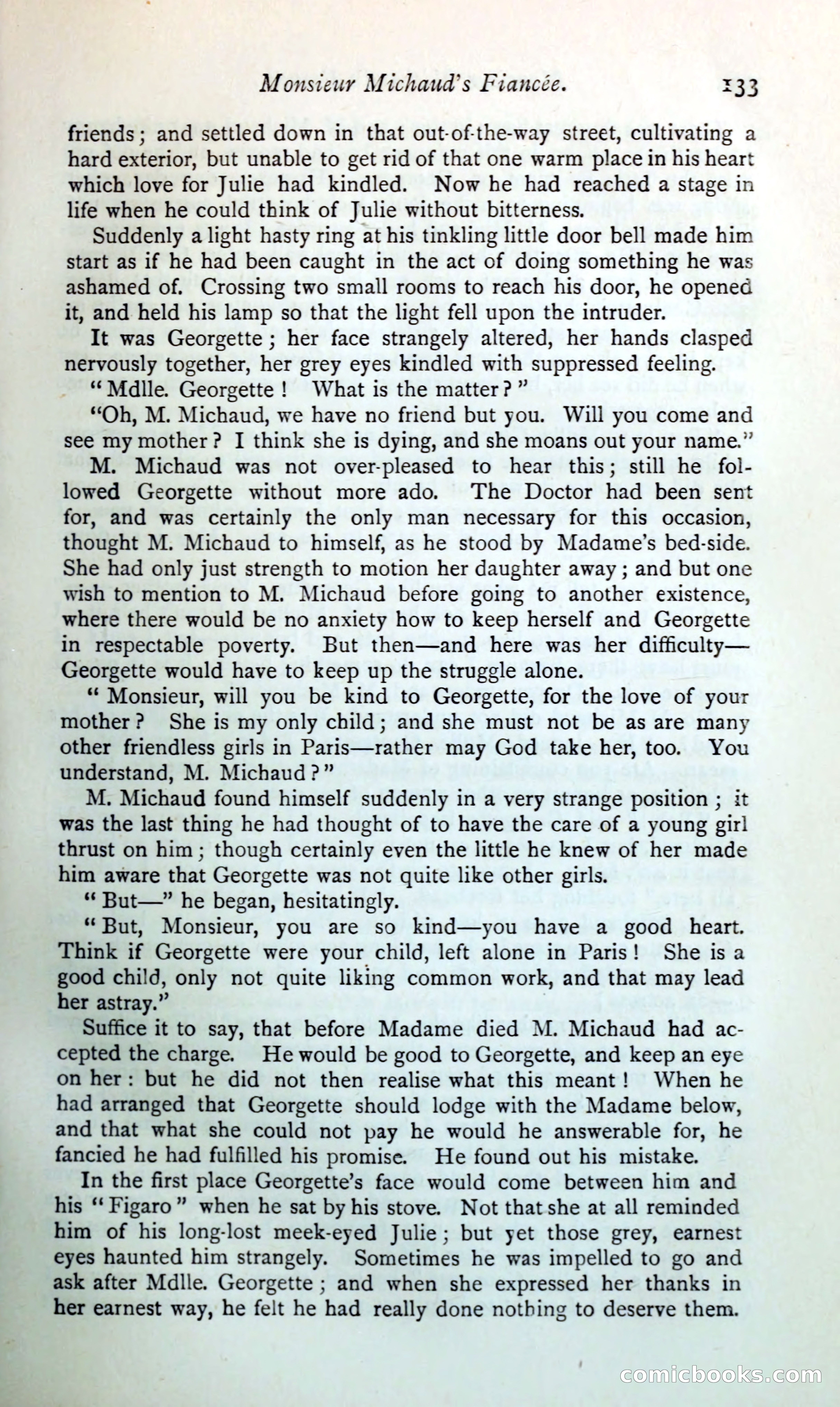
A restored page from Pulp Fiction, 1865. Page through the whole issue in the reader above.
📄 Transcribed text from this page (OCR, searchable)
Machine-transcribed from the original scan — historical spelling and the odd misread are preserved.
Monsieur Michaud’s Fiancée. X33 friends ; and settled down in that out-of-the-way street, cultivating a hard exterior, but unable to get rid of that one warm place in his heart which love for Julie had kindled. Now he had reached a stage in life when he could think of Julie without bitterness. Suddenly a light hasty ring at his tinkling little door bell made him start as if he had been caught in the act of doing something he was ashamed of. Crossing two small rooms to reach his door, he opened it, and held his lamp so that the light fell upon the intruder. It was Georgette ; her face strangely altered, her hands clasped nervously together, her grey eyes kindled with suppressed feeling. “*Mdlle. Georgette ! What is the matter?” “Oh, M. Michaud, we have no friend but you. Will you come and see my mother? I think she is dying, and she moans out your name.” M. Michaud was not over-pleased to hear this; still he fol- lowed Georgette without more ado. The Doctor had been sent for, and was certainly the only man necessary for this occasion, thought M. Michaud to himself, as he stood by Madame’s bed-side. She had only just strength to motion her daughter away ; and but one wish to mention to M. Michaud before going to another existence, where there would be no anxiety how to keep herself and Georgette in respectable poverty. But then—and here was her difficulty— Georgette would have to keep up the struggle alone. ** Monsieur, will you be kind to Georgette, for the love of your mother? She is my only child; and she must not be as are many other friendless girls in Paris—rather may God take her, too. You understand, M. Michaud ?” M. Michaud found himself suddenly in a very strange position ; it was the last thing he had thought of to have the care of a young gir! thrust on him; though certainly even the little he knew of her made him aware that Georgette was not quite like other girls. “* But—” he began, hesitatingly. “But, Monsieur, you are so kind—you have a good heart. Think if Georgette were your child, left alone in Paris! She isa good child, only not quite liking common work, and that may lead her astray.” Suffice it to say, that before Madame died M. Michaud had ac- cepted the charge. He would be good to Georgette, and keep an eye on her: but he did not then realise what this meant! When he had arranged that Georgette should lodge with the Madame below, and that what she could not pay he would he answerable for, he fancied he had fulfilled his promise. He found out his mistake. In the first place Georgette’s face would come between him and his ‘‘ Figaro” when he sat by his stove. Not that she at all reminded him of his long-lost meek-eyed Julie; but yet those grey, earnest eyes haunted him strangely. Sometimes he was impelled to go and ask after Mdlle. Georgette ; and when she expressed her thanks in her earnest way, he felt he had really done nothing to deserve them. Gomichoo (E(@) m