
Pulp Fiction, 1865 · page 146 of 399
The Argosy — page 146: what you’re looking at
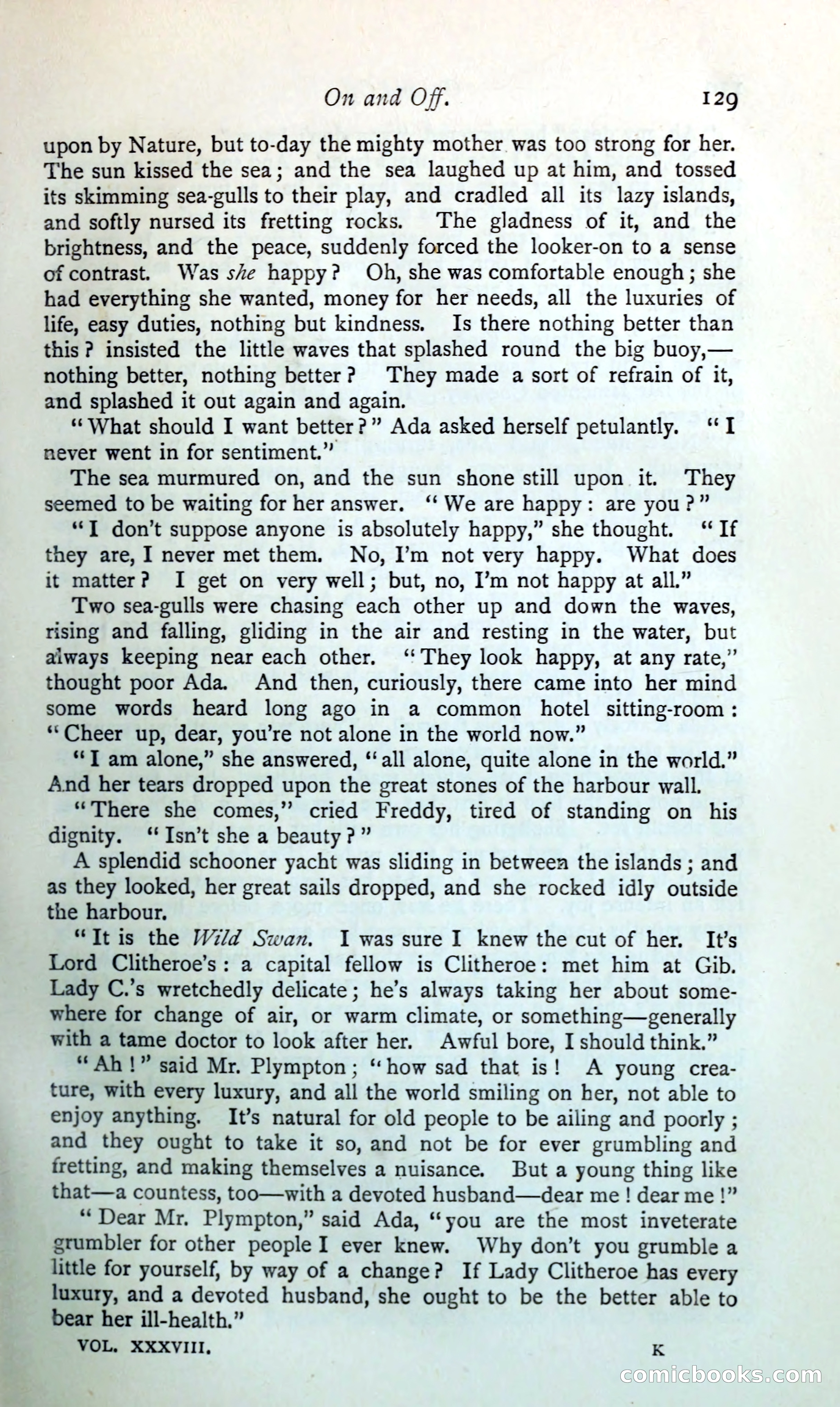
A restored page from Pulp Fiction, 1865. Page through the whole issue in the reader above.
📄 Transcribed text from this page (OCR, searchable)
Machine-transcribed from the original scan — historical spelling and the odd misread are preserved.
On and Off. 129 upon by Nature, but to-day the mighty mother was too strong for her. The sun kissed the sea; and the sea laughed up at him, and tossed its skimming sea-gulls to their play, and cradled all its lazy islands, and softly nursed its fretting rocks. The gladness of it, and the brightness, and the peace, suddenly forced the looker-on to a sense of contrast. Was se happy? Oh, she was comfortable enough; she had everything she wanted, money for her needs, all the luxuries of life, easy duties, nothing but kindness. Is there nothing better than this ? insisted the little waves that splashed round the big buoy,— nothing better, nothing better? They made a sort of refrain of it, and splashed it out again and again. “What should I want better?” Ada asked herself petulantly. ‘I never went in for sentiment.” The sea murmured on, and the sun shone still upon it. They seemed to be waiting for her answer. ‘‘ We are happy: are you?” “I don’t suppose anyone is absolutely happy,” she thought. “If they are, I] never met them. No, I’m not very happy. What does it matter? I get on very well; but, no, I’m not happy at all.” Two sea-gulls were chasing each other up and down the waves, rising and falling, gliding in the air and resting in the water, but always keeping near each other. ‘‘ They look happy, at any rate,” thought poor Ada. And then, curiously, there came into her mind some words heard long ago in a common hotel sitting-room: *“Cheer up, dear, you’re not alone in the world now.” “I am alone,” she answered, “‘all alone, quite alone in the world.” And her tears dropped upon the great stones of the harbour wall. “There she comes,” cried Freddy, tired of standing on his dignity. ‘‘Isn’t she a beauty?” A splendid schooner yacht was sliding in between the islands ; and as they looked, her great sails dropped, and she rocked idly outside the harbour. “It is the Wild Swan. I was sure I knew the cut of her. It’s Lord Clitheroe’s: a capital fellow is Clitheroe: met him at Gib. Lady C.’s wretchedly delicate; he’s always taking her about some- where for change of air, or warm climate, or something—generally with a tame doctor to look after her. Awful bore, I should think.” “Ah!” said Mr. Plympton; “how sad that is! A young crea- ture, with every luxury, and all the world smiling on her, not able to enjoy anything. It’s natural for old people to be ailing and poorly ; and they ought to take it so, and not be for ever grumbling and fretting, and making themselves a nuisance. But a young thing like that—a countess, too—with a devoted husband—dear me ! dear me !” “Dear Mr. Plympton,” said Ada, “you are the most inveterate grumbler for other people I ever knew. Why don’t you grumble a little for yourself, by way of a change? If Lady Clitheroe has every luxury, and a devoted husband, she ought to be the better able to bear her ill-health.” VOL. XXXVIII. K Gomichoo (E(@) m