
Pulp Fiction, 1865 · page 132 of 399
The Argosy — page 132: what you’re looking at
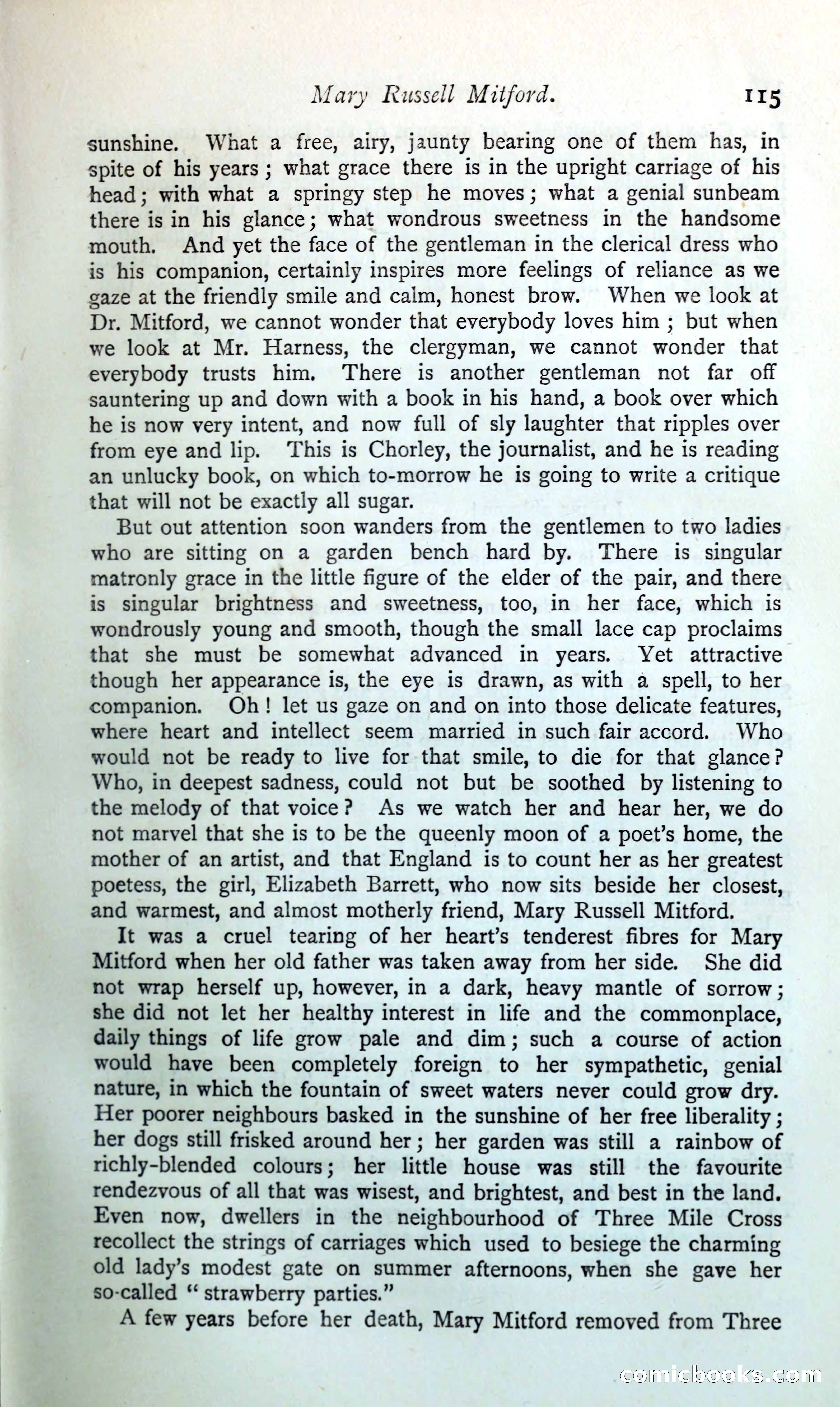
A restored page from Pulp Fiction, 1865. Page through the whole issue in the reader above.
📄 Transcribed text from this page (OCR, searchable)
Machine-transcribed from the original scan — historical spelling and the odd misread are preserved.
Mary Russell Mitford. II5 sunshine. What a free, airy, jaunty bearing one of them has, in spite of his years ; what grace there is in the upright carriage of his head; with what a springy step he moves; what a genial sunbeam there is in his glance; what wondrous sweetness in the handsome mouth. And yet the face of the gentleman in the clerical dress who is his companion, certainly inspires more feelings of reliance as we eaze at the friendly smile and calm, honest brow. When we look at Dr. Mitford, we cannot wonder that everybody loves him ; but when we look at Mr. Harness, the clergyman, we cannot wonder that everybody trusts him. ‘There is another gentleman not far off sauntering up and down with a book in his hand, a book over which he is now very intent, and now full of sly laughter that ripples over from eye and lip. ‘This is Chorley, the journalist, and he is reading an unlucky book, on which to-morrow he is going to write a critique that will not be exactly all sugar. But out attention soon wanders from the gentlemen to two ladies who are sitting on a garden bench hard by. There is singular matronly grace in the little figure of the elder of the pair, and there is singular brightness and sweetness, too, in her face, which is wondrously young and smooth, though the small lace cap proclaims that she must be somewhat advanced in years. Yet attractive though her appearance is, the eye is drawn, as with a spell, to her companion. Oh! let us gaze on and on into those delicate features, where heart and intellect seem married in such fair accord. Who would not be ready to live for that smile, to die for that glance? Who, in deepest sadness, could not but be soothed by listening to the melody of that voice? As we watch her and hear her, we do not marvel that she is to be the queenly moon of a poet’s home, the mother of an artist, and that England is to count her as her greatest poetess, the girl, Elizabeth Barrett, who now sits beside her closest, and warmest, and almost motherly friend, Mary Russell Mitford. It was a cruel tearing of her heart’s tenderest fibres for Mary Mitford when her old father was taken away from her side. She did not wrap herself up, however, in a dark, heavy mantle of sorrow; she did not let her healthy interest in life and the commonplace, daily things of life grow pale and dim; such a course of action would have been completely foreign to her sympathetic, genial nature, in which the fountain of sweet waters never could grow dry. Her poorer neighbours basked in the sunshine of her free liberality ; her dogs still frisked around her; her garden was still a rainbow of richly-blended colours; her little house was still the favourite rendezvous of all that was wisest, and brightest, and best in the land. Even now, dwellers in the neighbourhood of Three Mile Cross recollect the strings of carriages which used to besiege the charming old lady’s modest gate on summer afternoons, when she gave her so-called “ strawberry parties.” A few years before her death, Mary Mitford removed from Three CONNIE OOKS EO) m