
Pulp Fiction, 1865 · page 39 of 400
The Argosy — page 39: what you’re looking at
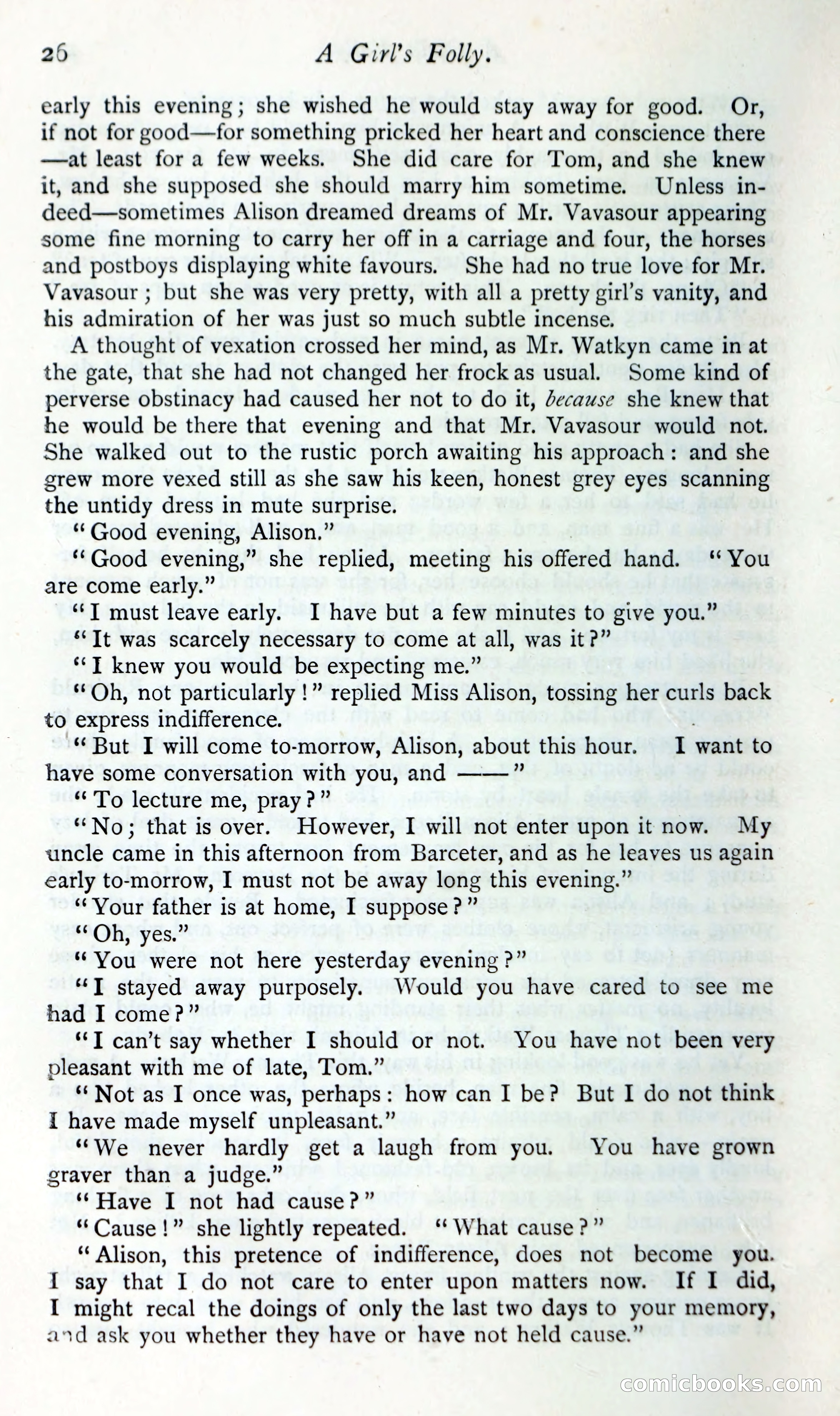
A restored page from Pulp Fiction, 1865. Page through the whole issue in the reader above.
📄 Transcribed text from this page (OCR, searchable)
Machine-transcribed from the original scan — historical spelling and the odd misread are preserved.
26 A Girl’s Folly. early this evening; she wished he would stay away for good. Or, if not for good—for something pricked her heart and conscience there —at least fora few weeks. She did care for Tom, and she knew it, and she supposed she should marry him sometime. Unless in- deed—sometimes Alison dreamed dreams of Mr. Vavasour appearing some fine morning to carry her off in a carriage and four, the horses and postboys displaying white favours. She had no true love for Mr. Vavasour ; but she was very pretty, with all a pretty girl’s vanity, and his admiration of her was just so much subtle incense. A thought of vexation crossed her mind, as Mr. Watkyn came in at the gate, that she had not changed her frock as usual. Some kind of perverse obstinacy had caused her not to do it, decause she knew that he would be there that evening and that Mr. Vavasour would not. She walked out to the rustic porch awaiting his approach: and she grew more vexed still as she saw his keen, honest grey eyes scanning the untidy dress in mute surprise. ** Good evening, Alison.” ‘** Good evening,” she replied, meeting his offered hand. ‘You are come early.” ‘‘T must leave early. I have but a few minutes to give you.” ‘“It was scarcely necessary to come at all, was it P” **T knew you would be expecting me.” Oh, not particularly!” replied Miss Alison, tossing her curls back to express indifference. . * But I will come to-morrow, Alison, about this hour. I want to have some conversation with you, and ——” “To lecture me, pray ?” ‘No; that is over. However, I will not enter upon it now. My uncle came in this afternoon from Barceter, and as he leaves us again early to-morrow, I must not be away long this evening.” ‘Your father is at home, I suppose ?” “Oh, yes.” * You were not here yesterday evening ?” “IT stayed away purposely. Would you have cared to see me had I come?” *T can’t say whether I should or not. You have not been very pleasant with me of late, Tom.” ‘‘ Not as I once was, perhaps: how can I be? But I do not think { have made myself unpleasant.” ‘We never hardly get a laugh from you. You have grown graver than a judge.” ‘‘ Have I not had cause?” “Cause!” she lightly repeated. ‘‘ What cause?” “Alison, this pretence of indifference, does not become you. { say that I do not care to enter upon matters now. If I did, I might recal the doings of only the last two days to your memory, ad ask you whether they have or have not held cause.” ECOMMIEMDIOO KS. ©