
Pulp Fiction, 1865 · page 275 of 400
The Argosy — page 275: what you’re looking at
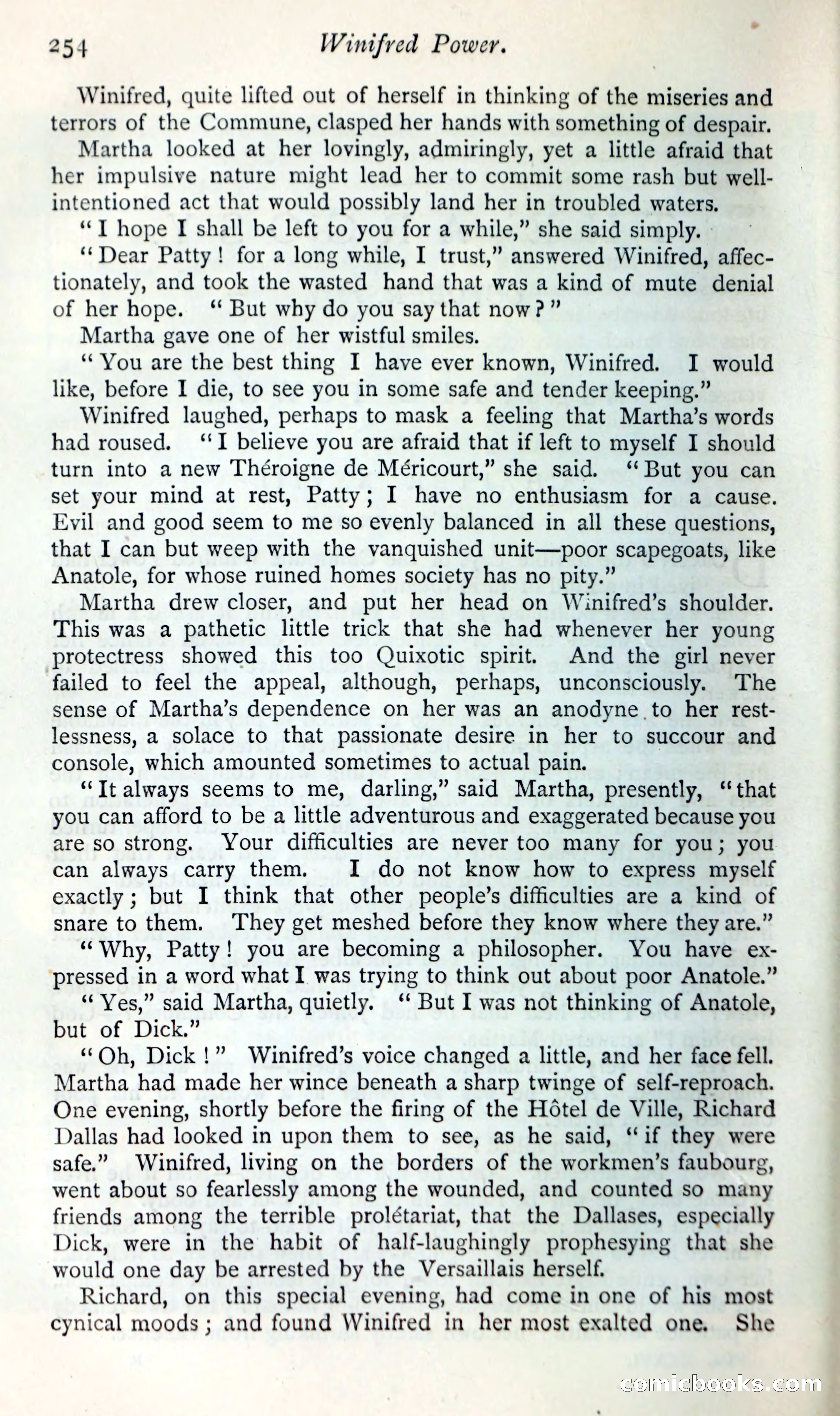
A restored page from Pulp Fiction, 1865. Page through the whole issue in the reader above.
📄 Transcribed text from this page (OCR, searchable)
Machine-transcribed from the original scan — historical spelling and the odd misread are preserved.
+. 254 Winifred Power. Winifred, quite lifted out of herself in thinking of the miseries and terrors of the Commune, clasped her hands with something of despair. Martha looked at her lovingly, admiringly, yet a little afraid that her impulsive nature might lead her to commit some rash but well- intentioned act that would possibly land her in troubled waters. ‘““T hope I shall be left to you for a while,” she said simply. | ‘Dear Patty! for a long while, I trust,” answered Winifred, affec- tionately, and took the wasted hand that was a kind of mute denial of her hope. ‘‘ But why do you say that now?” Martha gave one of her wistful smiles. ‘You are the best thing I have ever known, Winifred. I would like, before I die, to see you in some safe and tender keeping.” Winifred laughed, perhaps to mask a feeling that Martha’s words had roused. ‘‘I believe you are afraid that if left to myself I should turn into a new Théroigne de Méricourt,” she said. ‘‘ But you can set your mind at rest, Patty; I have no enthusiasm for a cause. Evil and good seem to me so evenly balanced in all these questions, that I can but weep with the vanquished unit—poor scapegoats, like Anatole, for whose ruined homes society has no pity.” Martha drew closer, and put her head on Winifred’s shoulder. This was a pathetic little trick that she had whenever her young protectress showed this too Quixotic spirit. And the girl never failed to feel the appeal, although, perhaps, unconsciously. The sense of Martha’s dependence on her was an anodyne to her rest- lessness, a solace to that passionate desire in her to succour and console, which amounted sometimes to actual pain. “Tt always seems to me, darling,” said Martha, presently, “that you can afford to be a little adventurous and exaggerated because you are so strong. Your difficulties are never too many for you; you can always carry them. I do not know how to express myself exactly ; but I think that other people’s difficulties are a kind of snare to them. They get meshed before they know where they are.” ‘‘Why, Patty! you are becoming a philosopher. You have ex- pressed in a word what I was trying to think out about poor Anatole.” ‘“‘-Ves,” said Martha, quietly. ‘ But I was not thinking of Anatole, but of Dick.” “Oh, Dick!” Winifred’s voice changed a little, and her face fell. Martha had made her wince beneath a sharp twinge of self-reproach. One evening, shortly before the firing of the Hotel de Ville, Richard Dallas had looked in upon them to see, as he said, ‘‘if they were safe.” Winifred, living on the borders of the workmen’s faubourg, went about so fearlessly among the wounded, and counted so many friends among the terrible prolétariat, that the Dallases, especially Dick, were in the habit of half-laughingly prophesying that she would one day be arrested by the Versaillais herself. Richard, on this special evening, had come in one of his most cynical moods; and found Winifred in her most exalted one, She EOPMIE LOO KS.) m