
Pulp Fiction, 1865 · page 264 of 400
The Argosy — page 264: what you’re looking at
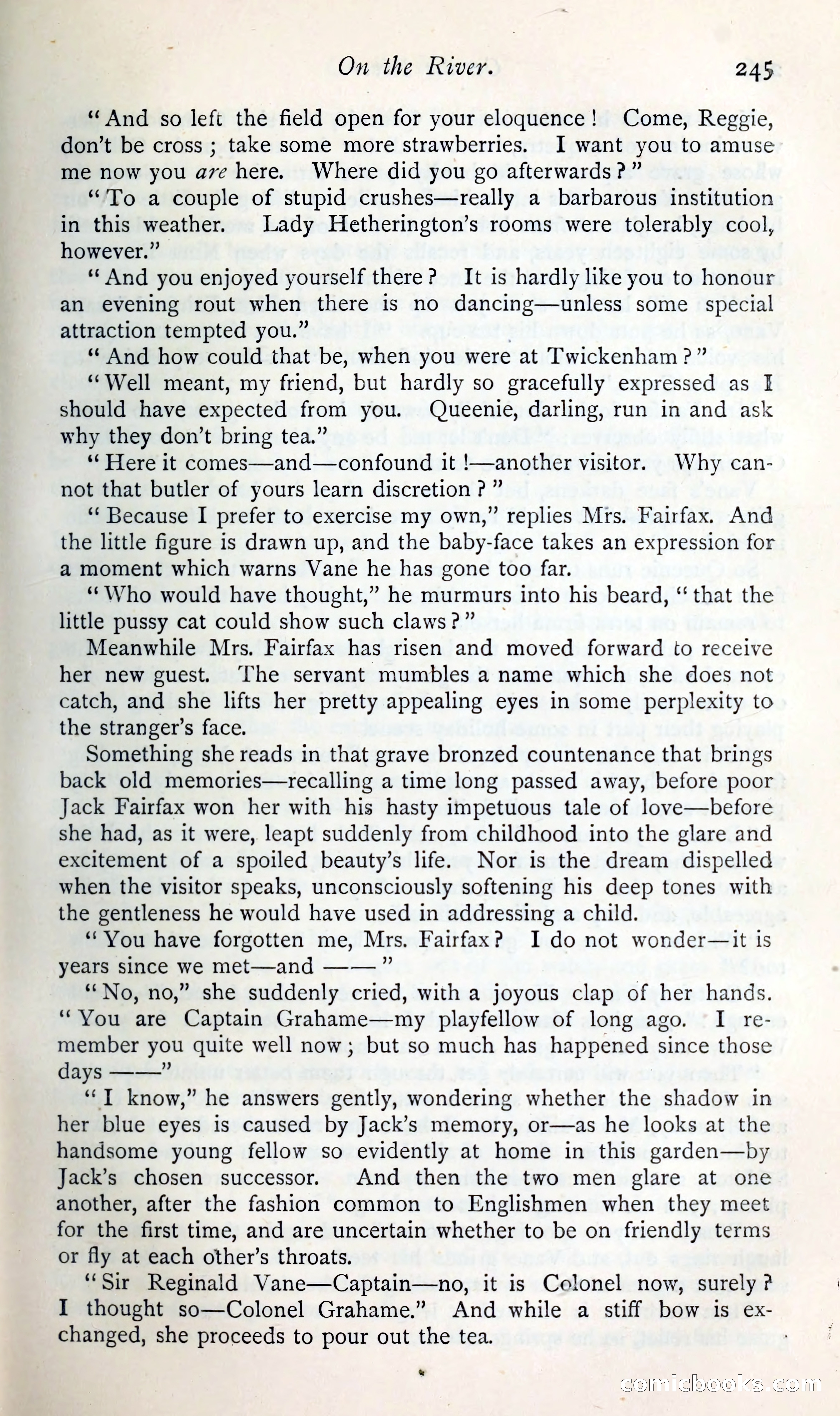
A restored page from Pulp Fiction, 1865. Page through the whole issue in the reader above.
📄 Transcribed text from this page (OCR, searchable)
Machine-transcribed from the original scan — historical spelling and the odd misread are preserved.
On the River. 245 “ And so left the field open for your eloquence! Come, Reggie, don’t be cross ; take some more strawberries. I want you to amuse me now you ave here. Where did you go afterwards ?” “’'To a couple of stupid crushes—really a barbarous institution in this weather. Lady Hetherington’s rooms were tolerably cool, however.” ‘And you enjoyed yourself there? It is hardly like you to honour an evening rout when there is no dancing—unless some special attraction tempted you.” | ** And how could that be, when you were at Twickenham ?” “Well meant, my friend, but hardly so gracefully expressed as I] should have expected from you. Queenie, darling, run in and ask why they don’t bring tea.” ‘Here it comes—and—confound it !—another visitor. Why can- not that butler of yours learn discretion ?” ‘*‘ Because I prefer to exercise my own,” replies Mrs. Fairfax. And the little figure is drawn up, and the baby-face takes an expression for a moment which warns Vane he has gone too far. “Who would have thought,” he murmurs into his beard, “ that the little pussy cat could show such claws?” Meanwhile Mrs, Fairfax has risen and moved forward to receive her new guest. The servant mumbles a name which she does not catch, and she lifts her pretty appealing eyes in some perplexity to the stranger’s face. Something she reads in that grave bronzed countenance that brings back old memories—recalling a time long passed away, before poor Jack Fairfax won her with his hasty impetuous tale of love—before she had, as it were, leapt suddenly from childhood into the glare and excitement of a spoiled beauty’s life. Nor is the dream dispelled when the visitor speaks, unconsciously softening his deep tones with the gentleness he would have used in addressing a child. “You have forgotten me, Mrs. Fairfax? Ido not wonder—it Is years since we met—and —— ” ‘“No, no,” she suddenly cried, with a joyous clap of her hands. ‘You are Captain Grahame—my playfellow of long ago. I re- member you quite well now; but so much has happened since those days ——” “I know,” he answers gently, wondering whether the shadow in her blue eyes is caused by Jack’s memory, or—as he looks at the handsome young fellow so evidently at home in this garden—by Jack’s chosen successor. And then the two men glare at one another, after the fashion common to Englishmen when they meet for the first time, and are uncertain whether to be on friendly terms or fly at each other’s throats. “Sir Reginald Vane—Captain—no, it is Colonel now, surely ? I thought so—Colonel Grahame.” And while a stiff bow is ex- changed, she proceeds to pour out the tea. & ECORNICLOOOKS.E© = |