
Pulp Fiction, 1865 · page 245 of 400
The Argosy — page 245: what you’re looking at
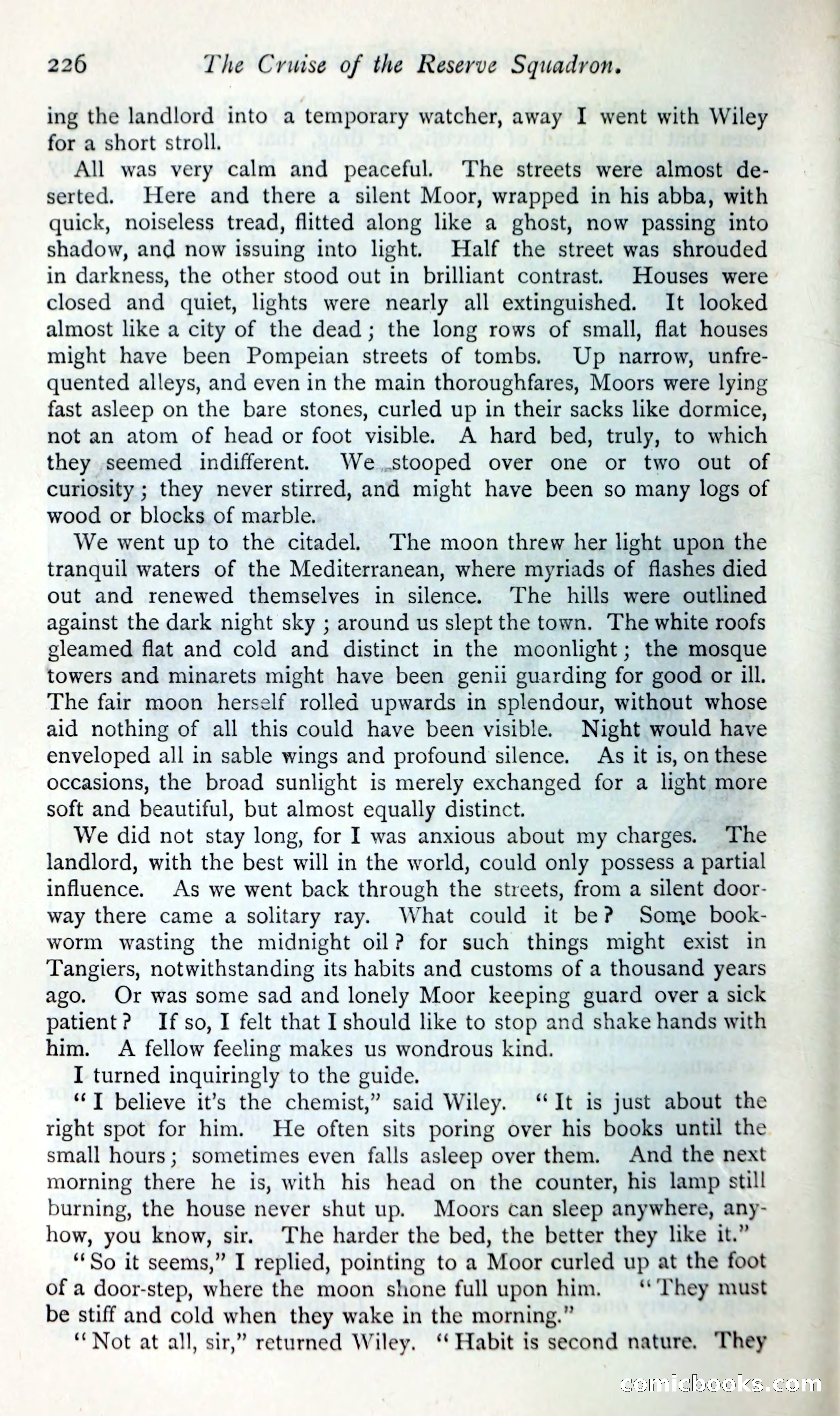
A restored page from Pulp Fiction, 1865. Page through the whole issue in the reader above.
📄 Transcribed text from this page (OCR, searchable)
Machine-transcribed from the original scan — historical spelling and the odd misread are preserved.
226 The Cruse of the Reserve Squadron, ing the landlord into a temporary watcher, away I went with Wiley for a short stroll. All was very calm and peaceful. The streets were almost de- serted. Here and there a silent Moor, wrapped in his abba, with quick, noiseless tread, flitted along like a ghost, now passing into shadow, and now issuing into light. Half the street was shrouded in darkness, the other stood out in brilliant contrast. Houses were closed and quiet, lights were nearly all extinguished. It looked almost like a city of the dead; the long rows of small, flat houses might have been Pompeian streets of tombs. Up narrow, unfre- quented alleys, and even in the main thoroughfares, Moors were lying fast asleep on the bare stones, curled up in their sacks like dormice, not an atom of head or foot visible. A hard bed, truly, to which they seemed indifferent. We. stooped over one or two out of curiosity ; they never stirred, and might have been so many logs of wood or blocks of marble. We went up to the citadel. The moon threw her light upon the tranquil waters of the Mediterranean, where myriads of flashes died out and renewed themselves in silence. The hills were outlined against the dark night sky ; around us slept the town. The white roofs geleamed flat and cold and distinct in the moonlight; the mosque towers and minarets might have been genii guarding for good or ill. The fair moon herself rolled upwards in splendour, without whose aid nothing of all this could have been visible. Night would have enveloped all in sable wings and profound silence. As it is, on these occasions, the broad sunlight is merely exchanged for a light more soft and beautiful, but almost equally distinct. We did not stay long, for I was anxious about my charges. ‘The landlord, with the best will in the world, could only possess a partial influence. As we went back through the streets, from a silent door- way there came a solitary ray. What could it be? Some book- worm wasting the midnight oil? for such things might exist in Tangiers, notwithstanding its habits and customs of a thousand years ago. Or was some sad and lonely Moor keeping guard over a sick patient? If so, I felt that I should like to stop and shake hands with him. A fellow feeling makes us wondrous kind. I turned inquiringly to the guide. ‘‘T believe it’s the chemist,” said Wiley. ‘It is just about the right spot for him. He often sits poring over his books until the small hours; sometimes even falls asleep over them. And the next morning there he is, with his head on the counter, his lamp still burning, the house never shut up. Moors can sleep anywhere, any- how, you know, sir. The harder the bed, the better they like it.” ‘So it seems,” I replied, pointing to a Moor curled up at the foot of a door-step, where the moon shone full upon him, “They must be stiff and cold when they wake in the morning.” ‘Not at all, sir,” returned Wiley. ‘‘ Habit is second nature. They Gomicbooks (E(@) m