
Pulp Fiction, 1865 · page 228 of 400
The Argosy — page 228: what you’re looking at
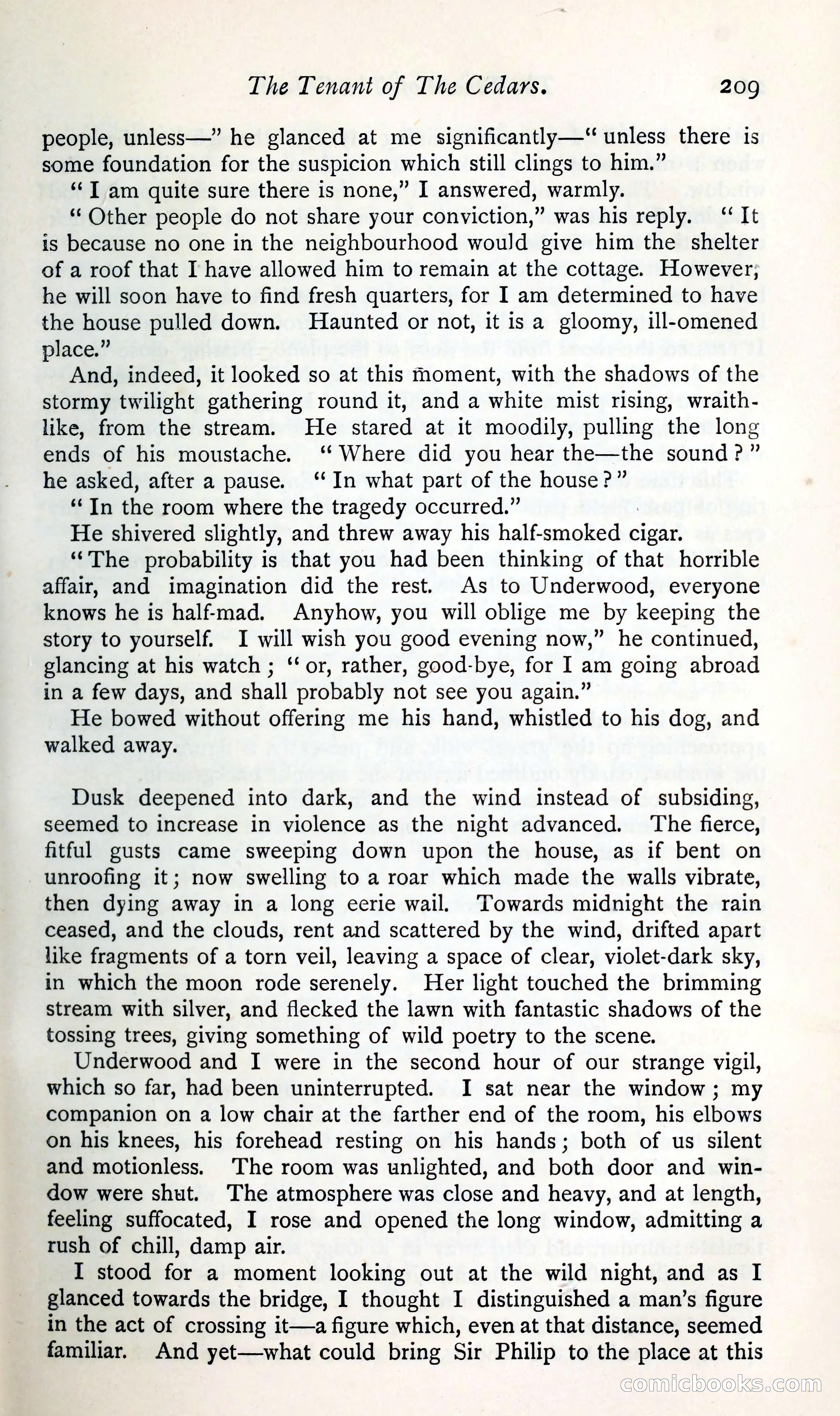
A restored page from Pulp Fiction, 1865. Page through the whole issue in the reader above.
📄 Transcribed text from this page (OCR, searchable)
Machine-transcribed from the original scan — historical spelling and the odd misread are preserved.
The Tenant of The Cedars. 209 people, unless—” he glanced at me significantly—“ unless there is some foundation for the suspicion which still clings to him.” ‘¢T am quite sure there 1s none,” I answered, warmly. ‘Other people do not share your conviction,” was his reply. ‘‘ It is because no one in the neighbourhood would give him the shelter of a roof that I have allowed him to remain at the cottage. However; he will soon have to find fresh quarters, for I am determined to have the house pulled down. Haunted or not, it is a gloomy, ill-omened place.” And, indeed, it looked so at this moment, with the shadows of the stormy twilight gathering round it, and a white mist rising, wraith- like, from the stream. He stared at it moodily, pulling the long ends of his moustache. ‘‘ Where did you hear the—the sound?” he asked, after a pause. ‘In what part of the house?” “In the room where the tragedy occurred.” He shivered slightly, and threw away his haitemeliiihd cigar. “The probability is that you had been thinking of that horrible affair, and imagination did the rest. As to Underwood, everyone knows he is half-mad. Anyhow, you will oblige me by keeping the story to yourself. I will wish you good evening now,” he continued, glancing at his watch; ‘‘or, rather, good-bye, for I am going abroad in a few days, and shall probably not see you again.” He bowed without offering me his hand, whistled to his dog, and walked away. Dusk deepened into dark, and the wind instead of subsiding, seemed to increase in violence as the night advanced. The fierce, fitful gusts came sweeping down upon the house, as if bent on unroofing it; now swelling to a roar which made the walls vibrate, then dying away in a long eerie wail. ‘Towards midnight the rain ceased, and the clouds, rent and scattered by the wind, drifted apart like fragments of a torn veil, leaving a space of clear, violet-dark sky, in which the moon rode serenely. Her light touched the brimming stream with silver, and flecked the lawn with fantastic shadows of the tossing trees, giving something of wild poetry to the scene. Underwood and I were in the second hour of our strange vigil, which so far, had been uninterrupted. I sat near the window; my companion on a low chair at the farther end of the room, his elbows on his knees, his forehead resting on his hands; both of us silent and motionless. The room was unlighted, and both door and win- dow were shut. ‘The atmosphere was close and heavy, and at length, feeling suffocated, I rose and opened the long window, admitting a rush of chill, damp air. I stood for a moment looking out at the wild night, and as I glanced towards the bridge, I thought I distinguished a man’s figure in the act of crossing it—a figure which, even at that distance, seemed familiar. And yet—what could bring Sir Philip to the place at this Cconniclooolks (C(O) mn