
Pulp Fiction, 1865 · page 215 of 400
The Argosy — page 215: what you’re looking at
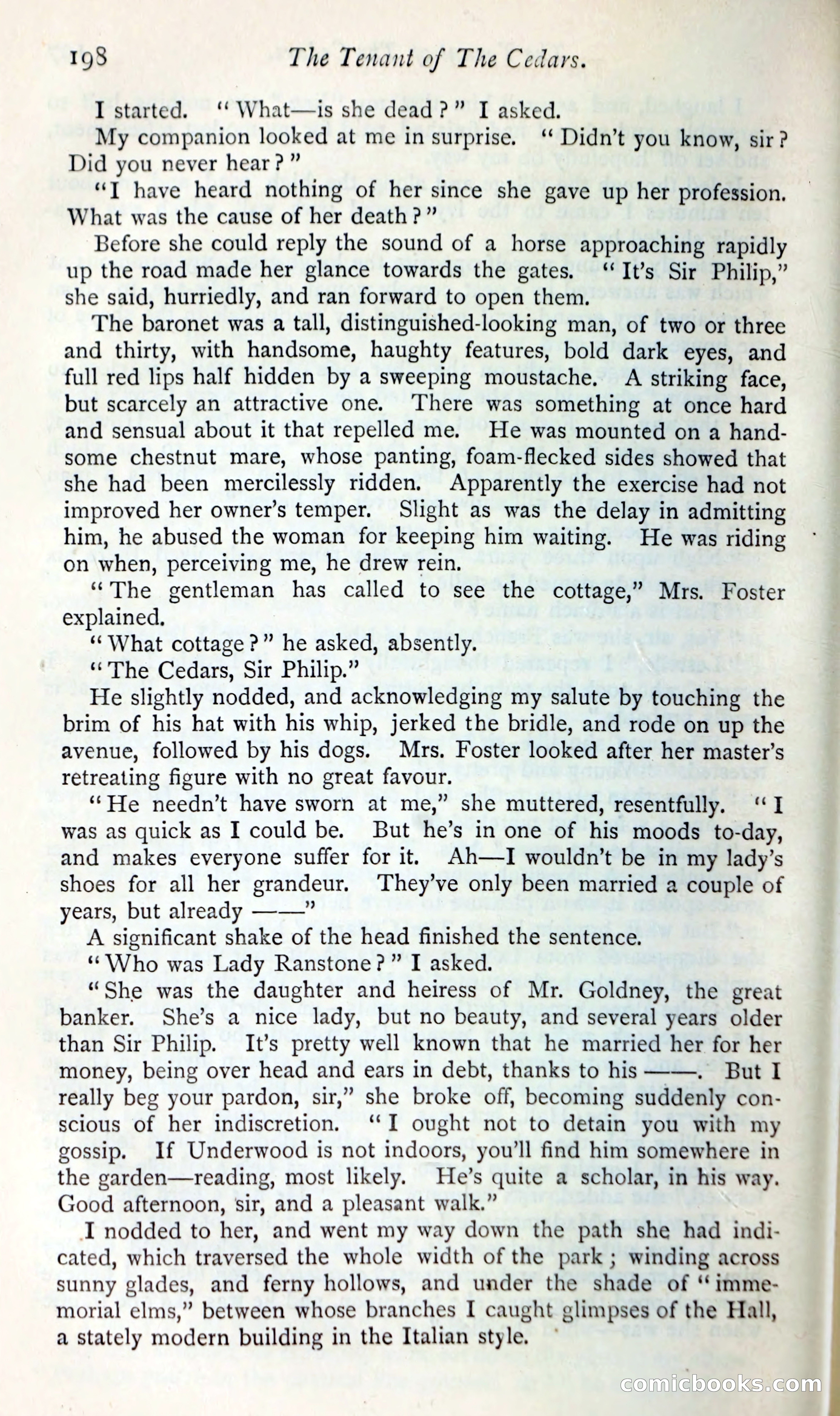
A restored page from Pulp Fiction, 1865. Page through the whole issue in the reader above.
📄 Transcribed text from this page (OCR, searchable)
Machine-transcribed from the original scan — historical spelling and the odd misread are preserved.
198 The Tenant of The Cedars. I started. ‘‘ What—is she dead?” I asked. My companion looked at me in surprise. ‘ Didn’t you know, sir ? Did you never hear?” “T have heard nothing of her since she gave up her profession. What was the cause of her death?” Before she could reply the sound of a horse approaching rapidly up the road made her glance towards the gates. “It’s Sir Philip,” she said, hurriedly, and ran forward to open them. The baronet was a tall, distinguished-looking man, of two or three and thirty, with handsome, haughty features, bold dark eyes, and full red lips half hidden by a sweeping moustache. A striking face, but scarcely an attractive one. ‘There was something at once hard and sensual about it that repelled me. He was mounted on a hand- some chestnut mare, whose panting, foam-flecked sides showed that she had been mercilessly ridden. Apparently the exercise had not improved her owner’s temper. Slight as was the delay in admitting him, he abused the woman for keeping him waiting. He was riding on when, perceiving me, he drew rein. ‘The gentleman has called to see the cottage,” Mrs. Foster explained. ‘What cottage?” he asked, absently. ‘The Cedars, Sir Philip.” He slightly nodded, and acknowledging my salute by touching the brim of his hat with his whip, jerked the bridle, and rode on up the avenue, followed by his dogs. Mrs. Foster looked after her master’s retreating figure with no great favour. ‘He needn’t have sworn at me,” she muttered, resentfully. ‘I was as quick as I could be. But he’s in one of his moods to-day, and makes everyone suffer for it. Ah—TI wouldn’t be in my lady’s shoes for all her grandeur. ‘They’ve only been married a couple of years, but already ———” A significant shake of the head finished the sentence. ‘Who was Lady Ranstone?” I asked. “She was the daughter and heiress of Mr. Goldney, the great banker. She’s a nice lady, but no beauty, and several years older than Sir Philip. It’s pretty well known that he married her for her money, being over head and ears in debt, thanks to his ——. But I really beg your pardon, sir,” she broke off, becoming suddenly con- scious of her indiscretion. ‘‘I ought not to detain you with my gossip. If Underwood is not indoors, you’ll find him somewhere in the garden—reading, most likely. He’s quite a scholar, in his way. Good afternoon, sir, and a pleasant walk.” I nodded to her, and went my way down the path she had indi- cated, which traversed the whole width of the park; winding across sunny glades, and ferny hollows, and under the shade of “imme- morial elms,” between whose branches I caught glimpses of the Hall, a stately modern building in the Italian style, Comicbooks.co